
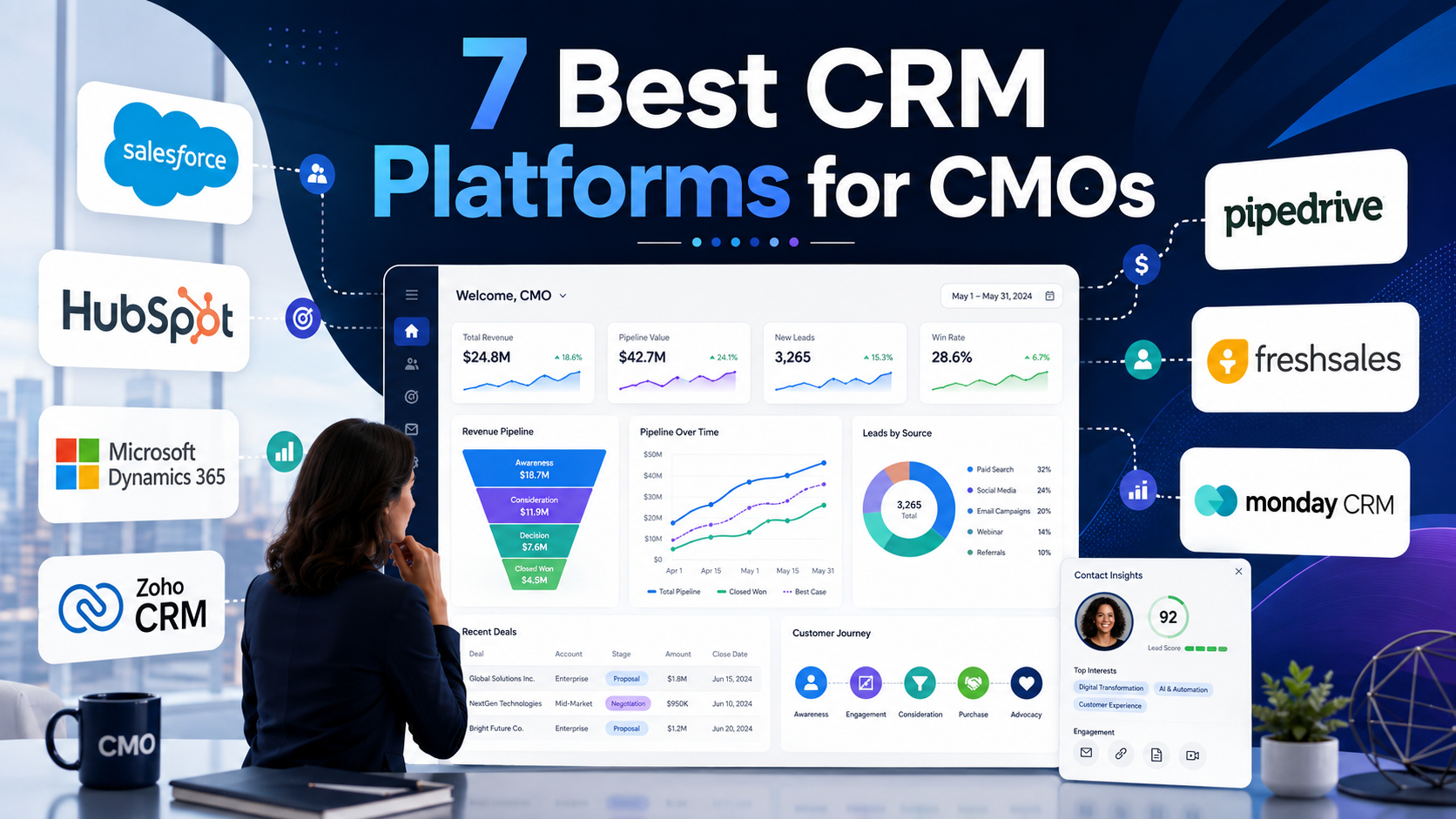
The best CRM platforms for CMOs are the ones that connect marketing activity, lead management, sales progress and revenue in one measurable system. Salesforce, HubSpot, Microsoft Dynamics 365, Zoho CRM, Pipedrive, Freshsales and monday CRM are seven strong options, but they serve different company sizes and operating models.
For a CMO, CRM should do much more than store names and deal stages. It should help answer which campaigns create qualified opportunities, which accounts are moving, where leads stall, how sales follows up and which marketing investments are contributing to revenue.
Salesforce: Best for complex enterprise revenue teams
Salesforce is one of the most established CRM platforms for large organizations with complex sales structures, multiple regions, large account teams and extensive reporting requirements.
For CMOs, the main advantage is the scale of the ecosystem. Sales, service, customer data, analytics and marketing capabilities can be connected across the wider Salesforce environment. That matters when marketing needs to understand not only lead volume, but account history, opportunity progression, customer value and revenue attribution.
Salesforce also continues to expand AI across its platform through Agentforce and related automation capabilities. The downside is complexity: implementation, data governance and administration can require significant resources.
HubSpot: Best for marketing led B2B growth
HubSpot is particularly attractive to CMOs because marketing, sales, service and customer data are designed to work within one connected platform.
A prospect can arrive through organic search, submit a form, enter an email workflow, become a qualified lead, move into the sales pipeline and eventually become a customer while keeping much of that history connected. This gives marketing leaders a clearer view of what happened before and after a lead was handed to sales.
HubSpot is especially useful for B2B companies where content, SEO, email, forms, landing pages and inbound lead generation are important parts of the growth model.
Microsoft Dynamics 365 Sales: Best for Microsoft centered organizations
Microsoft Dynamics 365 Sales is a strong option for companies already operating heavily inside Microsoft 365, Teams, Outlook, Power BI and the Power Platform.
For a CMO, the attraction is not only CRM functionality. It is the possibility of connecting sales data with the wider Microsoft environment used by employees every day. Customer information, opportunity data, reporting and internal collaboration can become part of a broader operational system.
Dynamics 365 Sales supports lead, account, contact and opportunity management, forecasting, analytics and AI assisted selling.
Explore Microsoft Dynamics 365 Sales
Zoho CRM: Best for broad functionality at a lower cost
Zoho CRM is well suited to growing companies that want broad functionality without immediately moving into enterprise level CRM costs and complexity.
It covers lead management, accounts, contacts, deals, workflows, analytics and communication. Zoho also has a wider business software ecosystem, which can be useful for organizations that want CRM, campaigns, analytics, service and other functions to work together.
For a CMO, Zoho is worth evaluating when flexibility and cost control are both important. The main requirement is discipline around setup, because a flexible CRM still needs clearly defined marketing and sales processes.
Pipedrive: Best for a simple visual B2B pipeline
Pipedrive is built around a visual sales pipeline and is particularly useful for B2B teams that want straightforward deal management.
From a marketing perspective, its value comes from visibility after lead generation. A CMO can see which leads become opportunities, which deals move forward and where prospects get stuck in the sales process.
Pipedrive is not designed to replace a full enterprise marketing platform, but that simplicity can be useful. Smaller commercial teams often benefit from a CRM that salespeople will actually keep updated.
Freshsales and monday CRM: Two flexible alternatives
Freshsales, part of Freshworks, combines CRM, automation, communication and AI features in a relatively accessible platform. It supports lead and deal management, customer interaction history, workflows, reporting and forecasting, making it relevant for teams that want more than basic pipeline tracking without a heavy enterprise implementation.
monday CRM applies monday.com's flexible work management approach to customer and revenue processes. Teams can manage leads, accounts, communications, tasks, pipelines and reporting through visual workflows, which can be attractive where marketing, sales, partnerships and customer work overlap.
How should a CMO choose the right CRM?
A CMO should begin with the revenue process, not the software demo. Map how a prospect moves from first interaction to qualified lead, opportunity, sale and customer, then identify what information marketing and sales need at each step.
Useful evaluation questions include:
- Can marketing see which campaigns create pipeline?
- Can sales see the marketing history behind a lead?
- Can the CRM support account based or complex B2B sales?
- Can teams track lead response and follow up?
- Can reporting connect marketing activity to opportunities and revenue?
- Will salespeople actually use the system consistently?
- Can the platform grow with the company's commercial model?
Large enterprises may prefer Salesforce or Microsoft Dynamics 365. Marketing led B2B companies should look closely at HubSpot. Zoho offers broad functionality for cost conscious companies, while Pipedrive is strong for simple sales pipeline management. Freshsales balances CRM and engagement capabilities, and monday CRM is useful when flexible workflows are a priority.