
Marketing automation software helps CMOs turn customer data into repeatable campaigns, lead nurturing, personalization and measurable revenue activity. The strongest platforms now go far beyond scheduled email and increasingly use AI to help teams build journeys, segment audiences and prioritize next actions.
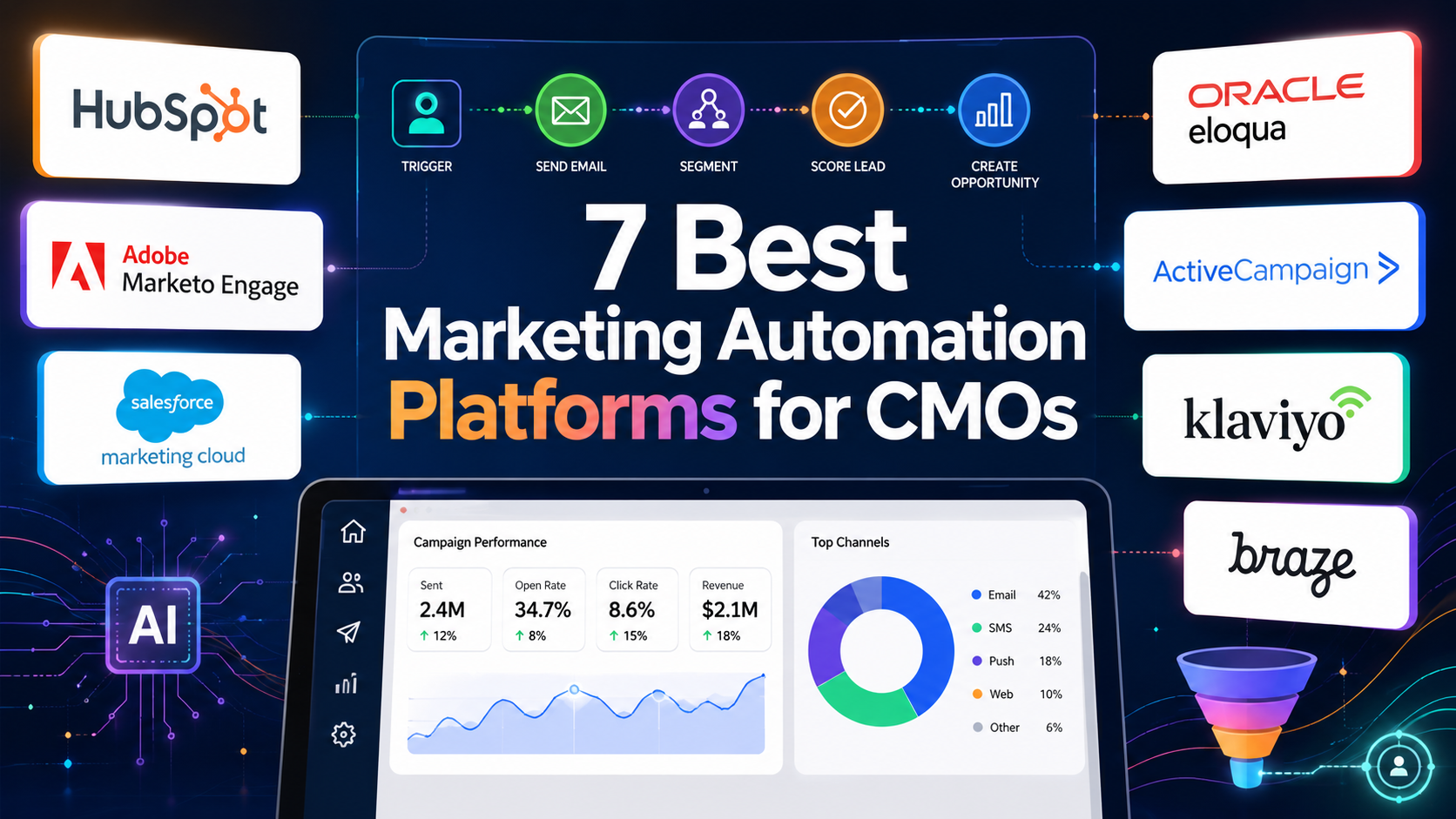
Seven vendors deserve particular attention: HubSpot, Adobe Marketo Engage, Salesforce Marketing Cloud, Oracle Eloqua, ActiveCampaign, Klaviyo and Braze.
HubSpot: Best for growing B2B companies
HubSpot is one of the easiest marketing automation platforms for a CMO to understand because its automation sits directly on top of CRM data.
Marketing Hub can automate email, forms, lead nurturing, lead scoring, customer journeys and internal workflows. The major advantage is the connection between acquisition and sales. A prospect can discover a company through search, submit a form, enter a nurture sequence, become a qualified lead and move into the sales pipeline while retaining the engagement history.
That makes HubSpot particularly useful for B2B companies where SEO, content, email and lead generation contribute heavily to pipeline.
Explore HubSpot Marketing Automation
Adobe Marketo Engage: Best for enterprise B2B automation
Adobe Marketo Engage remains one of the major platforms for sophisticated B2B marketing organizations.
Marketo supports automated nurture campaigns, audience management, personalized content, omnichannel campaigns, sales intelligence and marketing attribution. Its strength is depth. Large marketing teams can build complex programs around different products, regions, buyer groups and stages of the buying journey.
For a CMO managing a mature marketing operations team, Marketo offers considerably more control than simpler email automation products. That power also means implementation, governance and specialist knowledge matter.
Salesforce Marketing Cloud: Best for Salesforce centered companies
Salesforce is especially relevant when sales already operates inside Salesforce CRM.
For B2B marketing, Salesforce supports lead generation, nurturing, scoring, email personalization, analytics and marketing qualification. The strategic advantage is shared customer and revenue data. Marketing can work much closer to accounts, opportunities and sales activity instead of operating inside a separate email system.
CMOs should make sure they understand which Salesforce marketing environment fits their organization, because the product family spans different use cases and levels of complexity.
Explore Salesforce Marketing Automation
Oracle Eloqua: Best for complex B2B campaign operations
Oracle Eloqua is another major enterprise option, particularly for complex B2B demand generation.
Eloqua allows marketers to build multistep campaigns across channels, create dynamic email and landing page content, segment audiences using behavioral and firmographic data, score leads and route qualified opportunities into CRM systems.
For CMOs, one of the strongest use cases is marketing and sales alignment. Eloqua can share marketing activity and account information with sales teams while using CRM integrations to move highly engaged leads toward sellers.
ActiveCampaign: Best for midmarket automation
ActiveCampaign sits between basic email platforms and large enterprise marketing automation suites.
Its platform includes segmentation, automated journeys, email, SMS, WhatsApp, site and event tracking, predictive sending and integrations. It is attractive for marketing teams that want sophisticated automation but do not have a large marketing operations department.
For a CMO, ActiveCampaign is worth evaluating when automation depth and ease of execution both matter.
Klaviyo: Best for ecommerce and consumer brands
Klaviyo has evolved beyond email marketing into a broader B2C CRM and customer engagement platform.
Its automation can coordinate email, SMS, WhatsApp, mobile push and other channels. Customer data sits at the center, allowing marketers to trigger messages based on purchases, browsing behavior, customer attributes and real time actions.
This is particularly powerful for ecommerce brands, where automations can respond to abandoned carts, purchases, repeat buying behavior and changing customer value without requiring a manual campaign launch each time.
Braze: Best for large digital consumer brands
Braze approaches marketing automation through customer engagement and real time journey orchestration.
The platform brings together customer data, segmentation, AI, journey automation and messaging across channels including email, SMS, mobile, web, WhatsApp and paid media.
Braze becomes especially interesting when customer interaction happens continuously across apps and digital products. A streaming service, fintech platform, marketplace or consumer app may need to react to behavior almost immediately rather than placing customers into traditional email sequences.
Which marketing automation platform should a CMO choose?
The right platform depends on the company's customer journey and commercial model.
HubSpot is particularly attractive for growing B2B companies that want marketing, CRM and sales closely connected. Marketo, Salesforce and Eloqua make more sense when enterprise scale, complex segmentation and sophisticated marketing operations are important.
ActiveCampaign offers a strong middle ground for teams that need serious automation without enterprise overhead. Klaviyo is especially compelling for ecommerce and consumer commerce, while Braze is designed for brands managing continuous digital customer engagement.
Marketing automation only performs as well as the strategy feeding it. Automating weak segmentation, generic content or poor lead nurturing simply allows a company to execute ineffective marketing faster.