
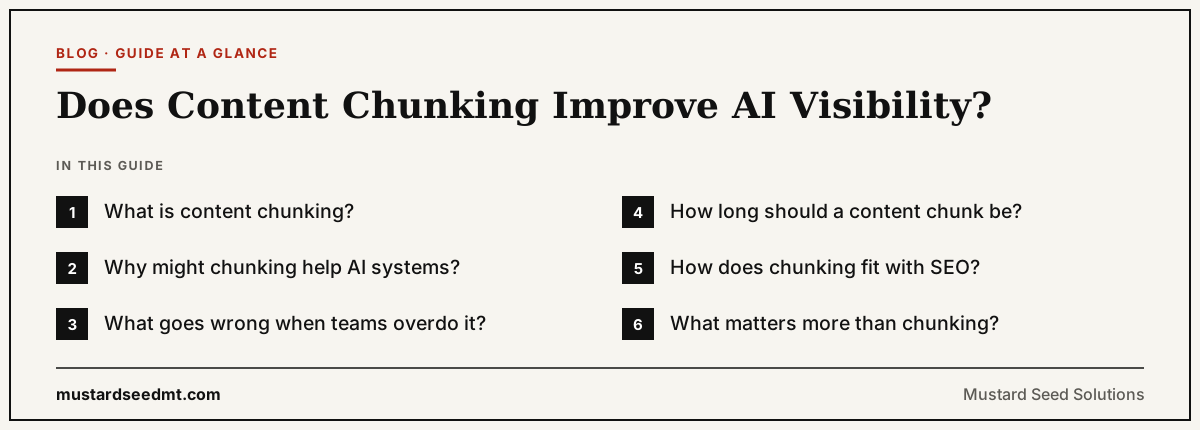
Content chunking can make information easier to scan, retrieve, and cite when each section answers a clear question and preserves enough context to stand on its own. It is useful as a writing and information architecture technique, but it is not a guaranteed ranking or AI citation tactic.
This matters because content chunking AI visibility is rarely a one factor problem. Website structure, authority, content, technical access, external evidence, and buyer intent can all shape the result.
The goal is to diagnose the system before applying isolated tactics. The sections below show what to check, what to improve, and how to connect the work to a useful commercial outcome.
What is content chunking?
Content chunking means organizing a page into focused sections that each cover one clear idea, question, or decision point. Good chunks reduce ambiguity and help readers locate the answer they need quickly.
It is a structure principle, not a required word count.
Why might chunking help AI systems?
Clear headings and self contained explanations make important information easier to identify. A well structured page can expose definitions, comparisons, processes, and evidence without forcing a retrieval system to infer the meaning of a long unbroken narrative.
That can improve citation readiness.
What goes wrong when teams overdo it?
Pages can become fragmented into tiny sections with repeated headings, shallow answers, and no narrative context. That hurts human readability and can create thin content even if the page looks optimized.
- Avoid one sentence sections
- Do not repeat the same answer
- Keep supporting evidence near the claim
How long should a content chunk be?
There is no universal length. A simple definition may need a few sentences, while a technical comparison may require several paragraphs and bullets.
Use the amount of content needed to answer the question clearly.
How does chunking fit with SEO?
Use search demand to identify the main intent, then organize the page around the related questions buyers actually ask. This preserves topical depth while making the information easier to consume and retrieve.
Link important educational content to the relevant AI Visibility service.
What matters more than chunking?
Accuracy, originality, authority, entity clarity, crawl access, evidence, and commercial relevance matter more. Chunking improves delivery of strong information; it cannot rescue weak information.
Treat it as one design choice inside a complete SEO and GEO system.