
Customer reviews influence how people evaluate products and services.
They can reveal common strengths, recurring problems, customer expectations, and the types of users who receive the most value.
As AI search tools become more involved in product research, reviews may also contribute to how brands are described and compared in generated answers.
An AI system may use information from review platforms, business directories, publications, forums, and other public sources.
This does not mean that one positive review will cause an AI tool to recommend a company.
Recommendations are usually shaped by a wider pattern of information.
Reviews can still matter because they provide independent evidence beyond the company’s own marketing.
Why reviews are useful to AI systems
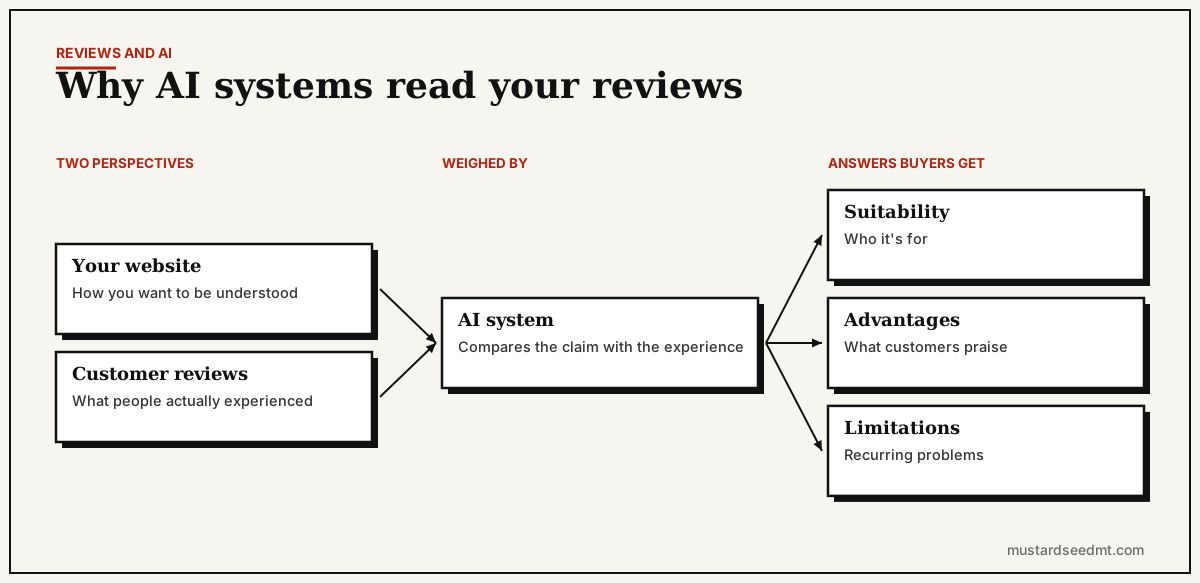
A company website explains how the business wants to be understood.
Customer reviews describe what people experienced.
These perspectives may agree, but they may also be very different.
A software company may claim that its platform is easy to implement. Customer reviews may report that implementation requires several months and significant technical support.
A hotel may advertise quiet rooms while many guests mention noise.
A consultancy may promote strategic expertise while clients repeatedly praise its communication and project management.
Reviews provide information about how the offer performs in practice.
This can help an AI system answer questions about suitability, advantages, limitations, and customer satisfaction.
Reviews create third party validation
Any business can publish positive claims about itself.
Independent feedback provides another layer of evidence.
When many customers describe similar strengths, the pattern may support the company’s positioning.
When complaints repeat across several sources, they may influence public perception.
AI systems may use this broader consensus when generating comparisons.
The word “consensus” should be used carefully.
Reviews do not always represent the entire customer base. People with very positive or very negative experiences may be more likely to post.
Some platforms attract certain types of customers more than others.
Even with these limitations, reviews can provide useful signals about real experiences.
Different platforms serve different markets
The importance of a review platform depends on the industry.
Software buyers may use platforms such as G2 or Capterra.
Local customers may rely on location based business reviews.
Travel decisions may depend on hotel and booking platforms.
Employers may be discussed on workplace review sites.
Professional services may receive feedback through directories, case studies, testimonials, or industry communities.
Businesses should focus on platforms that real customers use.
Creating profiles on dozens of irrelevant websites may produce little value.
A concentrated presence on credible and active platforms is usually more useful.
Detailed reviews provide more information
A review containing only “Great product” offers limited insight.
A detailed review can explain the customer type, use case, benefits, limitations, and results.
This information is more helpful to potential buyers and may provide clearer context for AI systems.
For example, a software review might explain that the product works well for small remote teams but lacks advanced enterprise reporting.
This statement helps answer a specific recommendation question.
Businesses can encourage customers to describe their genuine experience without telling them what rating or wording to use.
The request should make clear that honest feedback is welcome.
Review volume is not the only factor
A large number of reviews can increase the amount of public information about a company.
However, volume alone does not guarantee trust or recommendations.
The quality, consistency, recency, source, and authenticity of the reviews also matter.
A company with thousands of vague five star ratings may appear less credible than a company with a smaller number of detailed reviews.
A balanced profile can be more believable than perfect praise.
Customers expect that every product and service has limitations.
Businesses should focus on creating positive experiences rather than trying to maintain an unrealistic rating.
Review recency can matter
Products and services change.
A software platform may improve its interface, add integrations, or change its pricing.
A hotel may complete a renovation.
A service company may replace its management team.
Recent reviews may reflect the current experience more accurately than older feedback.
This does not mean old reviews become irrelevant.
They still form part of the company’s public history.
Businesses should continue generating genuine feedback over time so that potential customers and information systems can see current patterns.
Negative reviews do not always destroy visibility
A negative review can feel damaging, but one complaint rarely defines an entire brand.
The wider pattern matters.
Potential customers often evaluate how the company responds.
A professional response can show accountability, explain the situation, and demonstrate a willingness to solve problems.
Businesses should avoid arguing with customers or sharing confidential information.
They should acknowledge legitimate concerns and provide a clear next step.
Repeated negative reviews about the same issue deserve operational attention.
Marketing cannot permanently hide a weak customer experience.
Improving the underlying product or service is more valuable than trying to suppress criticism.
Fake reviews create serious risks
Some businesses purchase reviews or use employees, friends, or fabricated accounts to create artificial praise.
This may produce a temporary increase in ratings, but it creates significant risk.
Review platforms may remove the feedback or restrict the account.
Customers may recognise unnatural patterns.
Regulators may also take action against misleading practices.
Artificial reviews can contaminate the information used by search and AI systems.
A business that depends on fake feedback is building visibility on an unstable foundation.
Authenticity is more sustainable.
Reviews help define who a product is for
AI recommendation questions often include conditions.
A user may ask for software suitable for a small marketing team, a hotel appropriate for families, or an accountant experienced with international businesses.
Reviews can provide this context.
Customers naturally describe their situations.
They mention team size, industry, location, budget, technical ability, and business goals.
These details help connect the product with particular use cases.
Businesses should review customer feedback to understand which associations are developing around the brand.
The public perception may reveal a market position that the company has not clearly communicated.
Reviews influence comparisons
Generated recommendations often compare several options.
Review data can help identify recurring differences.
One product may be praised for ease of use. Another may be associated with advanced functionality. A third may receive positive comments about customer support.
AI systems may reflect these patterns when explaining which option suits a particular customer.
Companies should not attempt to control every comparison.
They should ensure that accurate product information and genuine customer experiences are publicly available.
Clear documentation, transparent pricing, and detailed use cases can complement the review data.
Reviews are only one source
AI recommendations may consider many forms of information.
These include official websites, product documentation, pricing pages, industry publications, expert reviews, directories, forums, news, and customer feedback.
Reviews do not operate in isolation.
A product with excellent ratings may still be excluded if it is not relevant to the user’s requirements.
A company may be well reviewed but unavailable in the user’s location.
A service may be popular with small businesses but unsuitable for a large enterprise.
Relevance remains essential.
How businesses can encourage reviews responsibly
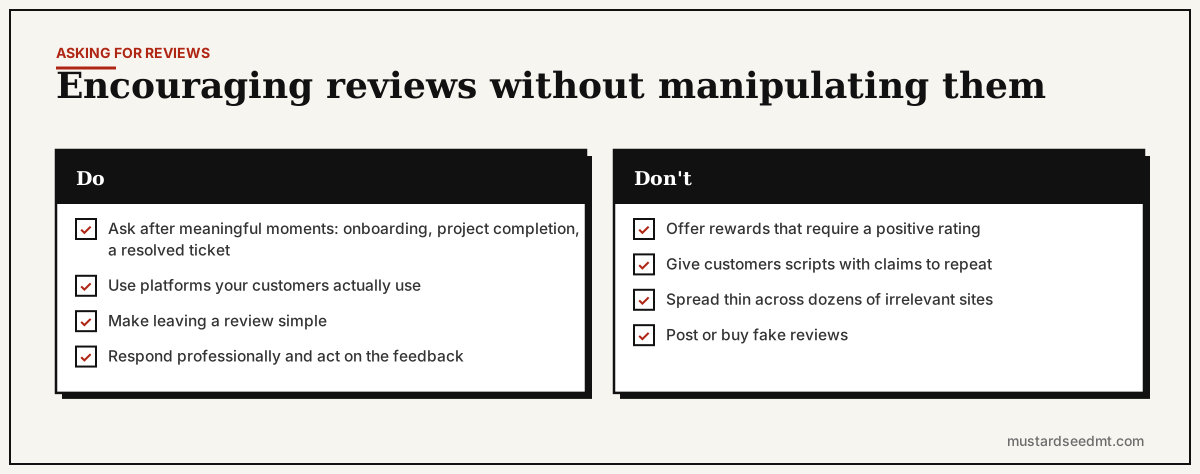
Ask customers for feedback after meaningful interactions.
This may happen after onboarding, project completion, a purchase, a support resolution, or a period of product use.
Choose platforms relevant to the customer and industry.
Make the process simple.
Do not offer rewards that require a positive rating.
Do not provide scripts that pressure customers to make specific claims.
Respond to reviews professionally and use the feedback to improve operations.
Customer review generation should be part of the customer experience, not a separate manipulation campaign.
Monitor common themes
Businesses should analyse review content rather than focusing only on the average rating.
Look for repeated strengths, complaints, questions, and use cases.
These themes can improve product development, sales messaging, support documentation, and website content.
If customers repeatedly praise a feature that is barely mentioned on the website, the company may be missing an important positioning opportunity.
If customers repeatedly complain about the same process, the business has identified a problem that needs attention.
Reviews are a form of market research.
Reviews can support AI visibility
Customer reviews may influence AI recommendations because they add independent information about real experiences.
Their effect depends on the platform, query, market, and wider information environment.
Businesses should not treat reviews as a direct ranking switch.
They should treat them as part of reputation, authority, and customer understanding.
A strong review strategy begins with delivering a product or service worth recommending.
It continues through honest feedback, professional responses, accurate public information, and operational improvement.
AI systems may change how reviews are summarised, but the underlying principle remains the same.
Credible customer experiences shape how a brand is understood.