
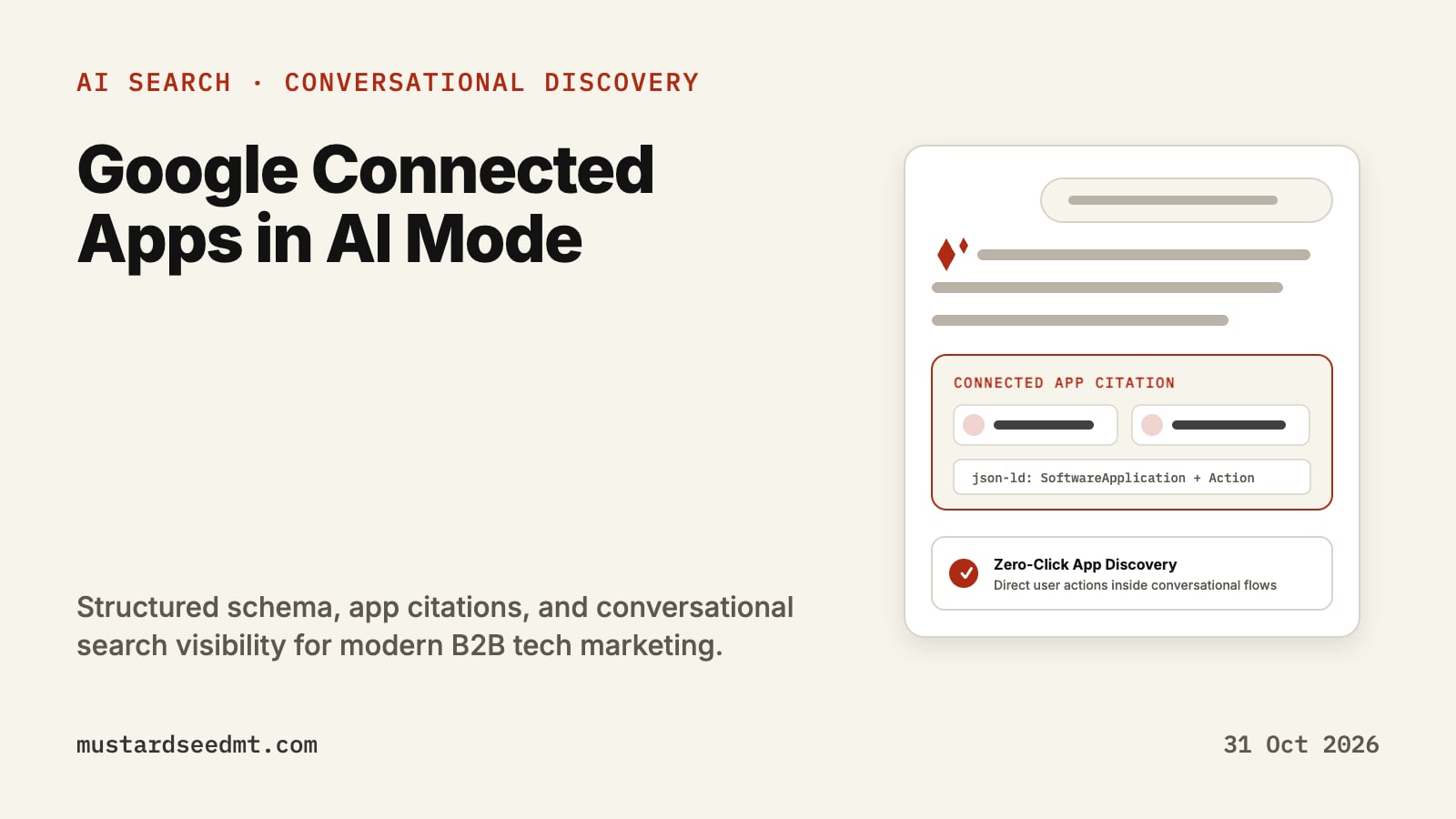
Google Connected Apps in AI Mode allows conversational search to interact directly with third-party software, calendars, and enterprise tools during multi-turn queries. Rather than just summarizing web pages, the AI model retrieves live data and suggests contextual actions from connected software ecosystems. For B2B tech marketers, this shifts discovery from traditional keyword ranking to structured API accessibility and direct in-conversation citations.
What Connected Apps do inside AI search
When users interact with Google AI Mode or conversational interfaces, Connected Apps enable the engine to reach beyond static index files. If a user asks for project timelines, pricing comparisons, or workflow automations, the conversational engine can invoke approved connected application interfaces to fetch current answers.
Search Engine Journal reported in late October 2026 that Google is expanding connected tool integrations across its conversational surfaces. The engine presents direct application links alongside synthesized answers, giving users one-click routes to launch tasks in the underlying software.
This architecture changes user behaviour. Instead of clicking ten web search results to compare feature specifications, buyers ask the AI to evaluate workflows across specific tools. Software products that supply machine-readable documentation and structured integrations earn prominence in those synthesized comparisons.
The difference between ranking and conversational citation
Traditional search engine optimization focuses on positioning a URL on page one of search results. In conversational search, visibility depends on whether the model cites your software as an authoritative solution during multi-turn problem solving.
If a prospect asks, "Which backup software supports immutable storage on Proxmox?" the AI synthesizes an answer from its training data, real-time web retrieval, and structured feeds. If your product documentation uses clear entities, clean pricing tables, and verified implementation steps, the model can extract and cite your product by name with an outbound link.
Vague marketing copy and generic buzzwords fail in conversational retrieval. The model prioritizes precise technical definitions, concrete support matrices, and unambiguous compatibility notes.
How B2B tech teams should prepare their web presence
To ensure your application is visible and accurately represented when conversational search evaluates your category, focus on four technical areas:
1. Implement detailed schema markup
Use Schema.org SoftwareApplication, TechArticle, and HowTo schemas across your product and documentation pages. Specify exact operating systems, pricing models, application categories, and feature sets. Structured schemas give search crawlers clear entity relationships without relying on inference.
2. Publish direct comparison and compatibility documentation
Conversational users frequently ask comparative questions. Create dedicated pages detailing how your product integrates with standard enterprise platforms. Provide objective data on file format support, deployment prerequisites, and licensing tiers.
3. Maintain machine-readable public documentation
Keep your documentation accessible without requiring logins or PDF downloads. When crawlers can index plain HTML guides with descriptive subheadings, AI search systems can extract precise procedural answers to user questions.
4. Monitor brand mentions across secondary sources
Conversational engines corroborate claims across multiple independent websites, including technical forums, developer repositories, and industry publications. A consistent technical footprint across external domains reinforces your software's authority.
Checklist for marketing and growth teams
- Audit your product schema markup using Google's Rich Results Test tool.
- Ensure all technical documentation is indexable in clean HTML format.
- Replace generic marketing phrases with verified technical parameters and measurable capabilities.
- Track conversational referral traffic in Google Search Console under AI Overviews and conversational discovery filters.
- Build dedicated integration guides for every major partner and ecosystem platform your software connects with.