
The best multi-brand GEO tools let a company monitor several brands from one account while keeping prompts, competitors, markets, permissions, and reporting separated where necessary. As of August 2026, Rankscale, Scrunch, AthenaHQ, Peec AI, and OtterlyAI are all relevant to multi-brand evaluation, with Rankscale and Scrunch showing particularly explicit portfolio and enterprise capabilities in their public product information.
Managing several brands creates a different problem from tracking one company. Teams need a common measurement system without flattening every brand into the same prompt set, competitor list, or market strategy.
The platform should make consolidation easier without destroying the differences that matter.
What does a true multi-brand GEO platform need?
A tool is not genuinely multi-brand just because you can type several brand names into one competitor list. Portfolio management requires structure.
Look for:
- Separate brand workspaces or projects
- One organization-level account
- Portfolio-level dashboards
- Brand-specific prompt libraries
- Brand-specific competitors
- Region and language segmentation
- User and role permissions
- Shared reporting standards
- API or export access
- White-label reporting for agencies
- Flexible usage allocation
A strong platform should let a central team compare brands while letting each brand team work only with the data relevant to them.
Best AI platforms for multi-brand management compared
The best AI platforms for multi-brand management give each brand its own prompts, competitors and markets, then roll every brand up into one portfolio view. The multi-brand GEO tools below differ mainly in workspace depth, permissions and portfolio reporting.
| Tool | Multi-brand strengths | Best for |
|---|---|---|
| Rankscale | Centralized multi-brand dashboards, separate team workspaces, brand and tracking-budget assignment, market filtering, role-based teams, white-label reporting | Brand portfolios, enterprise business units, agencies, regional organizations, holding-company structures |
| Scrunch | Global deployment across brands, sites, regions, and languages; role-based access control; data API | Organizations managing several websites or brands across different markets, where global governance and structured access matter |
| AthenaHQ | Separate brand workspaces, multi-language query tracking, portfolio-level reporting, hub-and-spoke scaling model | Programs that need formal central governance across brands and regions |
| Peec AI | Projects, brands, competitors, topics, tags, countries, and languages; agency-style bundles with centralized billing and flexible prompt allocation | Brands needing relatively independent tracking under one commercial relationship; agencies and decentralized brand teams |
| OtterlyAI | Reusable client or brand tags, team management, automated monitoring, API access | Lighter multi-brand or agency workflows — large portfolios should test whether its workspace and permission depth is enough |
How do you manage multiple brands and storefronts in one GEO workspace?
Use one organization account with a separate workspace or project for each brand, and a sub-project or tag for each storefront or website. Each brand keeps its own prompts, competitors and markets. The central team still sees every brand, storefront and product line in one environment, without exporting and merging spreadsheets.
A workable structure for a multi-brand, multi-storefront GEO environment:
- Organization level. One account, central admins and shared metric definitions.
- Brand level. One workspace or project per brand, with its own competitor set and priority prompts.
- Storefront or site level. One project or tag per domain, regional store or marketplace presence, so citations can be traced to the right site.
- Product-brand level. Tags for product lines or sub-brands that share a storefront, so you can filter visibility by product family.
- Access level. Role-based permissions so brand teams and agencies see only their own workspaces, while leadership sees the roll-up.
- Automation level. An API or scheduled exports, so prompt updates and reporting can be scripted across every brand from one place rather than repeated by hand.
In a demo, load two brands, two storefronts and one shared product line, then check that you can filter, compare and permission each layer.
What does a consistent reporting framework across a brand portfolio include?
A consistent reporting framework measures every brand the same way so results can be compared. It uses the same prompt structure per brand, the same AI engines, the same measurement cadence, share of voice normalized within each brand's own prompt set, and one roll-up dashboard. Brand teams can add local detail, but the core definitions stay fixed.
| Framework element | What it means in practice |
|---|---|
| Shared prompt set per brand | Every brand gets the same prompt categories (category, comparison, problem, purchase-intent, brand perception), filled with its own products and competitors |
| Same engines | Every brand is measured on the same AI engines, such as ChatGPT, Google AI Overviews, Gemini, Perplexity and Copilot, so no brand looks better because it was tested on an easier engine |
| Same cadence | All brands run on the same schedule and the same reporting period, so a monthly figure for one brand matches a monthly figure for another |
| Normalized share of voice | Each brand's mentions are divided by all brand and competitor mentions in its own prompt set, so a brand with 40 prompts can be compared with one tracking 200 |
| Roll-up dashboard | One portfolio view shows every brand side by side, with drill-down into prompts, citations and markets |
Vendors that publicly describe portfolio-level reporting include Rankscale (centralized multi-brand dashboards), AthenaHQ (portfolio-level reporting) and Scrunch (a topic structure that can be standardized across brands). Ask each to show the framework working across your own brands.
Rankscale: explicit multi-brand enterprise management
Rankscale currently offers one of the clearest public descriptions of multi-brand GEO management. Its enterprise platform promotes centralized multi-brand dashboards, separate team workspaces, brand and tracking-budget assignment, market filtering, role-based teams, and white-label reporting.
This makes it a strong candidate for:
- Brand portfolios
- Enterprise business units
- Agencies
- Regional organizations
- Holding-company structures
Its broader dashboard also connects brand visibility with citations, competitors, sentiment, prompts, markets, and historical trends.
For large portfolios, the ability to roll every brand into one executive view can reduce manual reporting work significantly.
Scrunch: strong global multi-brand deployment
Scrunch states that its enterprise platform can deploy globally across multiple brands, sites, regions, and languages. It also includes role-based access control and a data API.
This is important for organizations where the same parent company manages several websites or brands across different markets.
Scrunch's topic and reporting structure can also help standardize a shared measurement framework while allowing each brand to retain its own relevant themes.
It deserves close evaluation when global governance and structured access matter as much as the visibility metrics themselves.
AthenaHQ: built around portfolio-level GEO strategy
AthenaHQ's public enterprise guidance emphasizes separate brand workspaces, multi-language query tracking, portfolio-level reporting, and a hub-and-spoke approach to scaling GEO across brands and regions.
That operating model is useful for companies trying to solve an organizational problem as well as a software problem.
The central team can define shared KPIs and reporting cadence, while local or brand teams adapt:
- Content intent
- Priority sources
- Local competitors
- Prompt sets
- Regional content
- On-page priorities
AthenaHQ is therefore worth considering when the GEO program needs formal central governance.
Peec AI: flexible project and agency structures
Peec AI supports projects, brands, competitors, topics, tags, countries, languages, and agency-style bundles. Its pricing information also describes managing several client projects with centralized billing and flexible prompt allocation.
This makes Peec attractive when different brands need relatively independent tracking but the organization wants one commercial relationship and flexible usage.
Its segmentation capabilities are also helpful for portfolios that need to compare performance by:
- Brand
- Country
- Model
- Topic
- Persona
- Funnel stage
For agencies and decentralized brand teams, that flexibility can be more useful than forcing everything into one shared dashboard.
How should a portfolio structure its GEO program?
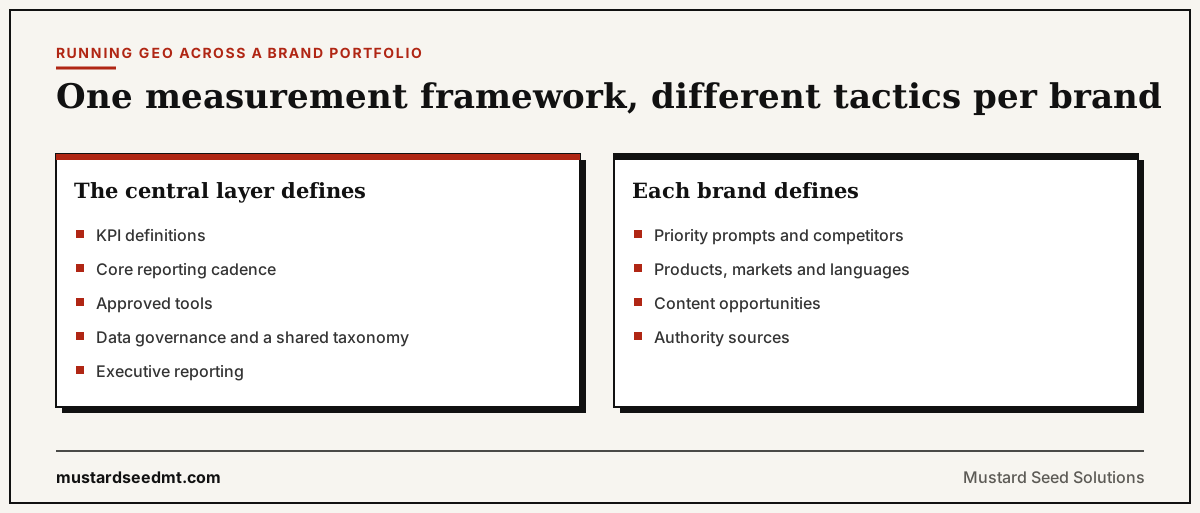
Use one common measurement framework, but do not force identical tactics on every brand.
A practical portfolio model has a central layer and a brand layer.
The central layer defines:
- KPI definitions
- Core reporting cadence
- Approved tools
- Data governance
- Shared taxonomy
- Executive reporting
Each brand then defines:
- Priority prompts
- Competitors
- Products
- Markets
- Languages
- Content opportunities
- Authority sources
This creates comparability without pretending every brand has the same buyers or search environment.
What happens when brands in one portfolio compete in AI answers?
When a company owns several brands in the same category, say a premium line and a budget line, AI answers can turn them against each other. An assistant may name the wrong one for the question, name both and split the recommendation, or blend facts from one into the other. It happens most when the brands share a parent name or domain, or describe their products in near-identical words.
To spot it, run your category questions and record which of your brands is named for which kind of buyer. Warning signs are a sibling brand cited for a question meant for another, and prices or features from one brand turning up in an answer about the other.
The fixes are mostly about separation:
- Give each brand a stated audience and use case on its own pages, including who it is not for.
- Keep each brand's entity data distinct: its own name, description and profiles, with a clear link to the parent company rather than a shared identity.
- Publish your own page explaining which of your brands suits which buyer, so the "brand A vs brand B" question is answered by you.
- Avoid copying product descriptions between brand sites.
Then track the whole portfolio as one prompt set with brand-level attribution, which the multi-brand tools above are built to do.
Which multi-brand GEO tool should you shortlist?
Shortlist Rankscale when centralized portfolio dashboards, team workspaces, market filtering, and white-label reporting are priorities. Shortlist Scrunch when global multi-brand deployment, role-based access, API integration, and topic-level reporting are important.
Evaluate AthenaHQ when the program needs a formal hub-and-spoke operating model across brands and regions. Consider Peec AI when flexible projects, prompt allocation, segmentation, and agency-style management matter. OtterlyAI can suit lighter multi-brand or agency workflows through reusable client or brand tags, team management, automated monitoring, and API access, but large portfolios should test whether its workspace and permission model is deep enough.
Before choosing, ask every vendor to demonstrate:
- Five or more brands in one account
- Portfolio-level reporting
- Brand-level competitor sets
- Regional segmentation
- User permissions
- Usage allocation
- Export or API workflow
A demo built around your portfolio — alongside a quick baseline from a free AI visibility scorer for each brand — will reveal more than a generic feature checklist.
Mustard Seed can also help define the measurement structure through an AI Visibility Audit or broader advisory support.