
AI Search Visibility: What It Is, How to Measure It, and How to Improve It
AI search visibility — usually shortened to AI visibility — is how often and how accurately your brand appears inside AI-generated answers on systems like ChatGPT, Google AI Overviews and AI Mode, Gemini, and Perplexity. Traditional search visibility is a rank position you can look up; AI visibility is a sampled measurement you have to build, by asking a fixed set of buyer questions and recording whether you were mentioned, cited, and described correctly. This guide defines it, gives you the formulas to measure it, and sets out what actually improves it — with every platform requirement checked against the vendor's own documentation rather than repeated from other blog posts.
What is AI visibility?
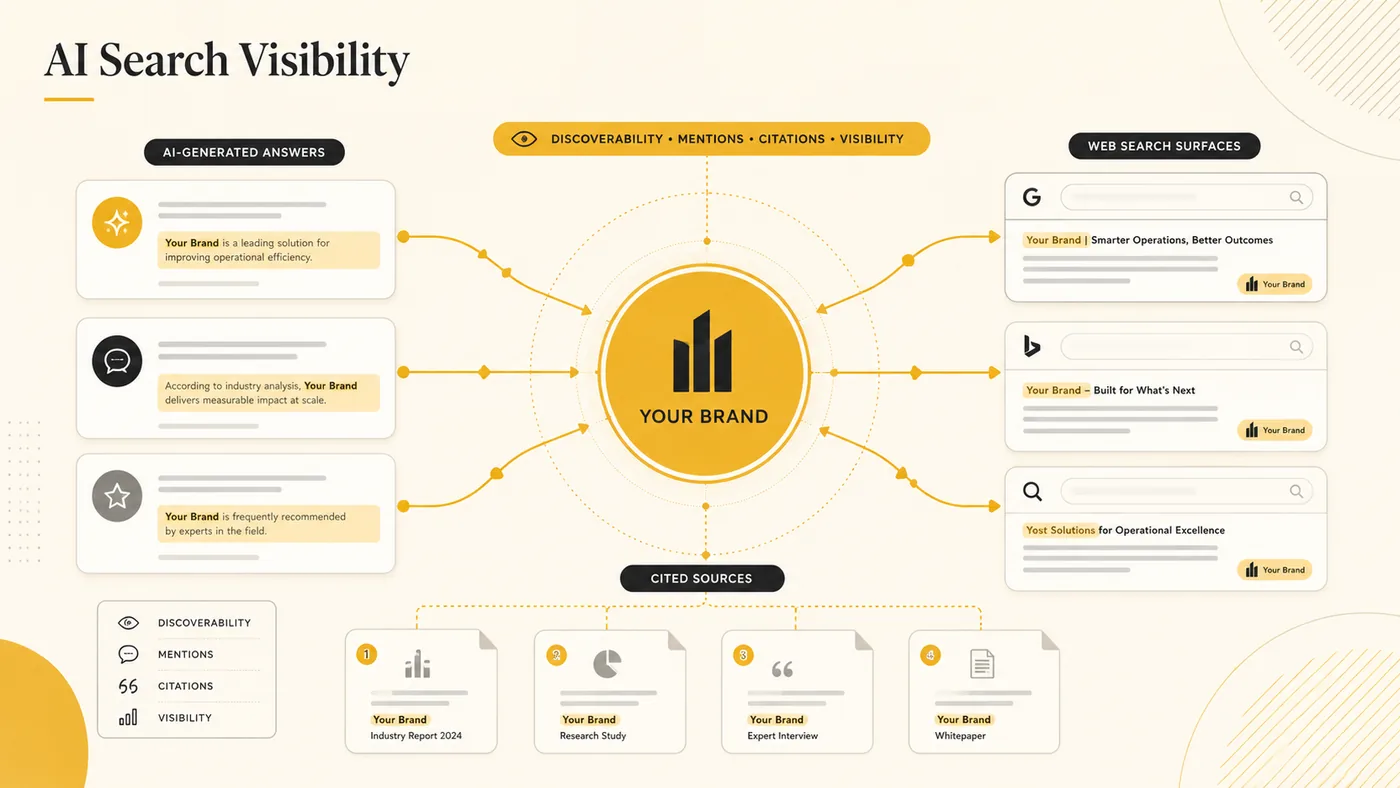
AI visibility, also called AI search visibility, is how often and how accurately a brand, product, or website appears in AI-generated answers. It is measured through brand mentions, citations, share of voice, description accuracy, and sentiment across systems such as ChatGPT, Google AI Overviews and AI Mode, Gemini, and Perplexity.
Traditional search visibility measures where a page ranks. AI visibility measures whether a brand or source appears inside a generated answer at all, and how it is represented once it does.
The distinction matters because the two can move independently. A page can sit on the first page of Google and still never be named in an AI answer to the same question. A brand can also be described confidently and repeatedly by an AI system on the strength of third-party sources it does not own or control.
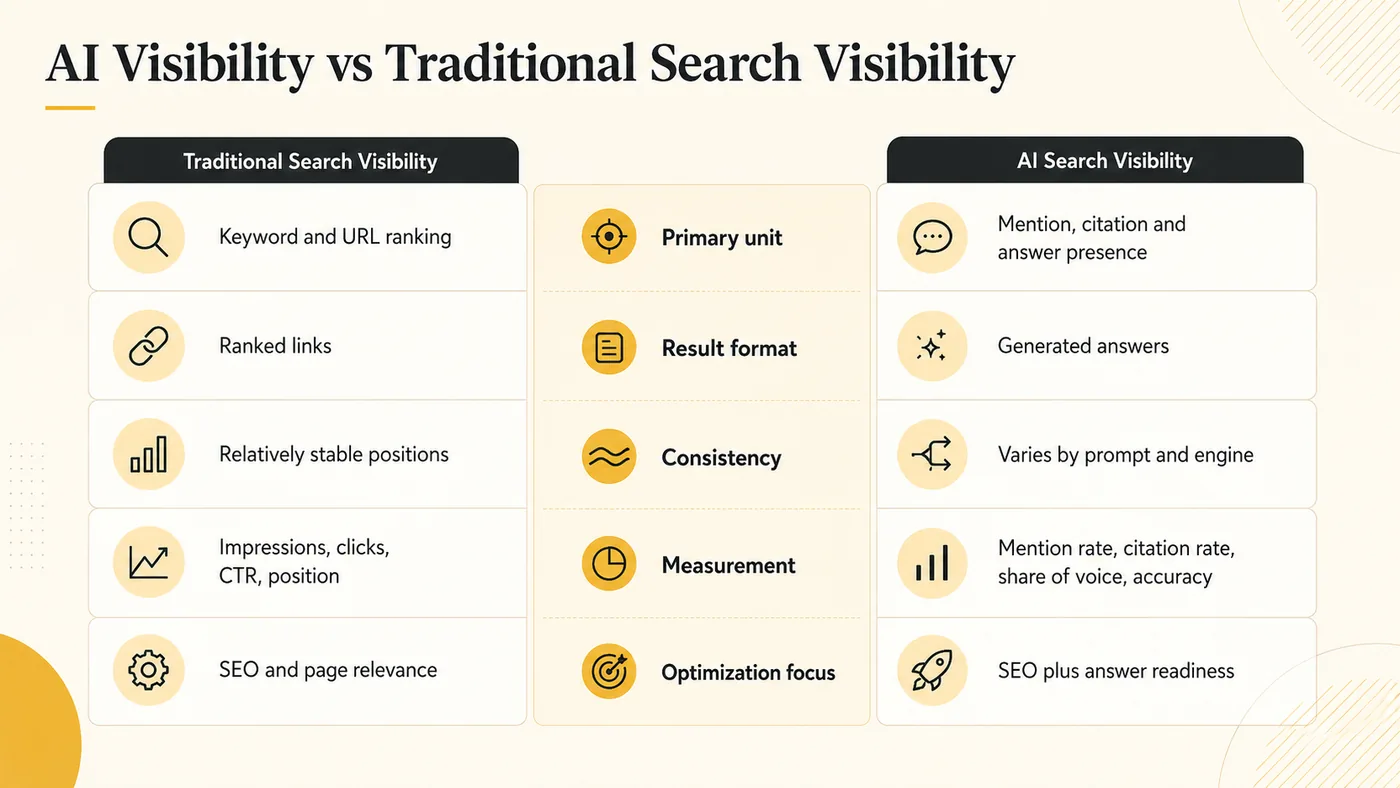
AI visibility vs. traditional search visibility
AI visibility differs from traditional search visibility because traditional search measures ranked links, while AI visibility measures whether your brand or content is mentioned, cited, and accurately represented inside generated answers.
In traditional search there is a fixed position to look up: a keyword tool can tell you where a URL stands at any moment. In AI search there is no equivalent coordinate. A brand either appears in a given answer or it does not, and the answer can change between two near-identical prompts, between engines, and over time as models and their retrieval sources update. That makes AI visibility something you sample and trend rather than something you check once.
The two remain connected, and on Google they are directly coupled. Google's documentation states that to appear in AI Overviews or AI Mode a page must be indexed and eligible to be shown in Google Search with a snippet — there are no additional requirements and no special optimizations. Conventional SEO is therefore the entry ticket to Google's AI surfaces, not a separate track alongside them.
| Dimension | Traditional search visibility | AI search visibility |
|---|---|---|
| Primary unit | Keyword and URL ranking | Mention, citation, and answer presence |
| Result format | A list of ranked links | A generated answer, with optional citations |
| Consistency | Relatively stable positions you can look up | Varies by prompt, engine, and session |
| Measurement | Impressions, clicks, CTR, average position | Mention rate, citation rate, share of AI voice, description accuracy, sentiment |
| Optimization focus | Crawlability, relevance, quality, links, page experience | The same SEO foundation, plus clear factual content and evidence an answer can be built from |
Why AI visibility matters
AI systems have become an additional discovery surface rather than a replacement for search. Buyers may now encounter a category overview, a vendor shortlist, or a direct comparison inside an AI tool before they ever open a results page — which means brand impressions are being formed in a place most measurement stacks cannot see.
Visibility there has two dimensions, and they fail independently. The first is whether you are mentioned at all. The second is whether the description attached to your name is accurate. A brand that is absent has a content and authority problem; a brand that is present but described wrongly has a very different problem, and the fixes are not the same.
The access layer is the one part of this that is fully measurable today, and it is not evenly distributed. In our own study of 1,000 randomly sampled domains, 12.2% blocked at least one major AI crawler in robots.txt, GPTBot was blocked roughly 3.9 times more often than PerplexityBot, and 13.2% had no robots.txt at all. A meaningful slice of the web has opted out of parts of AI visibility, in many cases without intending to.
The practical conclusion is narrow but useful: AI visibility deserves its own measurement layer alongside SEO, because a brand can rank well and still be absent from the answers that shape a shortlist.
What determines AI search visibility?
Five factors do most of the work. The first is the one teams most often get wrong, because the access mechanism genuinely differs from platform to platform — there is no single universal 'AI crawler' switch that governs all of them.
- 01
Search eligibility and crawl access. Handled differently by each platform. For Google AI Overviews and AI Mode, ordinary Search indexing and snippet eligibility is the requirement. For ChatGPT's search features, OpenAI identifies OAI-SearchBot as the relevant crawler. For Perplexity, it is PerplexityBot. Check each one that matters to your business separately rather than assuming one robots.txt rule covers them all.
- 02
Useful, specific content. Concrete information that answers a real question better than a generic page does: original data, benchmarks, clear definitions, direct comparisons, step-by-step methods, product specifications, named examples, and case studies. Specificity is what makes a passage safe for a model to quote and attribute.
- 03
Search authority and reputation. Strong search performance, credible references, relevant links, brand mentions, and consistent information across trusted sources all help systems understand what a company or page is about. Treat this as ordinary quality and reputation work rather than as a separate AI ranking mechanism.
- 04
Freshness, where freshness genuinely matters. Recency helps for topics where the answer changes over time — pricing, platform behaviour, regulations, tooling. For an evergreen definition, accuracy and completeness matter more than a recently updated date stamp.
- 05
Clear presentation. Descriptive headings, concise answers near the top of a page, lists, tables, and worked examples. These help readers scan and make the information easier to interpret correctly. They are good practice — not a documented requirement of any AI feature.
How to measure AI search visibility
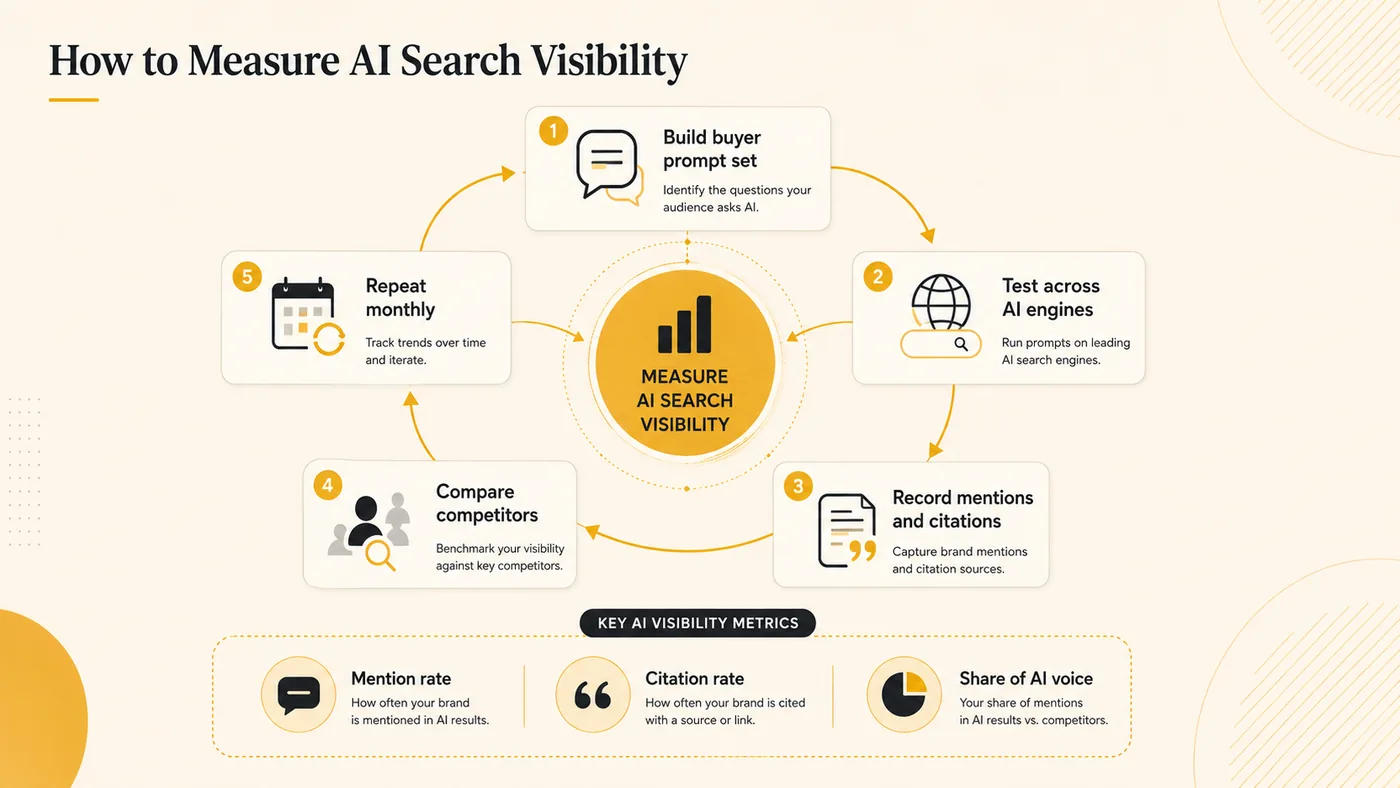
Measure AI search visibility by running a consistent set of buyer questions across the AI systems you care about, recording whether your brand is mentioned or cited, and repeating the same test on a fixed cadence. A first measurement takes an afternoon; the value comes from running it identically the second and third time.
The loop below is deliberately manual. Tooling can automate it later, but running it by hand once is the fastest way to learn which prompts, engines, and competitors actually matter in your category.
- 01
Build a buyer prompt set. Write 15–25 questions a real buyer would ask, in three types: brand prompts ('what is [brand]?'), category prompts ('best [category] for [use case]'), and direct comparisons ('[brand] vs [competitor]'). Freeze the wording — the prompt set only produces a trend if it stops changing.
- 02
Define the competitor set. List the 4–8 competitors buyers genuinely compare you against, not the aspirational set. AI tools describe brands relative to a category, so the wrong competitor list makes every downstream number measure the wrong contest.
- 03
Test across AI engines. Run the same prompts in each system that matters to you — ChatGPT, Google AI Overviews and AI Mode, Gemini, Perplexity. The same prompt routinely returns different brands and different framing in different tools. That variance is the finding, not noise to average away.
- 04
Record mentions and citations. For every prompt and engine, log whether you were mentioned, whether the description was correct, the tone of the mention, and — where the tool shows sources — which pages were cited, yours and everyone else's. The cited-source list is often the most actionable output of the whole exercise.
- 05
Compare against competitors. Count how often each named competitor appears across the same prompt set. This is what converts a list of individual mentions into a competitive picture.
- 06
Repeat monthly. AI answers shift as models and retrieval sources update. Re-running the identical prompt set monthly, logged the same way, is what turns anecdotes into a baseline.
Measuring Google AI visibility in Search Console
This is the part most articles get wrong, so it is worth stating precisely. Google includes AI Overviews and AI Mode data in Search Console — but it is folded into the overall Web search type in the Performance report. There is no separate generative AI report, and no filter that isolates AI Overviews or AI Mode traffic from ordinary search traffic.
The practical consequence: your Search Console numbers already contain your Google AI visibility, and you cannot break it out. Impressions and clicks earned inside an AI Overview are counted in the same totals as blue-link impressions and clicks. If you want a Google-specific AI read, it has to come from manual observation — searching your prompt set in Google and recording whether an AI Overview appears, whether you are in it, and which pages it draws from.
That limitation is the reason the manual loop above still matters. Google's first-party data tells you how the page performs in Search overall. It does not tell you how often you are named in an answer, and it tells you nothing at all about ChatGPT, Gemini, or Perplexity — those require separate monitoring of your own.
AI visibility metrics that matter
Most teams that start measuring AI visibility default to a single yes/no: mentioned, or not. That is not enough to run a program on. The five metrics below are the recordable numbers that turn a folder of screenshots into a report you can defend and repeat month over month.
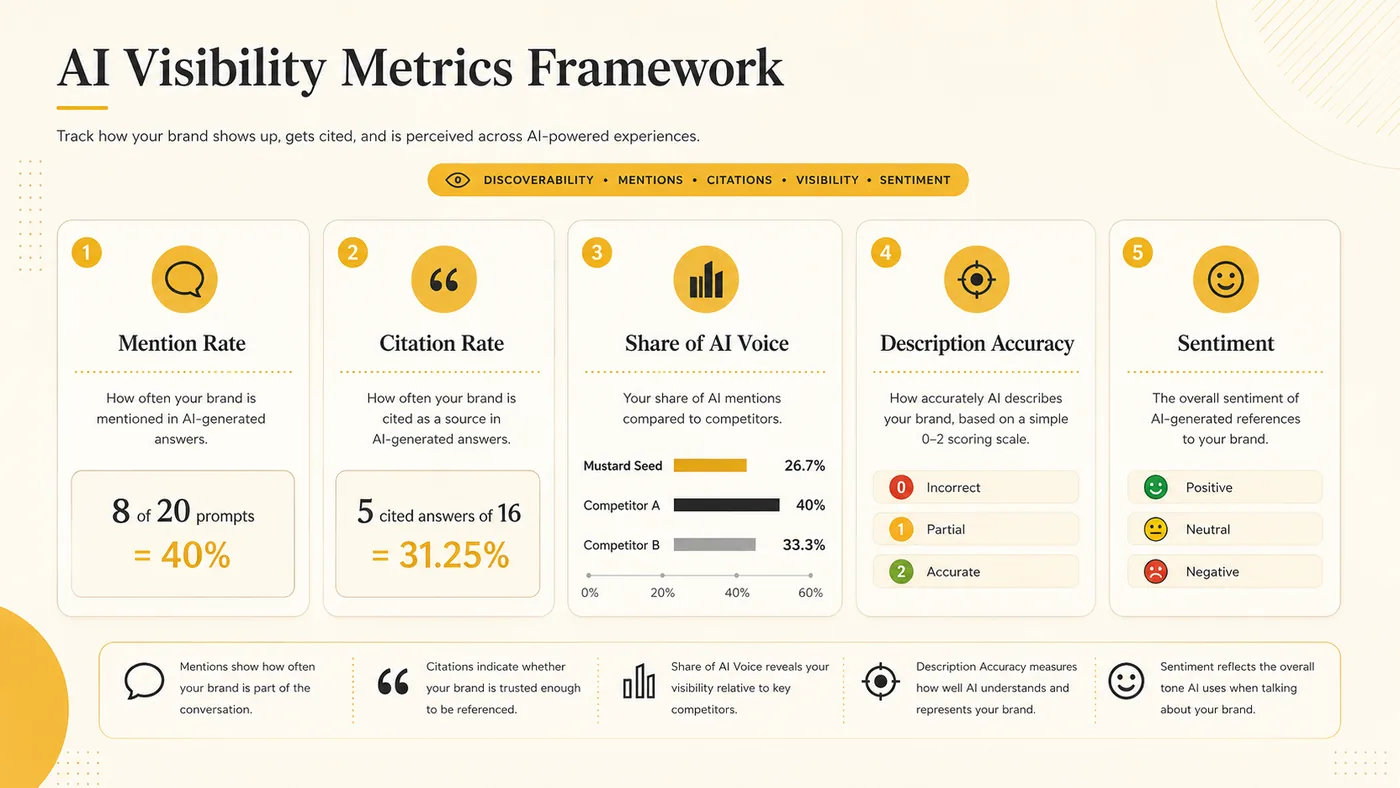
- Mention rate. Brand mentions ÷ eligible prompts × 100. The share of your prompt set where your brand is specifically named. This is the headline number and the denominator most of the others are read against.
- Citation rate. Answers citing your domain ÷ answers showing citations × 100. Measured only against answers that display sources at all, since an answer with no citations cannot cite anyone. This is the closest AI-search equivalent to a rank position.
- Share of AI voice. Your brand mentions ÷ all tracked mentions across your competitor set × 100. Mention rate rolled up into a head-to-head comparison instead of a standalone figure.
- Description accuracy. Scored 0 to 2 — 0 for incorrect, 1 for partly correct, 2 for accurate. Recorded separately from whether you were mentioned, because 'absent' and 'present but described wrongly' are different failures with different fixes.
- Sentiment. Positive, neutral, or negative. The qualitative read that sits alongside the counting metrics, and the one that most often explains a mention rate that looks fine but is not converting.
A worked example
Take a hypothetical run of 20 prompts across your chosen engines. Your brand is mentioned in 8 of them. Competitor A is mentioned in 12, competitor B in 10. Of the answers returned, 16 displayed citations, and 5 of those cited a page on your own domain.
Those six raw counts are enough to produce every headline metric. The point of writing them out is that the arithmetic is genuinely this simple — the discipline is in collecting the counts the same way every month, not in the calculation.
Worked example — hypothetical numbers
| Metric | Working | Result |
|---|---|---|
| Mention rate | 8 mentions ÷ 20 prompts × 100 | 40% |
| Citation rate | 5 citing answers ÷ 16 answers with citations × 100 | 31.25% |
| Share of AI voice | 8 ÷ (8 + 12 + 10) × 100 | 26.7% |
Brand visibility in AI search
Brand visibility in AI search is the brand-level view of the same measurement: not whether one page gets cited, but whether AI systems know your brand exists, place it in the right category, and describe it the way you would. A company can have well-optimized pages and still be missing from AI answers if models have never encountered consistent third-party evidence that it belongs in the category at all.
The fastest diagnostic is two prompts per engine. Ask 'what is [your brand]?' — that reveals whether the model knows you and describes you accurately. Then ask 'what are the best [your category] options?' — that reveals whether you are in the consideration set. A brand that passes the first and fails the second is known but not recommended, which is a positioning and evidence problem rather than a technical one.
Because brand-level visibility is driven by what other sites say about you, the work looks more like PR than on-page SEO: consistent naming and category language everywhere the brand appears, presence on the comparison and review sources that keep showing up in your citation logs, and original research that gives other publications a concrete reason to name you.
AI visibility by platform: Google, ChatGPT, Perplexity, Gemini
Each platform sources and presents answers differently, and — more importantly — each has a different access mechanism. The summaries below follow each vendor's own published documentation.
- Google AI Overviews and AI Mode. Google states there are no additional requirements to appear in AI Overviews or AI Mode beyond being indexed and eligible to appear in Search with a snippet. There is no separate crawler to allow and no AI-specific markup to add. Google-Extended is a different control — it governs training and grounding in some of Google's other systems, not eligibility for AI Overviews. To check visibility, search your prompt set in Google and note whether an AI Overview appears and which pages it draws from.
- ChatGPT. OpenAI identifies OAI-SearchBot as the crawler used to surface websites in ChatGPT's search features, and states that sites opted out of OAI-SearchBot will not be shown in ChatGPT search answers. GPTBot is a different agent used to improve foundation models, and ChatGPT-User handles individual user-triggered fetches — OpenAI notes it is not used to determine whether content may appear in search. If ChatGPT search visibility is the goal, OAI-SearchBot is the one to check.
- Perplexity. Perplexity identifies PerplexityBot as the crawler designed to surface and link websites in Perplexity search results, and states it is not used to crawl content for foundation models. Perplexity-User handles user-initiated requests. Perplexity is the easiest engine for manual checks because citations are part of the default answer format — look at which of your pages recur across different prompts, not just whether you appear.
- Gemini. Treat Gemini carefully, because behaviour differs between product surfaces and between answers grounded in live web results and answers drawn from model knowledge alone. Run your prompt set and record what you actually observe for the specific surface you care about, rather than generalising one Gemini result to every Gemini product.
How to improve AI search visibility
The improvements that move AI search visibility overlap heavily with good SEO, with a different emphasis on evidence and clarity. Work them in order — teams that complete the first two steps generally get further than teams that jump to whichever tactic is getting attention that quarter.
- 01
Fix indexing and crawl access. Confirm normal Google Search eligibility first: indexed, correct canonical, no accidental noindex, content reachable without JavaScript execution problems. Then check the platform-specific crawlers that matter to you — OAI-SearchBot for ChatGPT search, PerplexityBot for Perplexity. This is the cheapest work on the list and the only step that can silently block everything after it.
- 02
Improve the answer quality of your important pages. Put the direct answer near the top, add original data and worked examples, use comparison tables where a comparison is what the reader wants, answer the questions buyers actually ask, and cut vague marketing language. The goal is a passage a model can quote correctly rather than paraphrase loosely.
- 03
Build topic authority. Create genuinely connected articles across the cluster — AI visibility, brand visibility in AI search, AI visibility metrics, GEO, AEO, AI crawler access — and link them to each other with descriptive anchors. Depth across a topic is easier for a system to recognise than a single long page.
- 04
Build real external evidence. Promote original studies, earn relevant editorial coverage, get included in credible comparison pages, and publish first-party benchmarks and case studies. This is the slowest step and the one that most reliably teaches a model that your brand belongs in the conversation.
- 05
Measure repeatedly. Fixed prompt set, same engines, same log, monthly. Track Google performance in Search Console — remembering it already includes AI Overviews and AI Mode in the Web search totals — and track cross-engine mention and citation data separately, because nothing in Search Console covers ChatGPT, Gemini, or Perplexity.
Frequently Asked Questions
Related Resources
Brand Visibility in AI Search
The brand-level methodology: prompt design, scoring, and competitor benchmarking.
AI Visibility Audit Tool
Score your brand's AEO/GEO readiness across 17 signals.
AI Crawler Access Checker
Check whether OAI-SearchBot, PerplexityBot, and others can reach your site.
AI Crawler Access Study 2026
Original data from 1,000 domains: who blocks AI crawlers, and how much.
Best GEO Tools in 2026
Compare GEO platforms for marketing, growth, and product teams.
GEO vs SEO
How generative engine optimization differs from traditional SEO.
How AI Search Engines Find Information
Where AI answers actually come from: LLMs, retrieval, and search indexes.
How to Get Your Brand Mentioned in AI Search Results
The evidence AI systems need before they name your brand in an answer.
AI Search Visibility
Find Out If AI Tools Can Even See You
We help businesses become discoverable and accurately represented across ChatGPT, Perplexity, Gemini, and Google AI Overviews — starting with a free audit of the signals that actually matter.
Get a Free AI Visibility Audit