
Geo Targeting Ads: A Practical Guide for B2B Companies
Geo targeting ads help companies show advertising to people in specific countries, regions, cities, or local areas. For B2B companies, geo targeting is important for market entry, regional campaigns, event promotion, partner marketing, and paid media budget control.
Geo targeting ads help companies show advertising to people in specific countries, regions, cities, or local areas. For B2B companies, geo targeting is not only useful for local businesses — it also matters for market entry, regional campaigns, event promotion, partner marketing, sales territory planning, and paid media budget control.
A company entering the United States, the United Kingdom, Germany, Singapore, or another target market should not always advertise everywhere at once. Geo targeting helps focus budget where the buyer, sales opportunity, and market strategy are strongest.
What Are Geo Targeting Ads?
Geo targeting ads are ads shown to people based on location. The location can be broad or narrow, and can be used across platforms such as Google Ads, Meta Ads, LinkedIn Ads, YouTube Ads, programmatic advertising, and some industry advertising platforms.
What Is Geotargeting?
Geotargeting is the practice of delivering content, ads, offers, or website experiences based on a person's location. In advertising, geotargeting usually means choosing where ads should appear. In website strategy, it may mean creating pages for specific countries, cities, languages, industries, or regional markets.
Why Geo Targeting Matters for B2B
B2B companies often waste paid media budget by targeting too broadly. A company may want customers in North America but accidentally include regions where it has no sales coverage, no language support, no pricing fit, or no implementation capability.
Common Geo Targeting Use Cases
New Market Entry
A B2B company entering a new country can use geo targeted ads to test market response before committing a larger budget. For example, a European SaaS company entering the US market may run campaigns only in selected states or metro areas where its ICP is strongest.
Regional Lead Generation
A consulting company may want leads only from companies in specific regions where it can deliver services. Geo targeting prevents irrelevant inquiries from unsupported locations.
Event Promotion
If a company is attending or hosting an event in London, San Francisco, Singapore, Warsaw, or Berlin, it can run ads around the city or event venue — supporting booth traffic, meeting bookings, or post-event follow-up.
Partner Marketing
A vendor working with a regional partner may run campaigns only in the partner's territory. This helps align advertising with channel coverage and avoids competing with your own partners.
Account-Based Marketing
Geo targeting can support ABM when target accounts are concentrated in specific regions, cities, or business districts.
Regional Retargeting
A company may retarget website visitors differently depending on region. US visitors may see a US Market Strategy Review CTA, while European visitors see a different regional offer.
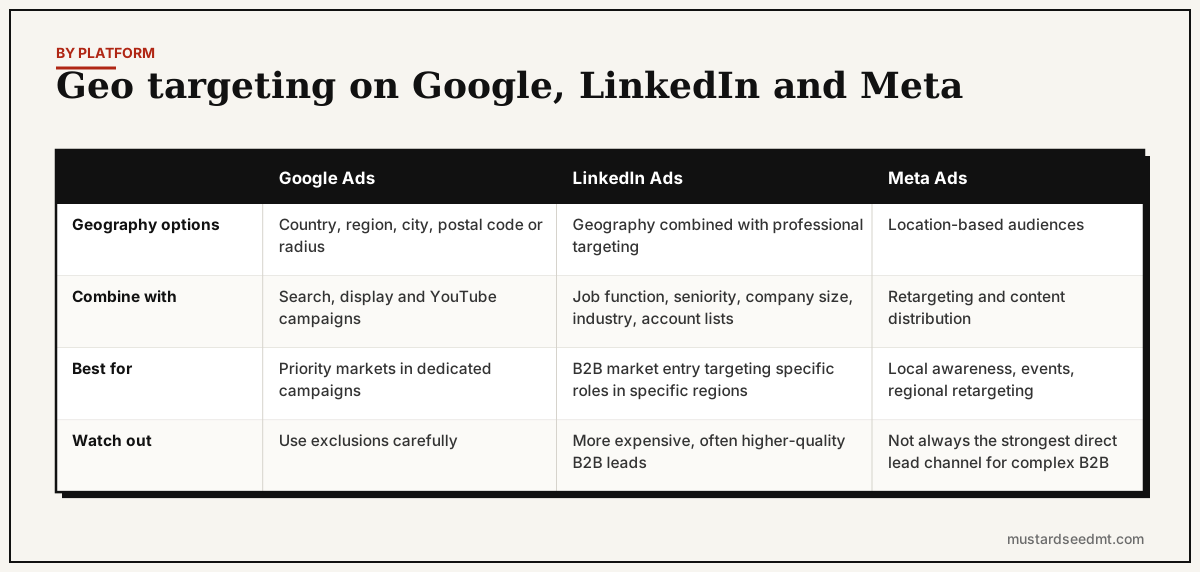
Geo Targeting by Platform
Target by country, region, city, postal code, or radius. Useful for paid search, display, and YouTube. Separate priority markets into dedicated campaigns or ad groups when volume allows. Use location exclusions carefully — they are as important as inclusions.
Combine geography with professional targeting — job function, seniority, company size, industry, or account list. Useful for B2B market-entry campaigns targeting specific roles in specific regions. More expensive than other platforms but often produces higher-quality B2B leads.
Useful for local awareness, retargeting, event promotion, and content distribution. For B2B companies, Meta geo targeting can support retargeting by region and founder-led content. Not always the strongest direct lead generation channel for complex B2B products.
Geo Targeting and SEO
Geo targeting is not only about paid ads. SEO can also support geographic targeting through region-specific content. For companies entering new markets, location-specific SEO pages can help explain market relevance and improve search visibility.
Geo Targeting and Landing Pages
Geo targeting works better when the landing page matches the location strategy. A geo targeted landing page may include local market headlines, region-specific pain points, local proof or examples, and a territory-specific CTA.
B2B Advertising Geographic Targeting on Professional Sites
For B2B advertising, geographic targeting on professional sites means LinkedIn Ads, Microsoft Advertising, and Google Ads, and each one has a location setting that decides who counts as "in" your market. For a sales territory, pick the setting based on where people live or work, not where they browse from or read about. Then add a professional layer such as job function or company.
The defaults on all three platforms lean towards reach. That suits consumer brands. A B2B company that can only sell, contract, or deliver in certain countries usually wants the narrower option.
LinkedIn Ads
- Location setting
- Three location options: "Recent or permanent location" (the default), "Permanent location" (the location on the member's profile), and "Recent location" (based on IP address, offered to select accounts).
- B2B choice
- Use Permanent location for a sales territory, so travellers and VPN users drop out. Use the default or Recent location for event and conference campaigns.
- Professional layer
- Job function, seniority, company, industry, company size, or an uploaded account list.
Google Ads
- Location setting
- "Presence or interest" (the default) also reaches people who have shown interest in a location. "Presence" limits ads to people in, or regularly in, your targeted locations.
- B2B choice
- Switch to Presence when you can only sell or deliver inside the targeted area. Keep Presence or interest only if out-of-area researchers are real buyers for you.
- Professional layer
- No profile data, so the professional filter comes from B2B keywords, negative keywords, and your own customer lists.
Microsoft Advertising
- Location setting
- By default, ads reach people in, searching for, or viewing pages about your targeted locations. The narrower option is people in your targeted locations.
- B2B choice
- Choose people in your targeted locations for territory campaigns. The Geographic report separates physical location from location of interest, so you can check the difference.
- Professional layer
- LinkedIn profile targeting by company, industry, and job function in Search, Dynamic Search Ads, Shopping, Audience, and Performance Max campaigns. It works as a bid adjustment and does not narrow the audience.
Setting Up a B2B Territory Campaign on Professional Platforms
- Write down the countries or states where you can actually sell, contract, and support customers. That list is your inclusion list.
- On LinkedIn, change the location option to Permanent location. On Google Ads and Microsoft Advertising, switch to the option that targets people in your locations.
- Add exclusions for markets you cannot serve, even if they sit next to your territory.
- Layer the professional filter: job function and seniority on LinkedIn, LinkedIn profile bid adjustments on Microsoft Advertising, and tight B2B keywords on Google.
- After two to four weeks, check each platform's location or demographics report and compare lead quality by region before widening anything.
Option names reflect each platform's help documentation as of October 2026. Platforms rename settings from time to time, so confirm the exact label in your account.
Geo Targeting Strategy for B2B Companies
Define Priority Markets
Choose markets based on business strategy, not just ad platform defaults.
- Sales coverage and language support
- Customer fit and market size
- Partner and delivery capability
- Legal or compliance requirements
Separate Test Markets
Do not mix every region into one campaign too early. Separate important regions so you can compare performance clearly.
- Separate campaigns by priority region
- Avoid blending markets with very different costs
- Start with two or three markets before scaling
- Keep naming conventions clear
Match Message to Market
A message that works in one country may not work in another. Adjust examples, pain points, terminology, and proof based on local context.
- Localise headlines and pain points
- Use region-specific examples or clients
- Adjust for language and spelling variations
- Consider local competitive landscape
Use Exclusions
Location exclusions are as important as targeting. Exclude markets where you cannot sell, support, or deliver.
- Exclude regions without sales coverage
- Exclude languages you cannot support
- Exclude poor regulatory or pricing fit markets
- Review exclusions when strategy changes
Build Regional Landing Pages
When the market is important enough, create dedicated pages that explain service availability and regional relevance.
- Local market headline
- Region-specific pain points and proof
- Relevant language and regional CTA
- Clear service availability statement
Track Quality, Not Only Clicks
A region with cheap clicks may produce poor leads. A region with expensive clicks may produce stronger opportunities.
- Track cost per qualified lead by region
- Review sales feedback by territory
- Compare opportunity creation rates
- Do not optimise for click volume alone
Connect With Sales Feedback
Sales teams should tell marketing which regions produce real opportunities. Marketing should adjust targeting, budget, and messaging based on pipeline data.
- Regular sales and marketing reviews
- Territory-level opportunity tracking
- Campaign adjustments based on sales quality
- Shared definitions of qualified leads
Common Geo Targeting Mistakes
Targeting too broadly
Running global campaigns before defining priority markets wastes budget in regions where you cannot sell or support customers.
Forgetting location exclusions
Without exclusions, your ads may reach buyers in regions where you have no coverage, cannot price competitively, or cannot support in their language.
Generic landing pages
Geo targeted ads should connect to relevant landing pages, not a generic homepage. A regional offer deserves a regional page.
Mixing many countries in one campaign
Combining dozens of countries makes it very difficult to understand what is working and what is not. Separate high-priority markets when budget allows.
One message for every market
Pain points, competitive alternatives, pricing expectations, and local terminology can vary significantly between markets.
Ignoring localisation
Even English-speaking markets can have meaningful differences — British English vs American English, pricing norms, compliance context, and cultural expectations.
Measuring only clicks
A low-cost region may produce many clicks but few qualified conversations. A higher-cost region may produce fewer clicks but much better pipeline.
Running ads without sales coverage
Generating leads in a region your sales team cannot follow up on creates a poor experience and wastes marketing budget.
Assuming low CPC means market fit
Low cost per click can mean low competition, but not necessarily strong buyer intent. Evaluate lead quality, not just cost.
Geo Targeting for New Market Entry
Geo targeting is especially important for companies entering a new country or region. A new-market campaign may include:
Geo Targeting for Technology Companies
Not every market has the same readiness, budget, competition, or buying behavior. For complex technology products, geographic targeting should be connected to positioning, content, proof, and sales capacity.
SaaS and AI Companies
Regional product launches, localized demand gen, partner campaigns
Cybersecurity Companies
Country-specific compliance, partner territory support, event geo targeting
Cloud and DevOps Vendors
Industry-specific regional campaigns, marketplace activation by region
Consulting and Professional Services
Sales territory support, event campaigns, market-entry GTM testing
Metrics to Track
For B2B campaigns, the best region is not always the cheapest. It is the region that produces qualified conversations and pipeline.
Frequently Asked Questions
What are geo targeting ads?
Geo targeting ads are ads shown to people based on their location, such as country, state, city, postal code, or radius around a specific area.
What is geotargeting in marketing?
Geotargeting in marketing means delivering ads, content, or offers based on a person's geographic location. It can apply to paid advertising, website content, landing pages, and SEO.
What is the difference between geo targeting and location targeting?
Geo targeting and location targeting are usually used to mean the same thing. Both refer to targeting ads or content based on geography.
Why is geo targeting important for B2B companies?
Geo targeting helps B2B companies focus budget on priority markets, support regional sales teams, test new countries, promote events, and avoid spending money in poor-fit regions.
Can geo targeting help with new market entry?
Yes. Geo targeting can help companies test demand in a new country or region before scaling a larger GTM campaign. It allows controlled spend, regional messaging, and performance comparison across markets.
How does geographic targeting work for B2B advertising on professional sites?
On LinkedIn, set location to Permanent location so ads reach people whose profile places them in your territory, then add job function, seniority, or company filters. On Google Ads and Microsoft Advertising, change the location option from the interest-based default to people physically in your targeted locations, and use Microsoft's LinkedIn profile targeting to raise bids on the companies, industries, and job functions you sell to.
What are common geo targeting mistakes?
Common mistakes include targeting too broadly, forgetting exclusions, using generic landing pages, ignoring localisation, and measuring only clicks instead of qualified leads.
Related Resources
Google Ads vs Meta Ads
A practical B2B comparison across search intent, targeting, ROI, and use cases.
Google Ads Cost Guide
Cost factors, budget planning, and waste reduction for B2B paid search campaigns.
Social Media Advertising Cost
How much LinkedIn, Meta, YouTube, and Reddit advertising costs for B2B companies.
Marketing Budget Allocation
A four-step framework for allocating B2B marketing spend across channels and markets.
Retargeting vs Remarketing
How to use ad-based and contact-based follow-up in B2B demand generation.
B2B Demand Generation Strategy
Nine components, campaign framework, and 15 demand generation metrics.
Geographic targeting and market entry
Need Help Targeting the Right Markets?
Mustard Seed Solutions helps B2B technology companies plan market entry, geo targeted advertising, SEO, AI Search visibility, paid media, content, LinkedIn, PR, and partner marketing. If you are unsure which markets to test or how to connect regional ads to qualified pipeline, we can help.
Request a Geo Targeting Strategy Review