
Search Engine Positioning: How to Rank Higher & Stay There
Search engine positioning refers to where your pages sit in the results for the keywords that matter to you — and the work of improving those positions. Position is everything in search: the top few results capture the vast majority of clicks, while page two is close to invisible. This guide explains what search engine positioning means, how it relates to SEO, and how to climb and hold your rankings.
What search engine positioning means
Search engine positioning is another way of talking about where you rank. If your page appears third for a keyword, that is its position. The term emphasises the outcome — your place in the results — where 'SEO' emphasises the practice that gets you there. In everyday use they overlap heavily, and 'search engine positioning services' is often just another name for SEO services.
Position matters enormously because attention drops off steeply. The first organic result typically earns far more clicks than the fifth, and results below the fold or on page two receive very little. Moving from position eight to position three can multiply your traffic without any change in search volume.
Other names for search engine positioning
Search engine positioning goes by several other names, and searchers use them interchangeably. Placement is a common shorthand for the same idea — where your page sits in the results. Rank position describes it more literally: the numbered spot your page occupies for a given query. And SEO positioning simply frames the same practice as an SEO activity rather than an outcome. Whichever term you hear, they all point to the same goal: where you show up, and the work of improving it.
What determines your position
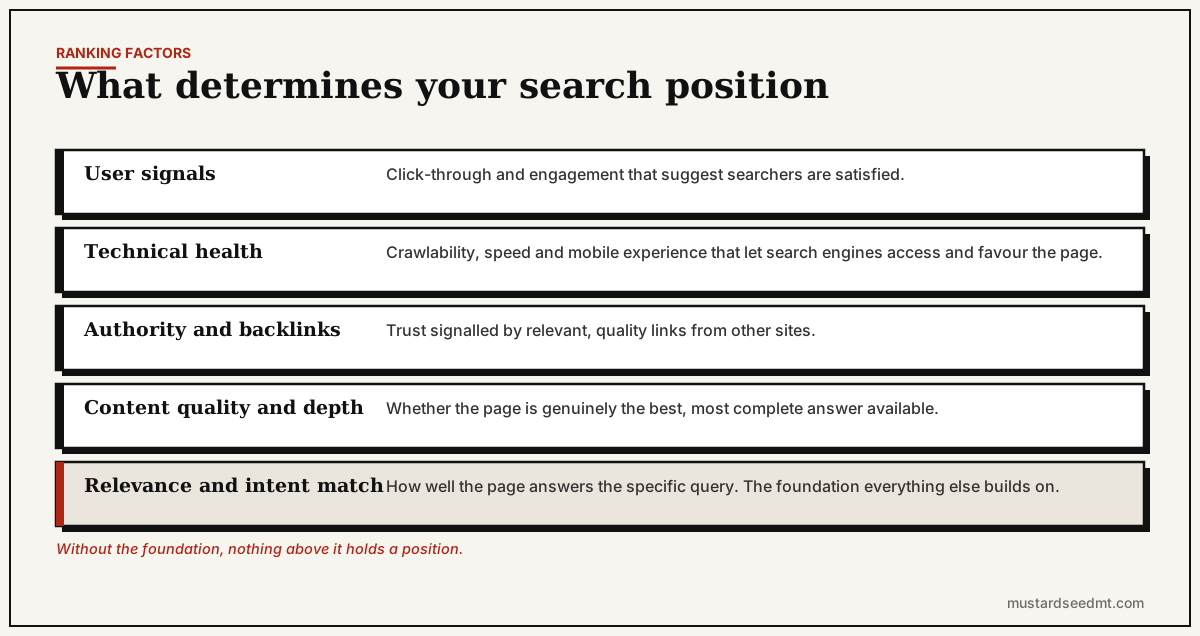
- Relevance and intent match. How well your page answers the specific query — the foundation everything else builds on.
- Content quality and depth. Whether your page is genuinely the best, most complete answer available.
- Authority and backlinks. The trust signalled by relevant, quality links from other sites.
- Technical health. Crawlability, speed, and mobile experience that let search engines access and favour your page.
- User signals. Click-through rate and engagement that suggest searchers are satisfied with your result.
How to improve your search engine positioning
- 01
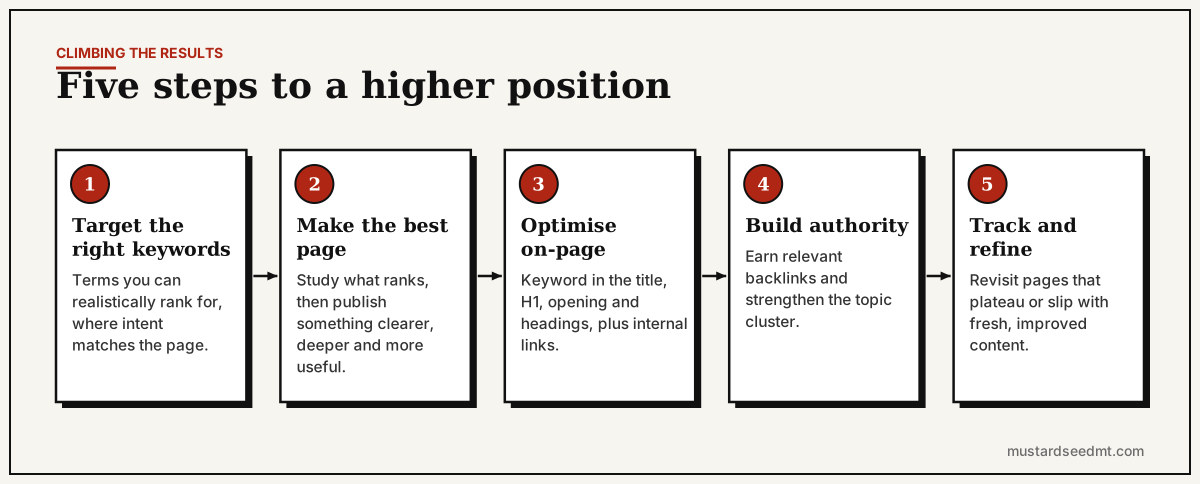
Target the right keywords. Pick terms you can realistically rank for, where the intent matches what your page offers.
- 02
Make the best page for the query. Study what ranks, then produce something clearer, deeper, and more useful than the current results.
- 03
Optimise on-page elements. Work the keyword into the title, H1, opening paragraph, and headings naturally, and add internal links.
- 04
Build authority. Earn relevant backlinks and strengthen your topic cluster so the page carries more weight.
- 05
Track and refine. Monitor positions, and revisit pages that plateau or slip with fresh, improved content.
Holding your position over time
Reaching a top position is not the end — competitors respond, content ages, and search engines update. Holding your ranking requires maintenance: refreshing content as it dates, defending against competitors publishing something better, and keeping your technical foundations sound. Positions are earned continuously, not once. The sites that stay at the top are the ones that keep improving after they arrive there.
Frequently Asked Questions
What is search engine positioning?
Search engine positioning is where your pages rank in the results for your target keywords, and the practice of improving those rankings. It overlaps heavily with SEO — 'positioning' emphasises the outcome (your place in the results), while SEO emphasises the work that achieves it.
Is search engine positioning the same as SEO?
Largely, yes. The terms are used interchangeably, and 'search engine positioning services' usually means SEO services. 'Positioning' simply frames the goal in terms of where you rank, whereas SEO describes the broader discipline of earning those positions.
Why does search position matter so much?
Because clicks concentrate at the top. The first few organic results capture the large majority of clicks, while results lower on the page or on page two get very little. Improving from position eight to position three can multiply your traffic even though the keyword's search volume is unchanged.
How do I improve my position in search results?
Target keywords you can realistically rank for, create the best and most relevant page for the query, optimise on-page elements like titles and headings, build authority through quality backlinks, and track your positions so you can refresh pages that stall or slip.
What is the difference between placement and search engine positioning?
There isn't a meaningful difference — placement is just a shorter, informal way of referring to search engine positioning: where your page appears in the results for a given query. The two terms are used interchangeably in most SEO conversations.
What does rank position mean in SEO?
Rank position refers to the specific numbered spot a page holds in the search results for a keyword — first, third, tenth, and so on. It is another term for search engine positioning, and improving your rank position is the central goal of SEO positioning work.
Ranking strategy
Climb the Results and Stay There
Mustard Seed Solutions helps businesses improve and defend their search engine positioning — targeting winnable keywords, building the best pages for them, and maintaining the rankings that drive steady, compounding traffic.
Request an SEO Review