
Whito reported 17,400 Microsoft Copilot and partner citations of its site across 127 pages over a three month period, while Bing sent 167 web search clicks during the same window. That is a striking example of why an AI citation and a website visit must be measured as different events.
AI visibility can create awareness and influence without producing a direct click. Marketers need a scorecard that separates citation share, brand exposure, referral traffic and commercial outcomes instead of treating citations as a new form of organic traffic.
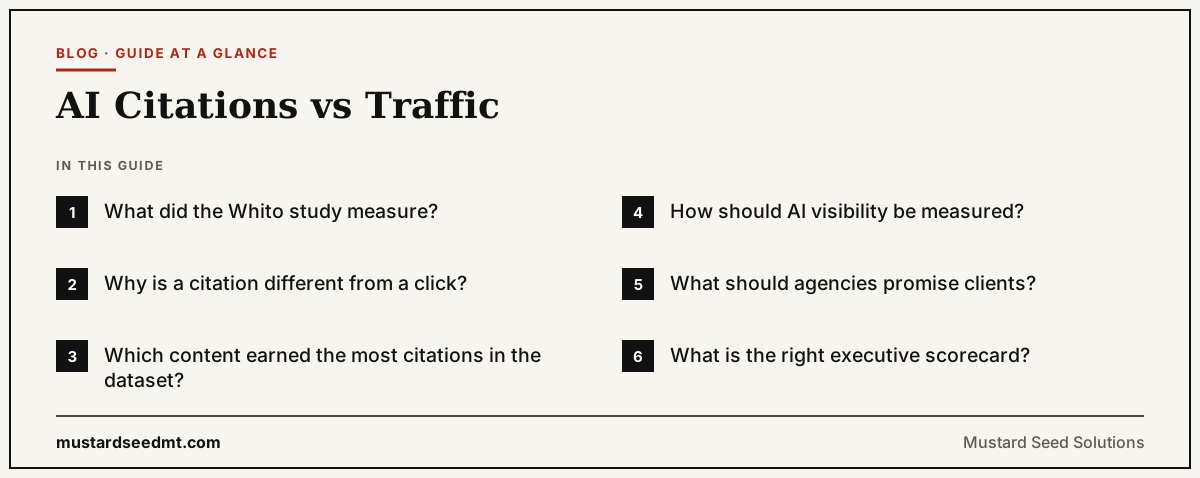
What did the Whito study measure?
Whito published data from Bing Webmaster Tools covering May 29 to August 28, 2026. It reported 17,400 Copilot and partner citations across 127 pages and 167 Bing web search clicks in the same period, a ratio of 104 citations for each click.
Whito emphasized that the citation report covers Copilot and partners and represents a sample of AI activity rather than every AI assistant. The company also published its method and acknowledged limits in attributing performance changes to specific site work.
Read the original Whito research.
Why is a citation different from a click?
A citation happens when an AI system uses a page as a source in an answer. A click happens when a person chooses to visit the page.
The user can receive the important fact without leaving the AI interface. That means a source may be used repeatedly while referral traffic remains small.
This is not automatically bad. The brand may still gain authority, awareness or influence. The mistake is claiming that citation growth will necessarily create proportional traffic growth.
Which content earned the most citations in the dataset?
Whito reported that its most cited pages were heavily concentrated in research, pricing and software evaluation content. The company concluded that sourced numbers and concrete data were particularly useful to the AI system.
That observation fits a broader GEO principle: original information gain is more citable than generic opinion. A page that contains a useful number, method, benchmark or comparison gives an AI system something specific to reference.
For B2B brands, this supports investment in original research, calculators, benchmarks and evidence rich commercial content.
How should AI visibility be measured?
Use separate layers rather than one vanity metric.
- AI mentions and citations
- Citation share by prompt category
- Accuracy of brand descriptions
- AI referral traffic
- Branded search changes
- Commercial page visits
- Lead and opportunity creation
- Assisted pipeline where evidence exists
The purpose of an AI Visibility Audit is to identify where the brand appears and where it is missing. Business reporting then needs to connect that visibility with engagement and revenue without pretending every exposure caused a sale.
What should agencies promise clients?
Agencies should avoid selling citation growth as guaranteed traffic. The Whito example shows why those are separate outcomes.
A better promise is measurable improvement in visibility conditions: crawl access, answer readiness, citation surfaces, authority signals, brand accuracy and share of voice. Traffic and pipeline can then be tracked as downstream outcomes.
This makes the commercial conversation more rigorous. Clients can decide whether the objective is awareness, category presence, lead generation or all three.
What is the right executive scorecard?
Executives need three sections: visibility, engagement and business outcome.
Visibility covers citations, mentions and share of voice. Engagement covers clicks, sessions and branded search. Business outcome covers leads, opportunities, influenced pipeline and revenue.
The layers can move differently. Citations may rise while clicks stay flat. Referral traffic may be tiny while branded search grows. The value comes from observing the whole system rather than choosing the easiest number to celebrate.
For companies building a broader website and growth strategy, this distinction prevents AI visibility work from becoming disconnected from business goals.