
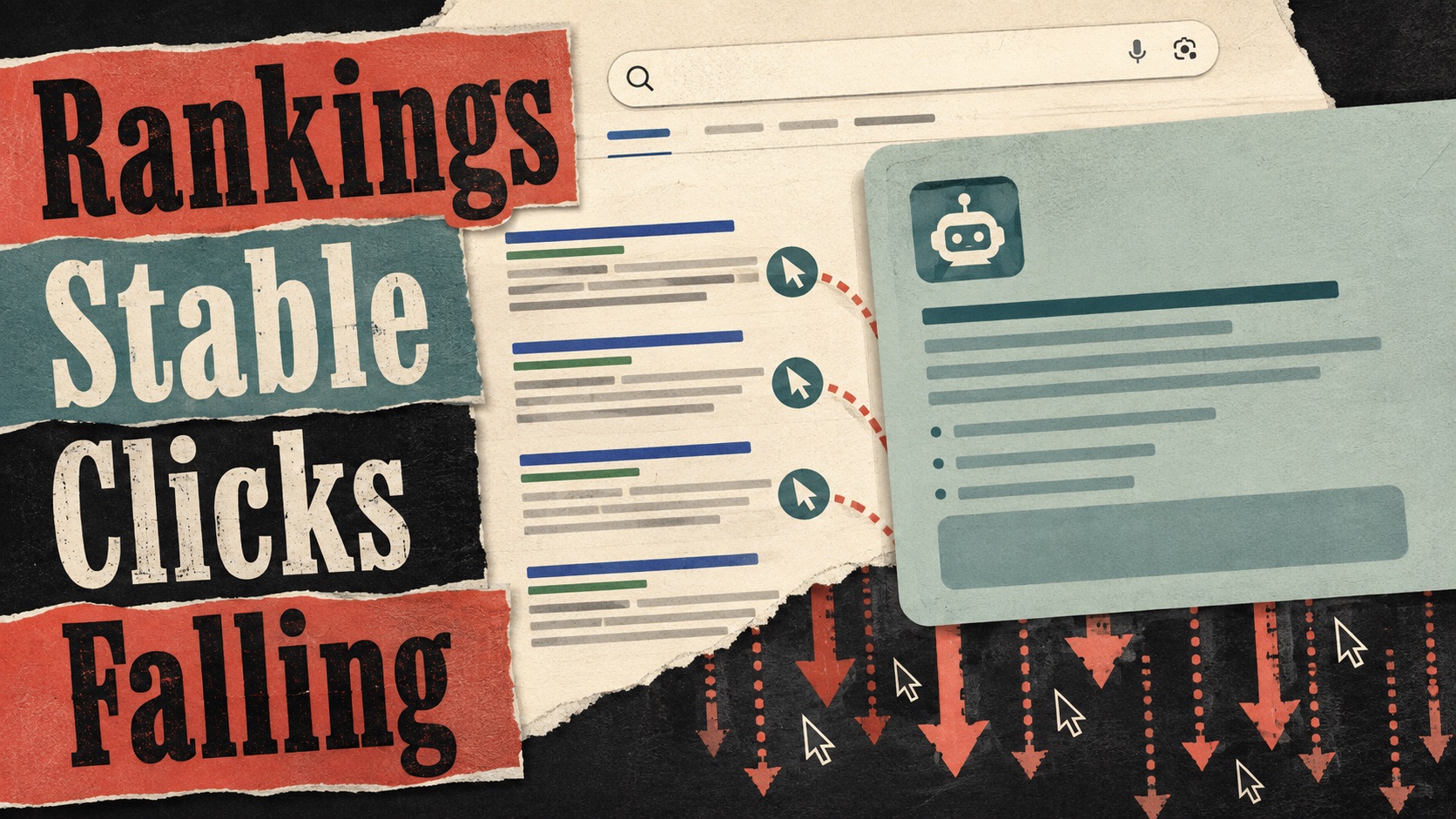
AI Overviews can reduce organic clicks even when rankings and impressions remain stable. That means an SEO report can look healthy at the ranking level while the website quietly loses visits from queries that Google now answers directly on the results page.
The key diagnostic pattern is simple: stable visibility, weaker click through rate, and an AI Overview appearing for the query. Marketers now need to separate ranking loss from click loss because the response to each problem is different.
What does AI Overview click loss look like?
An August 2026 Search Engine Journal analysis describes a useful pattern for diagnosing AI Overview impact. If impressions and average position stay relatively steady while CTR drops after an AI Overview appears, the generated answer is a plausible contributor to the decline.
That pattern does not prove causation on its own. Seasonality, snippet changes, device mix, additional SERP features, and shifts in user intent can also reduce CTR. The value is that marketers now have a stronger hypothesis to test instead of assuming every traffic decline is a ranking problem.
The original analysis explains the approach in more detail in Search Engine Journal's guide to AI Overview click loss.
Why can rankings stay stable while clicks fall?
A ranking measures where a page appears, not whether a user still needs to visit it. AI Overviews can summarize enough information on the search results page that the user finishes the task without clicking any organic result.
This changes the meaning of a stable position. A page can remain visible, preserve impressions, and still contribute fewer sessions because Google has inserted another answer layer between the query and the website.
That is why SEO teams need reporting that looks beyond average position. A broader AI visibility strategy should examine whether the brand remains present in the answer environment even when the traditional click declines.
Ranking loss vs click loss: how to diagnose the traffic drop
| Signal pattern | Likely cause | Response |
|---|---|---|
| Position drops | Ranking problem — the page is genuinely losing visibility | — |
| Stable position and impressions, CTR drops, AI Overview present | AI Overview click loss — the generated answer satisfies the query before the click | Publish original research, tools, proprietary data, and nuanced comparisons that still earn the visit |
| CTR drops without an AI Overview present | Seasonality, snippet changes, device mix, or other SERP features | — |
Which lost clicks actually matter to the business?
Not every lost click has the same commercial value. A visitor looking for a quick definition, formula, or factual answer may have created traffic without creating meaningful demand.
The more important question is whether CTR is falling on queries connected to comparison, pricing, services, products, evaluation, or other high intent research. Losing low intent informational sessions is different from losing clicks that historically contributed to leads or influenced buying decisions.
- Separate high intent queries from broad informational queries.
- Compare changes in CTR with conversion history, not traffic volume alone.
- Look for branded search or direct traffic that may rise after AI exposure.
How should SEO reporting change?
SEO reporting should distinguish visibility, traffic, and business outcomes. Rankings still matter, but they no longer explain the entire search experience.
A useful report should track impressions, average position, CTR, conversions, branded demand, and the presence of AI generated search features. Google has also introduced reporting for generative AI features in Search Console, giving site owners more visibility into how their pages appear in AI driven search experiences through its generative AI performance reporting documentation.
Teams that are still measuring success mainly through sessions should update the model. Mustard Seed's broader marketing advisory approach focuses measurement on visibility that contributes to demand, not traffic for its own sake.
What content is more defensible in an AI Overview world?
Content is more defensible when the user still needs the source after receiving a summary. Original research, firsthand experience, tools, templates, proprietary data, nuanced comparisons, expert analysis, and strong commercial guidance can give people a reason to click beyond the generated answer.
Generic explanatory content is more exposed because an AI Overview can often satisfy the basic informational need directly. That does not make educational content useless, but it raises the standard for what the page must add beyond a concise answer.
The strategic goal is to publish material that can earn visibility inside AI answers while also offering enough depth, utility, or evidence to justify the visit.