
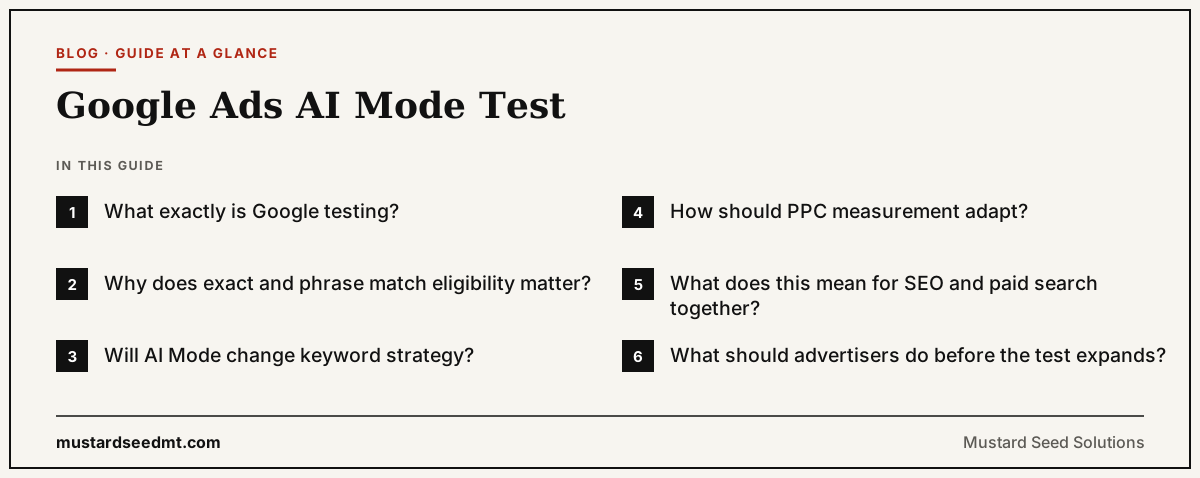
Google has confirmed a small experiment that allows regular Search campaigns using exact and phrase match keywords to serve text ads in AI Mode when user intent is explicit and direct. Until now, AI Mode advertising has been more closely associated with automated campaign types and broader intent matching.
The experiment matters because it brings familiar Search campaign logic into a conversational search environment. PPC teams should prepare for AI Mode to become another place where traditional keyword intent and AI interpreted intent overlap.
What exactly is Google testing?
Search Engine Roundtable reported on September 4, 2026 that Google's Ads Liaison confirmed a small experiment involving regular Search campaigns in AI Mode. Exact and phrase match keywords can be eligible to serve text ads when Google detects explicit and direct user intent.
The same report says AI Max and Performance Max for Search remain designed to capture more complex conversational intent and newer ad formats.
Read the Search Engine Roundtable report.
Why does exact and phrase match eligibility matter?
Exact and phrase match give advertisers a more familiar way to connect known search intent with ads. If those campaigns can appear in AI Mode, advertisers may not need to rely entirely on broader automated campaign types to reach some conversational search users.
The experiment also suggests Google sees continuity between classic keyword search and AI Mode. A conversational interface does not eliminate explicit commercial intent.
For advertisers, that could make campaign architecture more flexible while also creating new questions about where an impression occurred and how the user reached the ad.
Will AI Mode change keyword strategy?
Probably, but the test does not justify abandoning current keyword strategy. Exact and phrase match remain useful when the user expresses a clear need, while conversational AI queries can contain more context than traditional short queries.
Teams should start thinking in two layers:
- Explicit intent that maps cleanly to known keywords
- Complex intent that depends on context, constraints and conversation
Landing pages should satisfy both. The ad may be triggered by a known keyword, but the user may arrive after a much richer AI interaction.
How should PPC measurement adapt?
Advertisers need to know whether AI Mode traffic behaves differently from traditional Search. Useful questions include conversion rate, lead quality, assisted conversion, query complexity and landing page engagement.
Do not assume an AI Mode impression has the same meaning as a standard search impression. The user may have already seen recommendations, comparisons or explanations before clicking.
This creates a stronger need to connect paid media measurement with the full website and demand system. Mustard Seed advisory focuses on that relationship rather than treating ad platforms as isolated channels.
What does this mean for SEO and paid search together?
AI Mode makes the boundary between paid and organic visibility less clean. A buyer can encounter an AI generated answer, organic sources and an ad within one conversational experience.
That makes message consistency more important. If the ad promises one thing, the landing page says another and AI sources describe the company differently, the buyer receives a fragmented story.
SEO, GEO and PPC teams should share buyer questions, positioning and evidence. The channels can use different tactics while reinforcing the same company definition.
What should advertisers do before the test expands?
Keep the response measured.
- Review exact and phrase match campaigns with strong commercial intent
- Check whether landing pages answer deeper buyer questions
- Define AI Mode traffic reporting requirements
- Compare paid messages with organic AI descriptions
- Keep conversion tracking clean
- Avoid expanding budget solely because a new placement exists
The opportunity becomes valuable when the placement reaches qualified users and produces business outcomes, not simply because it is new.