
In the marketing ads open between October 2022 and March 2023, 4% named AI in their requirements section. In the ads open this autumn, 46% do [ai-era-it-jobs, 2026]. I counted only the text between a "Requirements" or "What you'll bring" heading and the next heading, so a company describing its own AI product does not count. AI now sits in the part of the ad that decides who gets an interview. Indeed's US data put marketing ahead of every other non-technical occupation on AI mentions, and it got there while European marketing openings fell to between half and two-thirds of their 2020 level.
From the company blurb to the requirements section
I compared company job pages from two windows: October 2022 to March 2023, before most teams had touched ChatGPT, and May to October 2026. That gave 1,202 marketing pages from the first window and 2,762 from the second, all from Greenhouse, Lever and Ashby boards, with at most 20 per company. Any mention of AI rose from 12.5% to 66.5% of marketing pages, which overstates the requirement because many of these employers sell AI. The requirements-only count is stricter: 4.0% to 45.8% [ai-era-it-jobs, 2026]. That puts marketing level with IT administration (46%) and close to software development (51%), and well ahead of sales (33%).
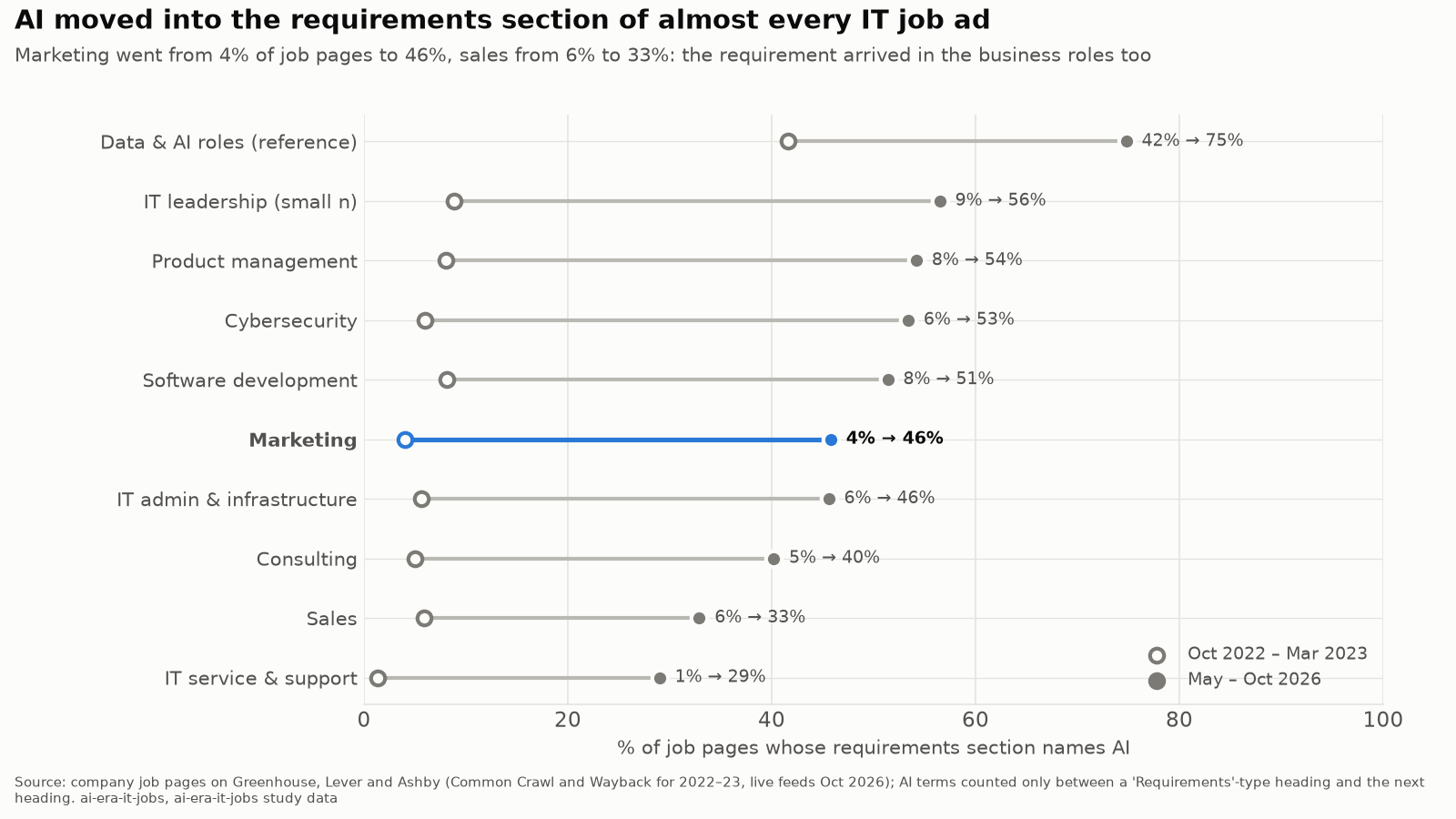
I trust the number because it survives three cuts of the data. Among companies that advertised in both periods, the share went from 3.1% to 41.4%. In US ads it went from 3.6% to 48.5%, in European ads from 5.7% to 42.6%. Outside counts agree on the direction. Indeed found AI in 8.4% of US marketing postings in January 2025 and 14.9% in December, the highest of any non-technical occupation it tracks [Indeed Hiring Lab, 2026]; in Germany the figure was 15.6% by November 2025 [Indeed Hiring Lab DE, 2025]. CXL reports that the share of US marketing job descriptions requiring AI went from 15% in the first quarter of 2026 to 28% in the second and 40% in the third [CXL, 2026].
Employers rarely ask for a product. In Ryan Doser's 1,229 US posts, 38.7% asked for AI skills, and 84% of those named no tool [Doser, 2026]. MKT1 found that 15% of 791 B2B start-up posts ask the hire to build AI workflows or agents [MKT1, 2026]. Some employers have put it in the job title. Postings I reviewed this month include "AI-native Growth Marketing Associate" at Sting in Stockholm, "AI-Native Growth Marketer" at Aurora Live in Helsinki, "Staff AI Native Growth Marketer" at Intuit in London, and "Marketing Operations & AI Lead" at Comarch in Kraków and Warsaw [public job postings, Oct 2026]. Such titles are still rare. In my whole autumn sample of European postings, only 11 titles carry "AI-native" or "AI-first" [ai-era-it-jobs European sample, 2026]. My guess is the label fades once everyone assumes the skill.
Fewer marketing jobs, and Europe took the bigger hit
The volume numbers are worse. Indeed's marketing postings index (February 2020 = 100) stood at 158 in Germany, 136 in the UK, 133 in France and 131 in the US in October 2022. By September 2026 it was 63, 48, 56 and 76 [Indeed via FRED, 2026]. The US line has been flat since 2024; the European ones kept falling.
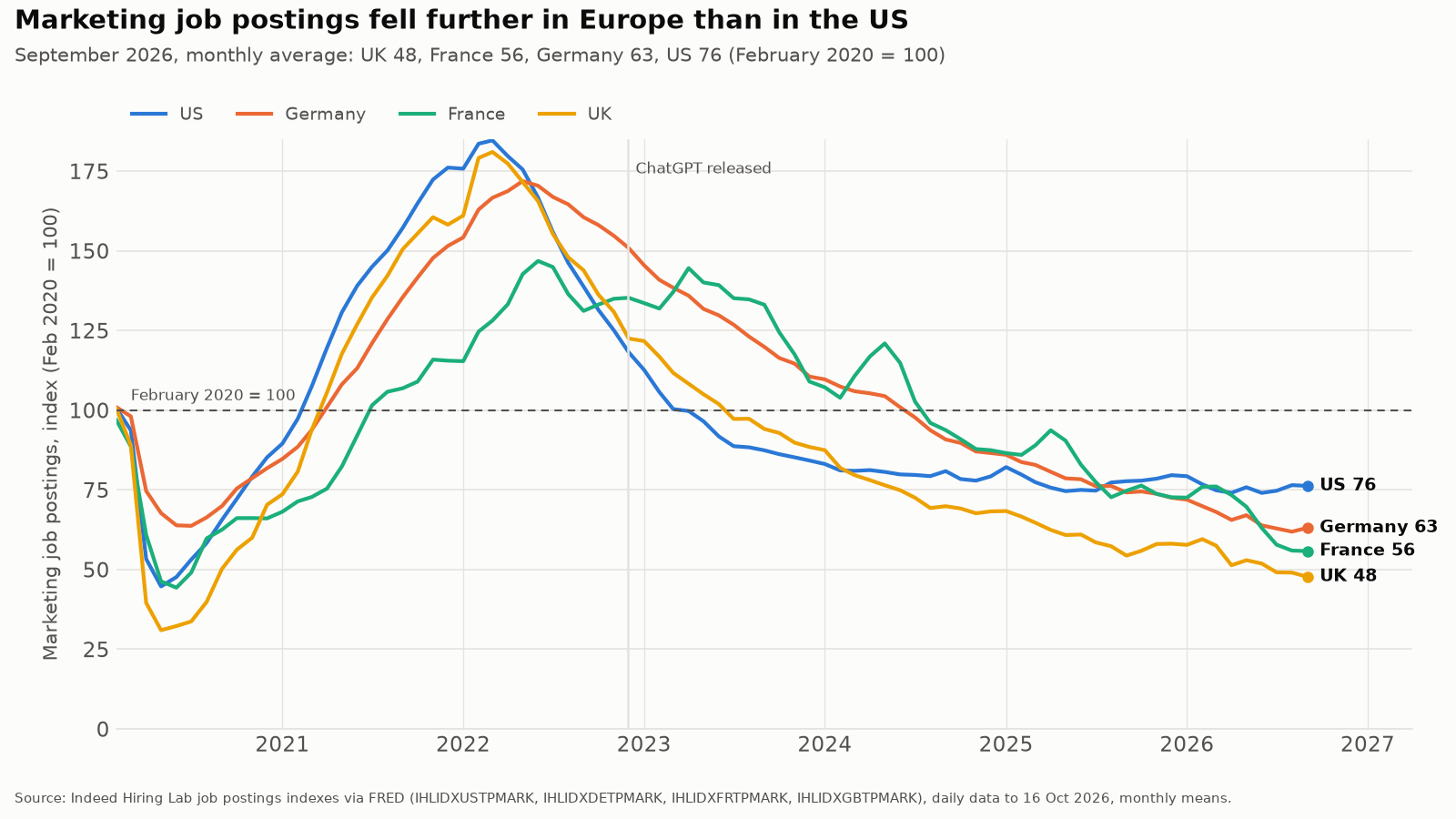
The German trade press counts the same slide: W&V and index Research found 111,731 marketing job offers in Q3 2024 and 69,778 in Q3 2026 [W&V, 2026]. Sales held up better, with Germany's sales index at 91 and the US at 93.
Openings and jobs are different things. US employment of marketing managers rose from 328,570 in May 2022 to 395,240 in May 2025, up 20.3% [BLS OEWS, 2025]. The function kept its people and hired fewer new ones, which is little comfort if you are looking for a marketing job in Europe right now.
In Poland the requirement has not arrived in volume yet. Only 5 of the 18 Polish marketing descriptions in my autumn sample mention AI, a small sample [ai-era-it-jobs European sample, 2026]. Across the 96 Poland-located postings for business roles in the 2026 data, English appears in 68.8% and Polish in 38.5% [ai-era-it-jobs, 2026]. Comarch's Marketing Operations & AI Lead is, so far, the exception.
What fell out of the ad, and what replaced it
I also counted about 375 non-AI terms in the same pages, with every AI word blanked out first. The changes below hold inside the same companies, and the ranking corrects for 2026 ads being longer.
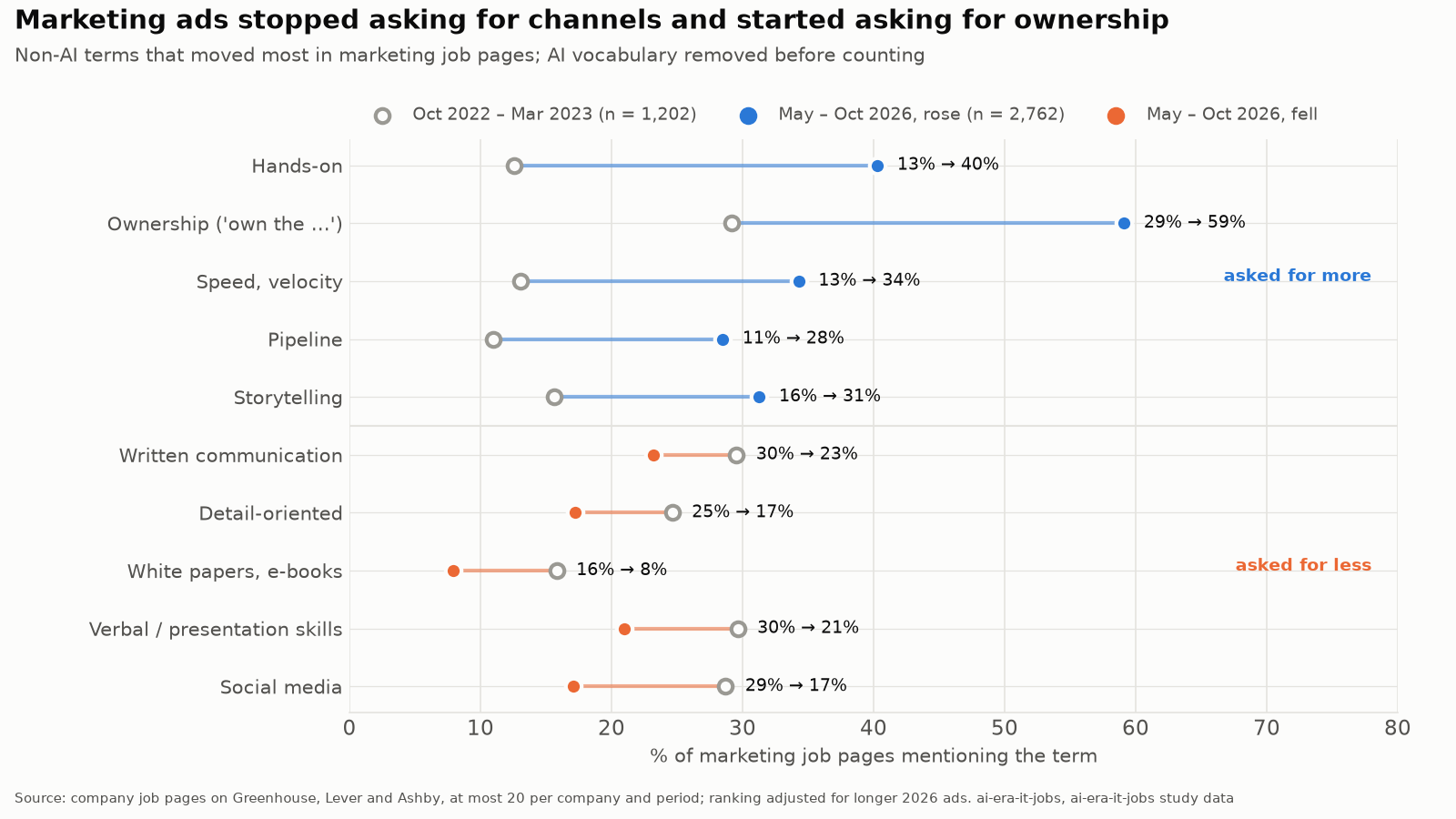
Channel and asset words fell. Social media went from 28.7% of marketing ads to 17.1%, white papers and e-books from 15.8% to 7.9%, written communication from 29.5% to 23.2%. Accountability words took their place: "hands-on" rose from 12.6% to 40.3%, ownership ("own the …") from 29.2% to 59.1%, speed from 13.1% to 34.3%, pipeline from 11.0% to 28.5%, and storytelling from 15.6% to 31.3% [ai-era-it-jobs, 2026].
Two things surprised me. The named tools barely moved: ads naming any marketing tool went from 26.4% to 29.4%, and MKT1 found that 59% of start-up marketing posts name no specific tool at all [MKT1, 2026]. And on social media the ads disagree with the surveys. HubSpot's marketers still rank social as their top channel, used by 43% [HubSpot, 2024]. My reading is that tech companies now buy social from specialists or agencies and want their in-house marketer to own pipeline, though the data cannot prove that.
The SDR was declared dead, then re-hired
Sales went through the same shift with more noise. In the requirements section, AI went from 5.9% to 32.9% of sales pages [ai-era-it-jobs, 2026]. In 2024 vendors sold AI SDRs as a replacement for the junior outbound team, and in a SaaStr poll that year 83% of respondents said they had not got AI SDRs to work [SaaStr, 2024]. In Emergence Capital's April 2025 survey, 36% of B2B software companies had cut SDR headcount over the previous year [SaaStr / Emergence, 2025]. By early 2026, SDR job posts at US digital natives were down 21% year on year, yet the AI-native companies building these tools had more than doubled their own SDR headcount [Growth Unhinged, 2026].
The job ads show where the work went. "Outbound" rose from 14.0% to 22.2% of sales pages and "pipeline" from 35.0% to 49.6%, while cold calling stayed at about 7% to 8% [ai-era-it-jobs, 2026]. Prospecting moved into the account executive's job, and some of the budget went to a new title: my European autumn sample holds 76 GTM, growth or marketing engineer titles, 22 of them in Germany, 14 in the UK and 9 in Poland [ai-era-it-jobs European sample, 2026].
What this means if you are a marketer
- Bring one campaign where AI changed the numbers. Ads rarely name a product, so a list of tool logos says little; show the cycle time or the number of variants tested before and after.
- Lead your CV with the pipeline your work sourced. "Pipeline" went from 11% to 29% of marketing ads while white papers fell from 16% to 8%, so the assets you produced matter less than the revenue they led to.
- In Europe, keep a second language on the CV next to English. Among Europe-located postings for the business roles I measured, those asking for fluency in a named language rose from 23.2% to 34.6%, and with fewer openings than in 2020, German, French or Polish still filters candidates.
This post is part of the AI-era IT jobs series. For the wider IT market, start with the series opener on mrplanb.com: The IT job market 2022→2026: openings collapsed, jobs mostly didn't.
Sources
- ai-era-it-jobs, skills-shift study of business roles: Greenhouse, Lever and Ashby job pages from Common Crawl and the Wayback Machine (Oct 2022 to Mar 2023) and live feeds (May to Oct 2026), 21 Oct 2026.
- ai-era-it-jobs European sample: sales and marketing postings in Europe, Sep to Oct 2026.
- Indeed Hiring Lab via FRED, marketing and sales job postings indexes IHLIDXDETPMARK, IHLIDXGBTPMARK, IHLIDXFRTPMARK, IHLIDXUSTPMARK, IHLIDXDETPSALE, IHLIDXUSTPSALE, data to 16 Oct 2026. fred.stlouisfed.org
- Indeed Hiring Lab, "January labor market update: jobs mentioning AI are growing amid broader hiring weakness", 22 Jan 2026.
- Indeed Hiring Lab Germany, "Indeed Jobs & Hiring Trends Report Deutschland 2026", 11 Dec 2025.
- CXL, "40% of marketing jobs now require AI: Q3 2026 hiring data", 9 Oct 2026.
- Ryan Doser, "AI Marketing Jobs: What 1,229 Job Posts Actually Ask For", 7 Oct 2026.
- Emily Kramer, MKT1, "I analyzed 1,100+ marketing job posts. They're stuck in 2023.", 19 Oct 2026.
- W&V / index Research, "Marketingstellen werden seltener und KI-Kenntnisse gewinnen an Bedeutung", 19 Oct 2026.
- BLS, Occupational Employment and Wage Statistics, Marketing Managers (11-2021), May 2022 and May 2025. bls.gov
- HubSpot, "The 2024 State of Marketing & Trends Report: Data from 1400+ Global Marketers", 9 Jan 2024 (archived copy).
- SaaStr, "83 percent of you haven't gotten AI SDRs to work yet", c. Nov 2024 (LinkedIn poll).
- SaaStr, "The Great SDR Downsizing: 36% of B2B Companies Cut Sales Development Teams in 2025", citing Emergence Capital (survey of 560+ B2B software companies, April 2025), c. Jun 2025.
- Kyle Poyar, Growth Unhinged, "Who's actually hiring in GTM right now?", 20 May 2026 (Sumble data).
- Public job postings, October 2026: Sting, "AI-native Growth Marketing Associate"; Aurora Live, "AI-Native Growth Marketer"; Intuit, "Staff AI Native Growth Marketer – Customer Journey Growth"; Comarch, "Marketing Operations & AI Lead".