
A Ten Speed study reported by Search Engine Journal found product pages generated 24.1% of citations across a B2B AI search dataset, the largest single content category in the study. Reddit, YouTube, forums and discussion threads combined accounted for 4.2%.
The finding does not mean community platforms are irrelevant. It means B2B brands should stop treating their own product pages as static sales collateral and start treating them as important AI retrieval surfaces.
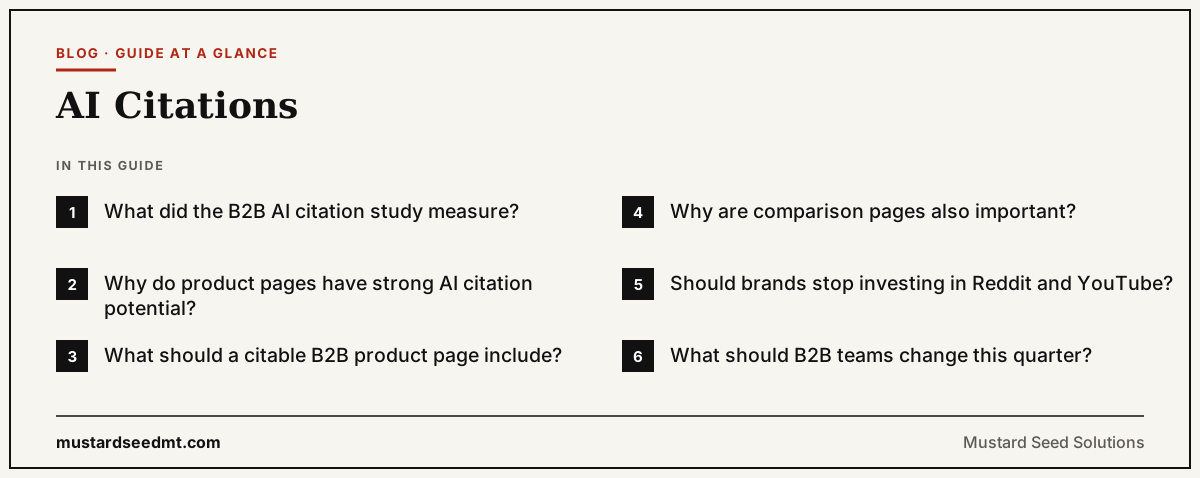
What did the B2B AI citation study measure?
Search Engine Journal reported that Ten Speed used citation data from Peec AI across ChatGPT, Perplexity, Claude and Gemini. Ten Speed created 170 prompts designed to resemble later stage B2B buyer questions and recorded 7,387 citation appearances.
Product pages led with 24.1% of citations. Articles accounted for 17.4%, comparison pages and listicles each landed around 13%, and brand controlled content accounted for 88.3% of citations in the dataset.
The study had limitations, including an undisclosed number of client brands, so the percentages should not be treated as universal benchmarks. The methodology still provides a useful signal about what content AI systems may retrieve during B2B evaluation. Read the Search Engine Journal analysis.
Why do product pages have strong AI citation potential?
A strong product page contains exactly the information a buyer asks for when evaluating a vendor: what the product does, who it is for, how it works, what makes it different and how it compares with alternatives.
When those answers are explicit, an AI system has concrete material to retrieve. When they are hidden behind vague brand language, tabs, images or unsupported claims, the page becomes harder to use as evidence.
This gives product marketing and GEO a shared job: make the product understandable in precise language.
What should a citable B2B product page include?
The goal is not to stuff a page with keywords. The goal is to remove ambiguity.
- A direct description of the product
- The target customer and use cases
- Important capabilities
- Clear limitations or scope
- Differentiation that can be verified
- Integration or implementation information where relevant
- Evidence such as customer examples, documentation or research
- Links to deeper technical material
For service businesses, the same logic applies to commercial service pages. A strong AI visibility service page should answer what the service evaluates, who it is for and what the buyer receives.
Why are comparison pages also important?
The study found comparison content performed strongly relative to its share of prompts. That makes sense because later stage buyers frequently ask AI systems to compare named vendors, products or approaches.
Brands should create comparison content when they can make the comparison useful and fair. Thin pages written only to claim superiority are weak evidence.
A good comparison explains criteria, tradeoffs, ideal use cases and situations where another option may be a better fit. That credibility makes the page more useful to buyers and more defensible as a source.
Should brands stop investing in Reddit and YouTube?
No. Community content can influence awareness, reputation and early stage research even when it is not the dominant citation source in one B2B dataset.
The strategic mistake is assuming community mentions can compensate for weak owned content. If your product page cannot explain the product clearly, an AI system may retrieve someone else's description instead.
Owned pages, third party authority and community evidence work best together. The mix should follow buyer behavior rather than whichever GEO tactic is currently fashionable.
What should B2B teams change this quarter?
Audit the top product and service pages using real buyer questions. Ask whether a person or AI system can extract a clean answer to each question without guessing.
Then strengthen the pages that matter commercially before producing more generic top of funnel content. Improve definitions, comparisons, proof, internal links and technical access.
This is a good use case for an AI Visibility Audit, because citation readiness is partly a content problem and partly an entity, authority and access problem.