
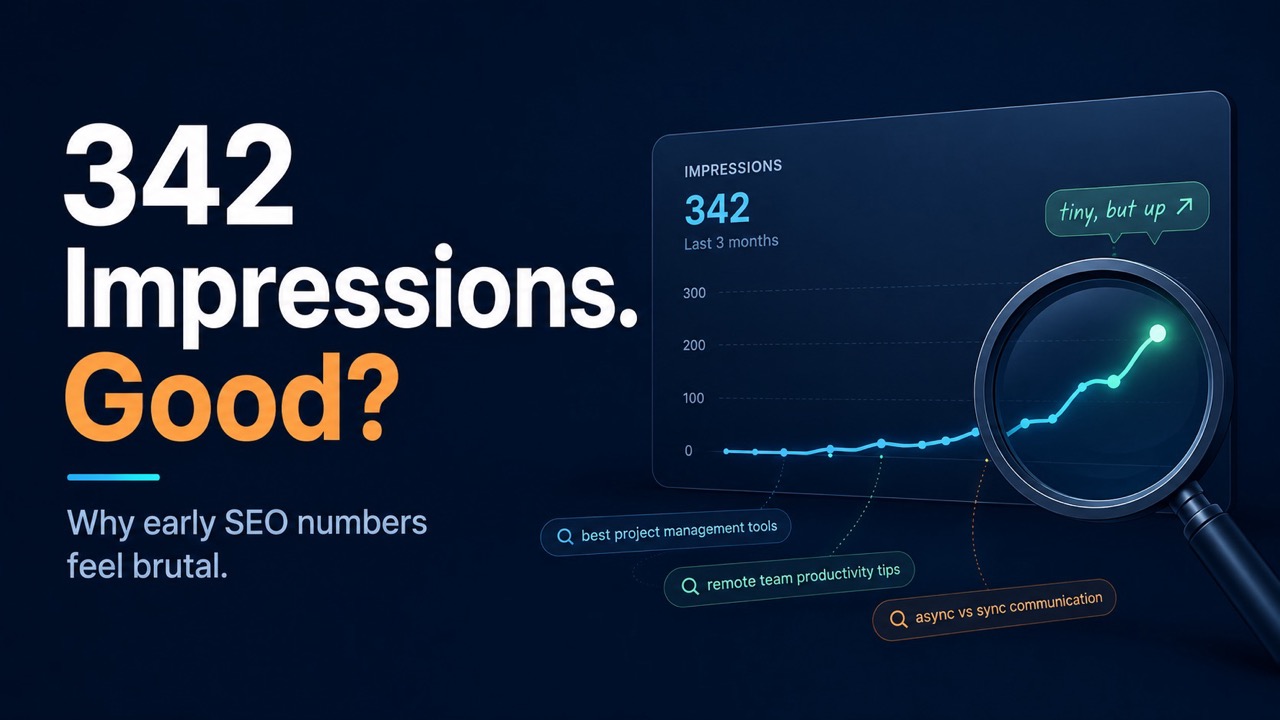
A Reddit Google Search Console numbers discussion asked a painfully simple question: are roughly 342 impressions after three months a good start for a new website with only four blog posts? The strongest takeaway was that the number alone cannot answer the question. Some commenters saw early visibility and an upward trend, others called the performance weak, and several argued that four posts were too little evidence to judge anything.
The site owner was a full stack developer learning SEO to promote personal projects organically. The website mixed software development and SEO content, and the broader plan included future SaaS products. The questions were practical: how to increase impressions, get more clicks, build topical authority, and decide whether to focus on development, SEO, or both.
The replies exposed why early SEO feels so brutal. Small numbers invite huge emotional conclusions, even when the data is too fragile to support them.
Are 342 impressions in 3 months good for a new website?
They can be encouraging, disappointing, or nearly meaningless depending on context. That was the clearest lesson from the Reddit SEO beginner discussion.
The harshest replies said no. One commenter called the result low for large topics such as software development and SEO. Another argued that the site should already have far more impressions if the setup and keyword targeting were strong.
The optimistic camp saw the same situation differently. A three-month-old site with only four posts was at least being discovered by Google. Several commenters focused on the upward trend rather than the absolute total. One described the early data as a signal and argued that the metrics would change as impressions scaled.
That disagreement is not surprising. A portfolio site cannot be compared directly with a tools site, a local business, or a focused niche publisher. Search demand, competition, indexing, backlinks, internal structure, page quality, and domain history all affect what “good” looks like.
The number is therefore not useless. It simply needs context.
A better first question is not “Is 342 good?” It is “What produced the 342 impressions, and is that pattern becoming stronger?”
Why are early SEO metrics so easy to misread?
Early SEO metrics are easy to misread because small samples are unstable. One query, one page, or a handful of clicks can completely change the apparent trend.
The discussion included a joking but painful suggestion that some clicks might be the owner visiting the site. The thread did not prove that this happened, but the comment exposed a real anxiety. When traffic is tiny, every click feels important.
Small datasets are also vulnerable to temporary rankings. A page can receive a burst of impressions from a query where it briefly appears, then disappear. A few clicks can create a CTR that looks impressive until the impression count grows.
This is why several commenters warned against obsessing over the dashboard. Search Console is useful, but early totals should be treated as clues rather than verdicts.
A better analysis looks at:
- Queries that are repeatedly generating impressions.
- Pages that are carrying most of the visibility.
- Position trends over time.
- Whether impressions are growing for relevant topics.
- Whether clicks come from useful search intent.
- Whether visibility connects to the creator's actual goals.
That kind of analysis turns early data into a hypothesis.
The total number alone mostly creates emotion.
Why did four blog posts become the biggest issue?
Four blog posts became the biggest issue because several commenters saw the site as too thin to build meaningful topic depth. Even people who were optimistic about the early trend still argued that the content base needed to expand.
One participant said blogs alone would not do the job without stronger internal linking and authority. Another recommended more pages targeting the main keywords connected to the creator's work. Several emphasized quality content, internal links, and backlinks over time.
The strongest recommendation was to go deeper on one topic.
That advice makes sense from an SEO perspective. Software development is enormous. SEO is enormous. Four posts split across both subjects cannot create much depth.
Yet the creator's real situation was more complicated. The site was also a portfolio. Future plans included SaaS products, an SEO-related project, an EdTech project, and eventually multiple tools under the same website.
This creates a tension many independent operators face. A narrow site can be easier to position in search, but a personal brand or product studio may genuinely cover several areas.
The right answer may therefore be focus without pretending the business has only one interest.
Should a developer focus on development, SEO, or one connected niche?
A developer should focus the site around a coherent business story rather than publishing random content across several broad categories. The Reddit discussion leaned heavily toward choosing one niche and building a focused cluster, but the creator's plans suggest another possibility: connect the topics through the work itself.
A developer building and promoting software products can create content around the intersection of product building, technical implementation, technical SEO, distribution, and SaaS growth. That specific positioning was not a direct consensus from the thread, so it should be treated as an inference rather than a quoted recommendation.
The advantage is coherence.
Instead of writing one generic coding article, one generic SEO article, and one unrelated product post, the site can build around recurring problems:
- Building a SaaS feature and documenting the architecture.
- Explaining technical SEO decisions made inside the product.
- Showing how a tool was launched and discovered.
- Documenting indexing problems and fixes.
- Writing tutorials connected to real product use cases.
- Comparing implementation choices with business outcomes.
This creates a stronger relationship between expertise and evidence.
It also gives internal linking a natural purpose because pages support one another.
What did “act like a brand, not just a dev with a blog” really mean?
It meant the creator should build a visible body of work around real projects instead of treating the blog as a side folder of isolated articles. This was one of the sharpest recommendations in the discussion.
The commenter suggested writing about software already created, adding useful articles, videos, images, internal links, calls to action, and broader distribution. The exact format matters less than the operating mindset.
A developer has a major advantage over a generic content site: real projects generate real material.
That can include architecture decisions, debugging failures, performance issues, API tradeoffs, deployment lessons, search experiments, product analytics, launch mistakes, and technical problems solved during development.
This kind of content can build trust because it comes from work that exists.
It also supports a stronger site structure. Product pages can link to tutorials. Tutorials can link to technical explanations. Technical explanations can link to related case studies. The result is a connected body of content rather than four isolated posts.
Mustard Seed's solo business marketing work often starts from the same place. A one-person business should turn real expertise and real projects into a coherent marketing system.
How should a new site use Google Search Console impressions?
A new site should use Google Search Console impressions to identify emerging relevance, not to declare success or failure. The most practical comments advised checking which queries were already generating impressions and then expanding around those topics.
This is a strong early-stage workflow because Google is already providing clues about how it interprets the pages.
A creator can look for:
- Queries with repeated impressions but weak positions.
- Queries that match commercial or strategic goals.
- Pages receiving visibility across several related terms.
- Topics where one article is already close to earning more clicks.
- Queries that reveal missing supporting content.
From there, the next steps may include stronger internal links, clearer page titles, better content depth, new supporting articles, or improved alignment with search intent.
This is more useful than comparing the total impression count with someone else's site.
A different site may have completely different search demand, competition, and structure.
The better benchmark is the site's own pattern.
Should a new website focus on impressions before clicks?
Often, yes, because clicks are hard to scale before the site has enough visibility. Several participants argued that the creator should focus on growing impressions first.
That does not mean CTR is irrelevant. Titles, page relevance, and search intent still matter. But a site with a tiny impression base can spend too much time optimizing a metric that is not yet stable.
A practical sequence is:
- Increase relevant visibility.
- Identify queries that repeatedly surface the site.
- Improve pages already close to better positions.
- Strengthen titles and snippets where impressions exist.
- Expand topic depth around proven relevance.
This keeps the work grounded in actual search behavior.
The key word is relevant. A large number of impressions for unrelated queries can make the chart look better without helping the business.
What should the developer do next?
The strongest next move is to stop treating 342 impressions as a final score and build enough evidence for a real pattern to emerge. The discussion repeatedly pointed toward more content, better internal linking, clearer topic focus, query analysis, and content connected to real projects.
A practical next phase could include:
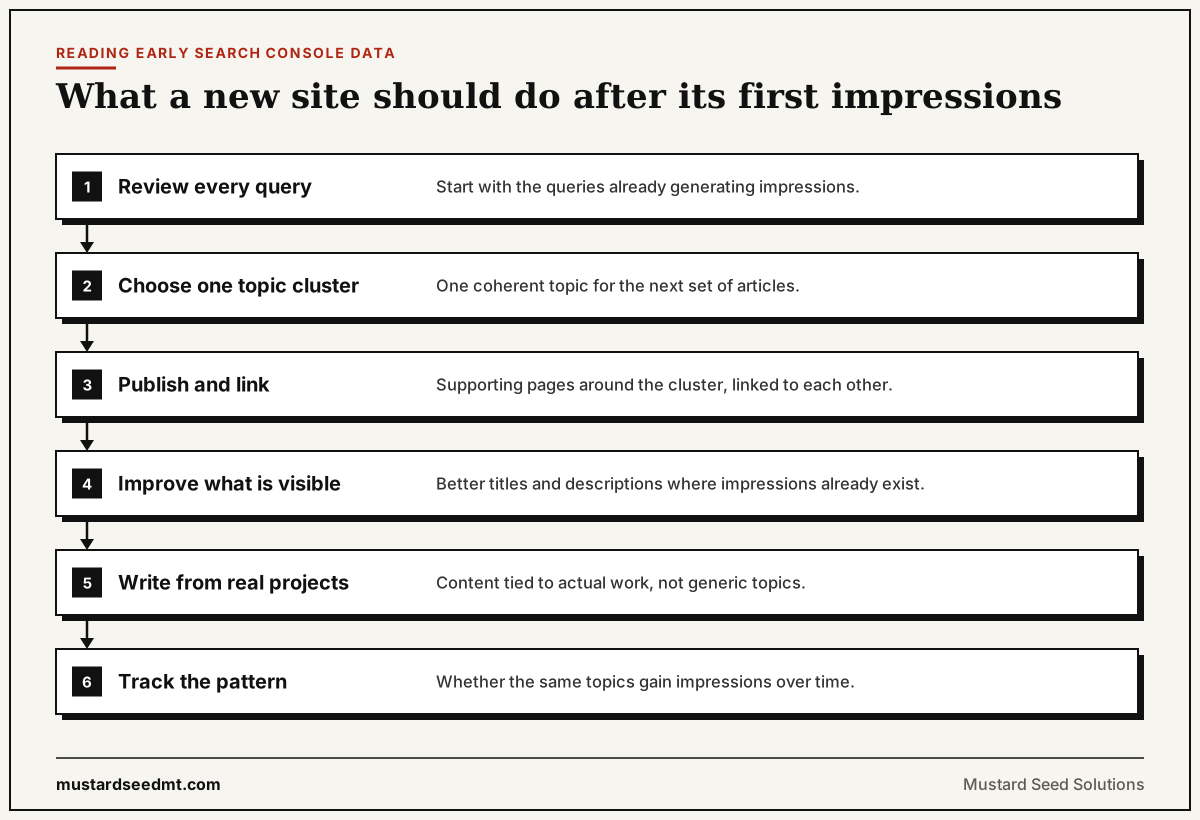
- Review every query already generating impressions.
- Choose one coherent topic cluster for the next set of articles.
- Publish supporting pages around that cluster.
- Add internal links between related pages.
- Improve titles and descriptions where visibility already exists.
- Create content around real software projects.
- Track whether the same topics gain impressions over time.
The developer should also connect the site to a broader business objective. Is the goal to get freelance leads, promote SaaS products, build a personal brand, or become known for technical SEO? The answer should influence the content plan.
Without that clarity, the site can accumulate traffic that does not lead anywhere.
Mustard Seed's marketing approach starts with the same question: what business outcome should organic visibility support?
Why is the emotional reaction to early Search Console data often misleading?
The emotional reaction is misleading because the dashboard looks more authoritative than the sample deserves. A graph with exact numbers creates the feeling that success can already be judged.
But the discussion itself showed how unstable the interpretation was. Some commenters saw failure. Others saw a positive foundation. Another person compared the results with a different site that reached 400 impressions in 20 days. Someone else felt the numbers were fantastic compared with their own clicks.
These comparisons are not controlled experiments.
The better response is to separate signal from story. The signal is that Google is showing the pages for some queries. The story is whatever the owner decides that means about talent, potential, or failure.
Early SEO becomes less brutal when the creator stops asking the dashboard for a final verdict.
The dashboard cannot give one yet.