
Job posts for sales and business development representatives at US digital-native companies fell 21% year on year in the first quarter of 2026. The same data shows the AI-native companies, the ones building and selling the tools that were supposed to replace SDRs, more than doubled their own SDR headcount over the same year and posted 50% more SDR roles as a share of their sales hiring than other digital natives [Growth Unhinged with Sumble data, 2026]. The SDR was declared dead by vendors in 2024. In 2026 the vendors were hiring SDRs. This post looks at what the hiring data shows for sales development, in Europe and the US, and what changed in the job.
Sales held up better than marketing
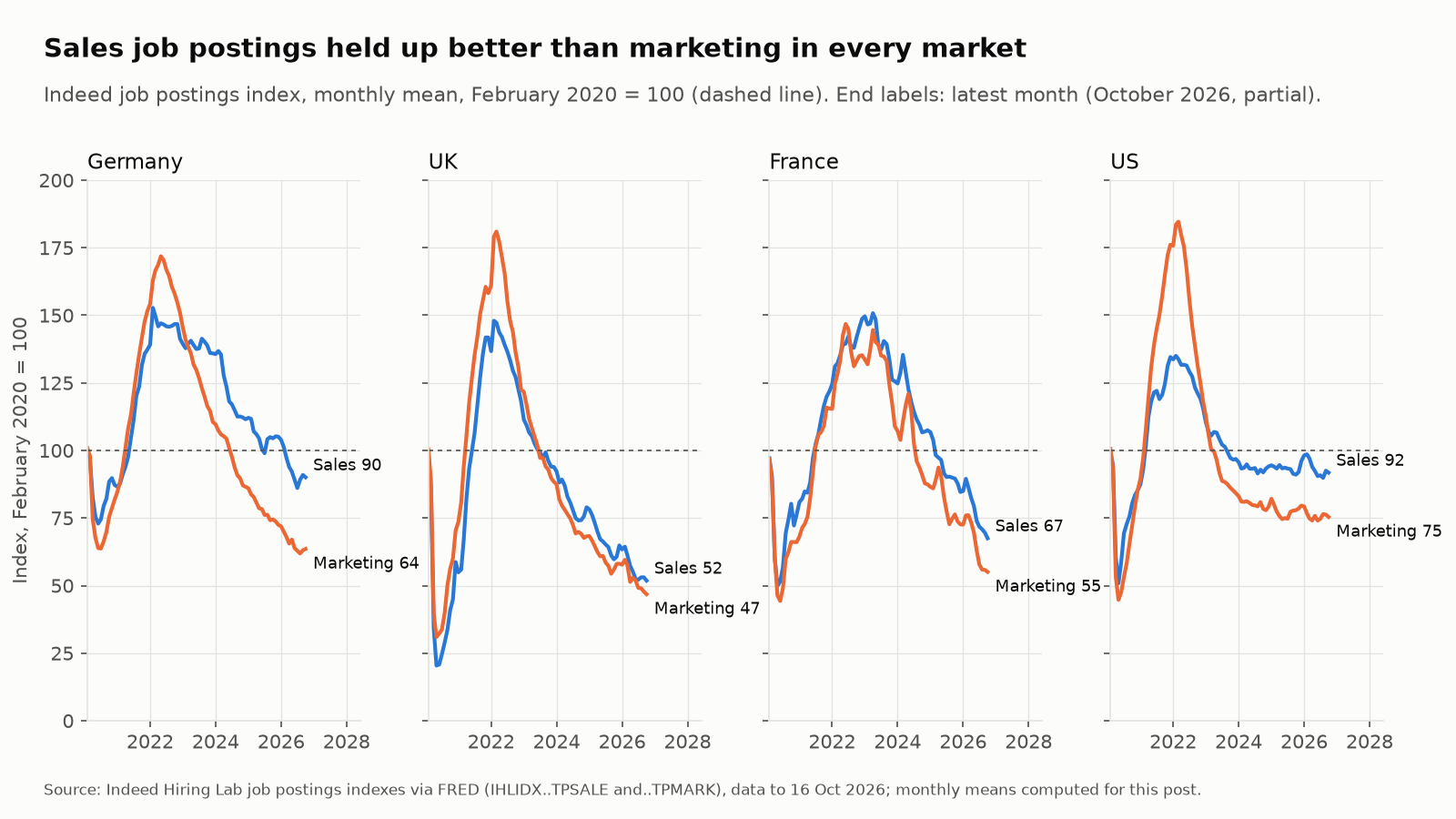
In September 2026 Indeed's index of sales job postings stood at 91 in Germany and 93 in the US (February 2020 = 100). Marketing was at 63 and 76. The UK was weaker on both, sales at 53 and marketing at 48, and France sat at 70 and 56 [Indeed Hiring Lab via FRED, 2026]. Sales postings fell in every market from their 2022 and 2023 peaks, and in every market they fell less than marketing.
US employment data tells the same story with a split inside it. Sales managers grew from 536,390 to 637,080 between May 2022 and May 2025, up 19%. Technical sales representatives slipped from 290,830 to 284,800, down 2% [BLS OEWS, 2025]. After 10.1% inflation, sales managers' median pay rose 3.1% in real terms and technical reps' fell 2.4%.
The claims came first
The "AI SDR" story has a clear start date. In September 2023 Gartner forecast that 60% of B2B seller work would run through conversational AI interfaces by 2028, from under 5% in 2023 [Gartner, 2023]. The phrase "AI SDR" first appears on Hacker News in October 2023 [Hacker News via Algolia, 2026]. Salesforce made Agentforce and its SDR agent generally available on 30 October 2024 [Salesforce, 2024]. In December 2024 Artisan put up billboards in San Francisco telling companies to "Stop Hiring Humans" [PetaPixel, 2024], while saying on its own site that it was "actively hiring across all roles" [Artisan, 2024].
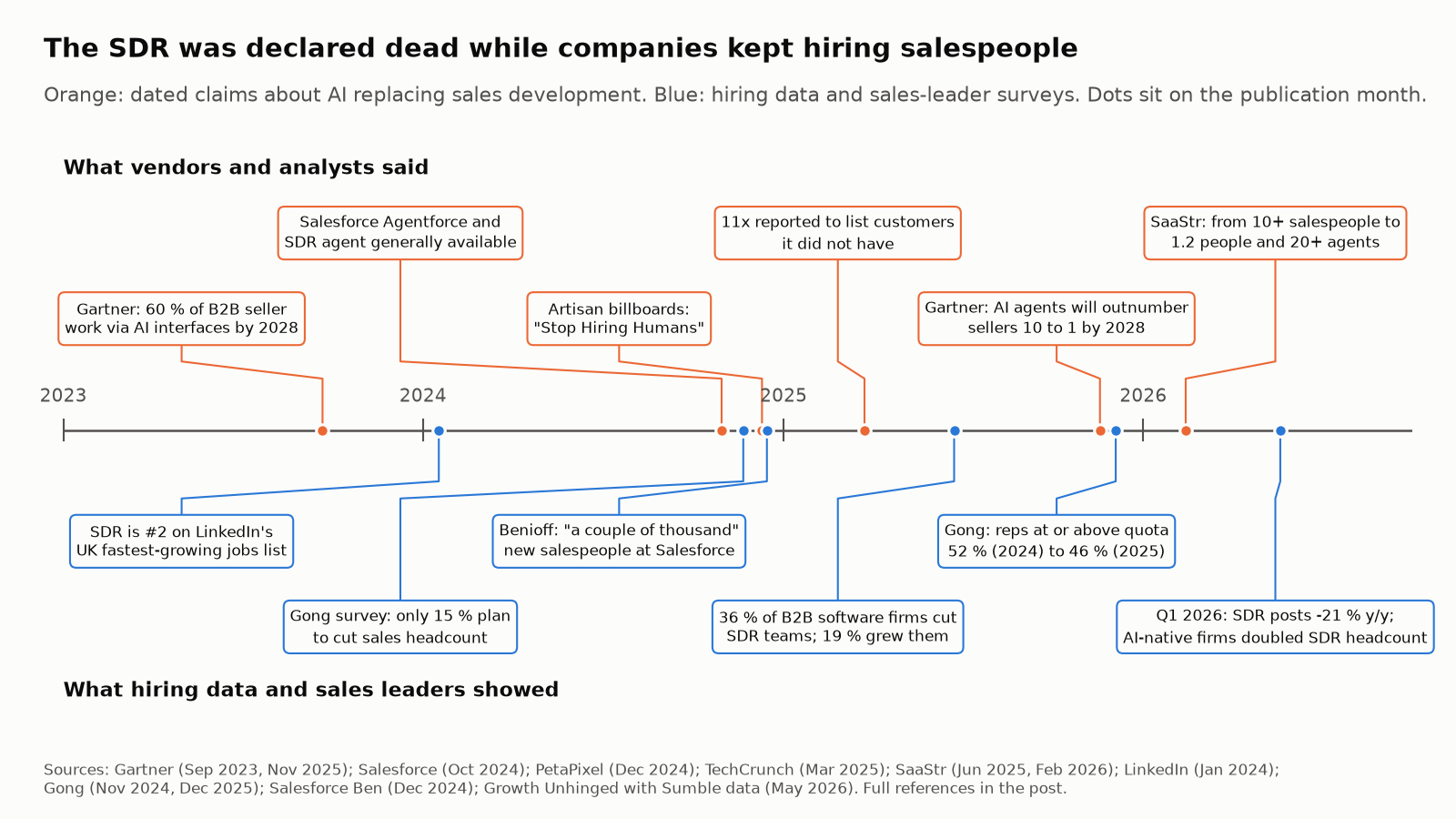
The results did not match the billboards. In a SaaStr poll in November 2024, 83% of respondents said they had got nothing from AI SDRs, 11% had built some pipeline and 3% had generated real revenue [SaaStr, 2024]. In March 2025 TechCrunch reported that 11x, one of the best-funded AI-SDR start-ups, had listed customers it did not have [TechCrunch, 2025]. Gartner's later forecast was more careful: AI agents will outnumber human sellers ten to one by 2028, but fewer than 40% of sellers will say the agents made them more productive [Gartner, 2025].
What the hiring data showed
Sales leaders said something different from the vendors. In Gong's November 2024 survey of 600 revenue leaders, only 15% planned to cut sales headcount at all in 2025, and AI-using firms were more likely to plan a big increase (7%) than those still planning AI (4%) [Gong, 2024]. In December 2024 Marc Benioff said Salesforce would hire no new software engineers in 2025 but "a couple of thousand" salespeople [Salesforce Ben, 2024]. When Salesforce cut support from about 9,000 to about 5,000 people in 2025, it moved "hundreds" into sales, professional services and customer success [TechRepublic, 2025].
The cuts that did happen hit the SDR layer harder than any other sales role. In Emergence Capital's April 2025 survey of 560+ venture-backed software companies, 36% had reduced SDR headcount in the past year and 19% had grown it; for account executives the split was 25% down and 28% up, and professional services teams grew at 34% of companies [SaaStr, 2025]. By the first quarter of 2026, all GTM job posts at US digital natives were down 15%, SDR posts down 21%, and three in five open GTM roles were account executives or solution engineers [Growth Unhinged with Sumble data, 2026].
Salesforce's own SDR agents show why companies still want people in the role. In four months they contacted 130,000 leads and created 3,200 opportunities [Salesforce, 2026], about 2.5 opportunities per 100 leads, from leads the company says it used to leave untouched. That is useful volume, and someone still has to work those opportunities. Meanwhile the share of reps at or above quota fell from 52% in 2024 to 46% in 2025 [Gong, 2025].
How the SDR job ad changed
The job ads show the change most directly. Comparing 2,028 sales postings on company job pages from October 2022 to March 2023 with 5,743 from May to October 2026, with AI terms removed before counting, the ads moved from personal qualities to accountability [company job pages, ai-era-it-jobs study, 2026].
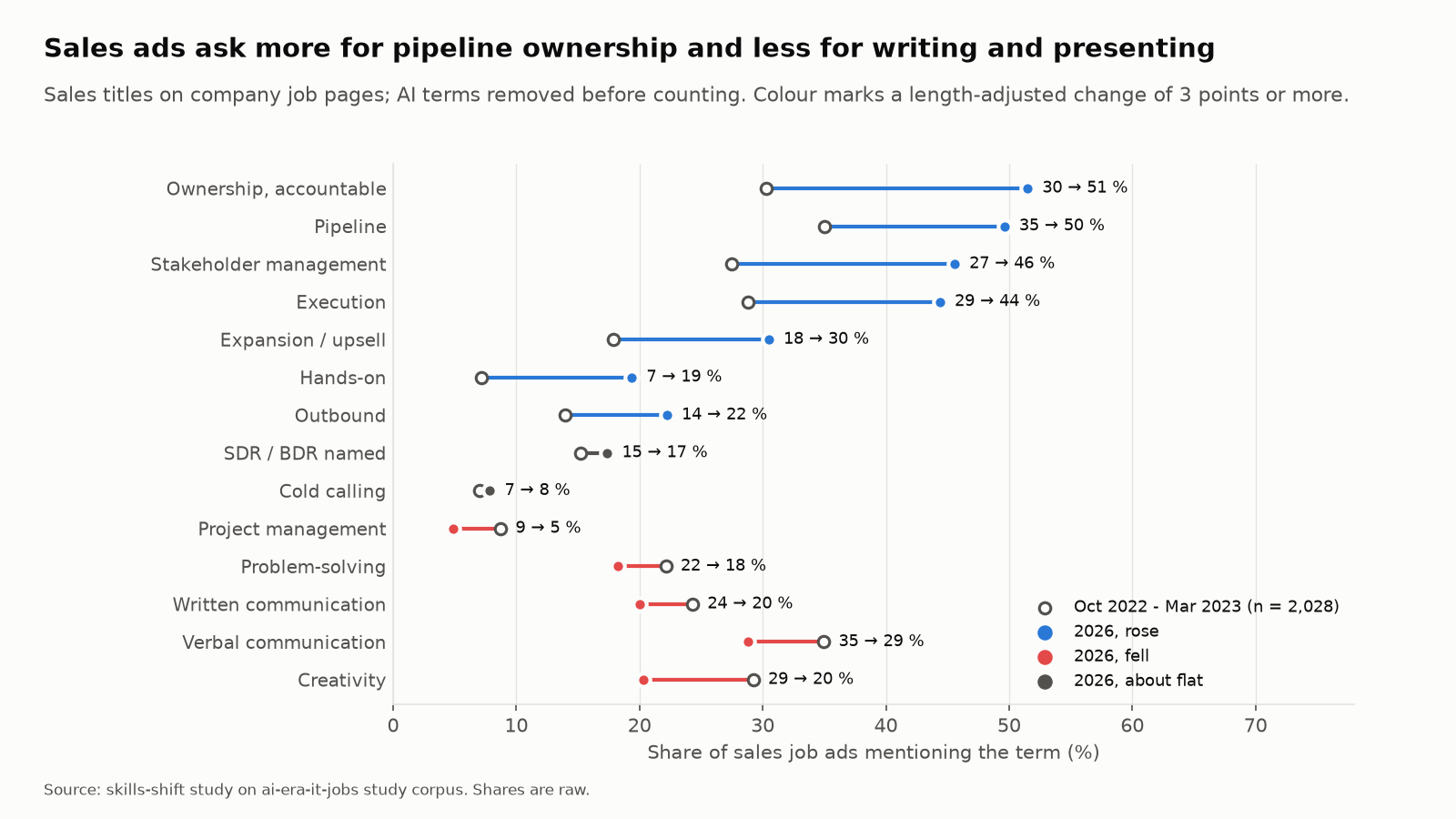
Ownership language rose from 30% to 51% of sales ads, pipeline from 35% to 50%, stakeholder management from 28% to 46% and outbound from 14% to 22%. Creativity fell from 29% to 20%, verbal communication from 35% to 29% and written communication from 24% to 20%. Named sales methods grew from a small base: MEDDIC-type qualification went from 1.9% to 9.4% [company job pages, ai-era-it-jobs study, 2026]. Two things the "SDR is dead" story predicts would fall held steady: ads naming an SDR or BDR role went from 15% to 17%, and cold calling stayed at 7% to 8%. With outbound up and SDR mentions flat, the prospecting work looks to have moved into the account executive's job.
AI went into the same ads. Any mention of AI in sales postings went from 16% to 62%, and AI named inside the requirements section went from 6% to 33%. Among the 1,162 and 2,623 postings from companies present in both periods, the any-mention share went from 17% to 62% [company job pages, ai-era-it-jobs study, 2026]. Europe matches the US on this: requirements sections in Europe-located sales ads named AI in 33% of cases in 2026, as in the US.
In Europe there is one more requirement the US barely has. Across 2,517 European marketing and sales postings in 2026, 43.6% named English and 23.3% German, against 4.2% naming English in the US, and the share of European business ads asking for fluency in a named language rose from 23% to 35% since late 2022 [company job pages, ai-era-it-jobs study, 2026].
What this means if you are an SDR, or want to become one
- Pick your next step now. The roles that held are account executive and solution engineer, three in five open GTM roles in early 2026, and the new one is the GTM engineer, with more than 400 at US digital natives and 76 such titles in a European sample of postings I reviewed this autumn. Build one prospecting workflow yourself (Clay, n8n or Make) and put the result on your CV.
- Apply to the companies that sell AI. They doubled SDR headcount while everyone else cut, and their sales teams need people who can explain the product to a buyer.
- Write your CV around pipeline you owned: meetings booked, opportunities created, revenue sourced. Ownership and pipeline are now in half of all sales ads. In Europe, put your languages at the top; they are a hiring filter that no agent removes.
Sources
- Indeed Hiring Lab, job postings indexes for sales and marketing (IHLIDXDETPSALE, IHLIDXGBTPSALE, IHLIDXFRTPSALE, IHLIDXUSTPSALE and the corresponding MARK series), via FRED, data to 16 October 2026. fred.stlouisfed.org
- US Bureau of Labor Statistics, Occupational Employment and Wage Statistics, national files May 2022 and May 2025 (sales managers 11-2022; sales representatives, technical and scientific products 41-4011); US CPI-U via FRED. bls.gov
- Kyle Poyar, Growth Unhinged, "Who's actually hiring in GTM right now?", 20 May 2026 (Sumble data, 22,988 GTM job posts).
- Gartner, "Gartner expects 60% of seller work to be executed by generative AI technologies within five years", 21 September 2023.
- Gartner, "Gartner predicts by 2028 AI agents will outnumber sellers by 10X", 18 November 2025.
- Hacker News comment search via the Algolia API, first mention of "AI SDR" (13 October 2023). hn.algolia.com
- Salesforce, Agentforce general availability, 30 October 2024. salesforce.com
- PetaPixel, "Billboards around San Francisco urge you to 'Stop Hiring Humans'", 10 December 2024; Artisan's account: artisan.co
- SaaStr, "83% of you haven't gotten AI SDRs to work yet", November 2024.
- TechCrunch, "a16z- and Benchmark-backed 11x has been claiming customers it doesn't have", 24 March 2025.
- Gong, "Revenue organizations using AI in 2024 reported 29 percent higher sales growth than their peers", 21 November 2024.
- Gong Labs, "The State of Revenue AI 2026", December 2025.
- Salesforce Ben, "Salesforce will hire no more software engineers in 2025, says Marc Benioff", December 2024.
- TechRepublic, "Salesforce 'needs less heads,' so it cut 4,000 jobs, as AI takes over", 3 September 2025.
- SaaStr, "The great SDR downsizing: 36% of B2B companies cut sales development teams in 2025", June 2025, citing Emergence Capital's Beyond Benchmarks survey (April 2025).
- Salesforce, "The productivity gap: new survey shows 9 in 10 sellers are betting on AI and agents", 3 February 2026.
- Company job pages on Greenhouse, Lever and Ashby boards, October 2022 to March 2023 (Common Crawl, Wayback Machine) and May to October 2026 (live boards); ai-era-it-jobs business-role skills-shift study; AI shares from the ai-era-it-jobs report, Table 6.1.
- LinkedIn, "Jobs on the Rise 2024: the 25 UK roles growing in demand", 17 January 2024 (used in the timeline).
- Growth Unhinged, "Do you need a GTM engineer?", 10 September 2025.
- ai-era-it-jobs European sample: sales and marketing postings in Europe, September to October 2026 (GTM-engineer titles by country).