
The safest time to quit your day job isn't a feeling — it's the point where your side business covers expenses on a trailing average, and your savings cover a defined number of months if it doesn't. Real solopreneur stories suggest six months of runway as a common threshold, though plenty quit with less, and plenty who waited still found it hard.
There's no universal green light. What shows up across dozens of stories is a recurring tension between two instincts: the advice to wait until you have a real cushion, and the lived experience of people who say the "right" moment never quite arrives no matter how long you wait.
Both instincts are grounded in real outcomes, which is exactly why this decision benefits from a number rather than a mood. Our cash flow management guide covers the broader financial groundwork; this piece focuses specifically on the quit decision itself.
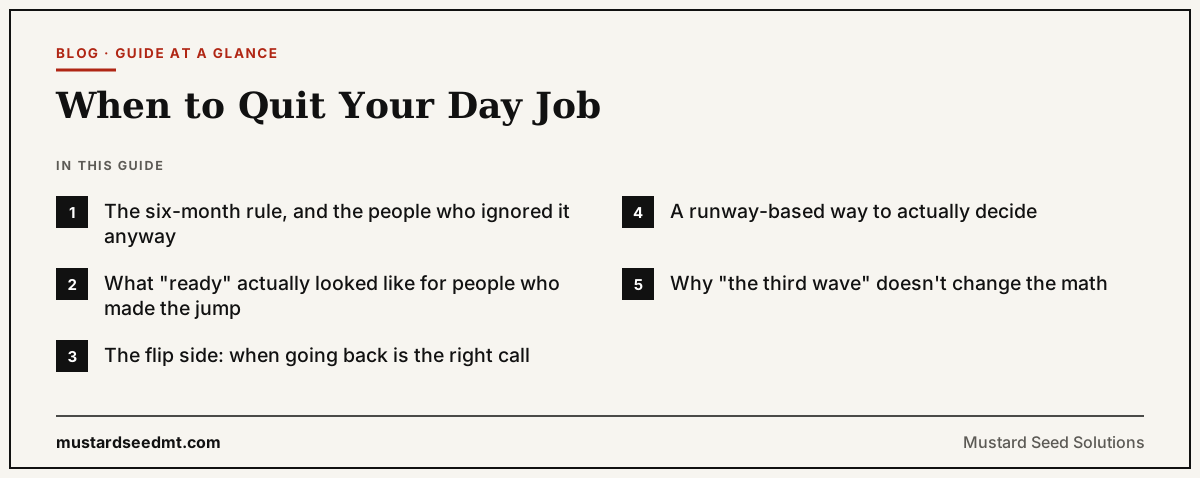
The six-month rule, and the people who ignored it anyway
One frequently cited story involved someone who'd been advised not to leave their job until they had six months of expenses saved. They didn't wait. Juggling both jobs had become unsustainable — "hanging on by a thread, not excelling at either," in their words — so they resigned with a plan mapped out on a spreadsheet rather than a full cash cushion.
The replies split cleanly into two camps. One argued that the absolute worst case — going back to a job, any job — is a smaller risk than people assume, and that waiting for perfect readiness just means someone else takes the opportunity instead. Another reply pushed back with real caution: four months goes by fast in early-stage business life, and it's worth spending a few hours a week applying to backup roles rather than depleting all six months of cash chasing traction that never arrives.
Neither side was wrong. They were describing two different failure modes — waiting too long for certainty that never comes, versus leaping without a plan for what happens if the ramp takes longer than expected.
What "ready" actually looked like for people who made the jump
A different story showed the more gradual version of the same decision. A side income from a mobile beverage-service business grew to the point of being booked almost every weekend, and expanded further once the owner started offering a higher-priced package with cocktails. Along the way, the owner met someone through the business who offered them a separate high-ticket sales role — and between the two income streams, quitting the original 9-to-5 stopped being a leap and became closer to a formality.
A solo founder answering questions about their own path put the tension into words directly: they sat on their idea for about eight months before going all-in, with roughly three months of savings and some credit-card room as the actual cushion — far short of six months — and said in hindsight they still felt they'd waited too long, because there's never a fully comfortable moment to make the decision.
A third, smaller story captured the more common in-between state: someone earning real, substantial side income from a hobby-turned-business — tens of thousands of dollars a year, run alongside a full-time job — who described wanting to quit eventually but said the jump still "feels massive," even with meaningful revenue already proven out.
The flip side: when going back is the right call
Not every version of this story ends in quitting a day job — some end in returning to one. A marketing agency owner who'd run their own business for seven years, through a stretch where annual revenue fell from over $150,000 to about $60,000 due to industry headwinds outside their control, eventually took a full-time in-house role instead. They described the change as relief rather than defeat, comparing it to taking a heavy backpack off their back, and specifically named no longer chasing overdue invoices as part of that relief.
One line from the replies to that story has stuck with a lot of readers since: everyone wants to be their own boss until they don't know when they're getting paid. It's not an argument against self-employment — it's a reminder that the runway question runs in both directions. The same math that tells you when it's safe to leave a job can also tell you when it's reasonable to go back.
A runway-based way to actually decide
Pulling the recurring threads together into something usable, rather than a mood to wait out:
- Calculate your true monthly expenses — business and personal combined, not a rough guess.
- Look at your side income as a trailing average over several months, not your single best month.
- Divide your available savings by monthly expenses to get an actual number of months of runway.
- Decide your own minimum threshold in advance — six months is common, but several people quit successfully with less once income was already trending toward covering expenses.
- Set a real fallback plan — some solopreneurs kept applying to a handful of backup roles even after quitting, treating it as insurance rather than a lack of commitment.
Our runway calculator turns this into a single number — enter your savings, expenses, and current side income, and it tells you exactly how many months of runway you're standing on today, before you make the call.
As a worked example: if your combined monthly expenses run about $4,000 and you have $24,000 in savings with no reliable side income yet, that's six months of pure runway. If your side business already covers $2,500 of that $4,000 on a trailing average, the same $24,000 stretches much further — because the calculation should measure the gap your savings need to cover, not your full cost of living from zero.
Why "the third wave" doesn't change the math
It's tempting to think the calculus is different now that AI tools make it faster to build something on the side. One founder's comment on a thread about where solopreneurs are finding traction put it well: coding agents can get a working product built in days instead of weeks, but building is still hard after that first sign of product-market fit — distribution, retention, and pricing don't get automated away just because the build got faster. Another reply in the same thread, from someone who'd left a corporate job the week before to build what they called a "life-first business," made the same point from the other side: the tools change, but the runway question — how long can you survive before the thing you're building needs to pay you back — doesn't.
That's worth sitting with, because faster building can create a false sense of readiness. A working prototype in two days is not the same as validated, repeatable income, and the runway calculation should be based on the second thing, not the first.
The takeaway
There's no story here where "just wait for the perfect moment" turns out to be good advice — the moment never fully arrives. But there's also no story where quitting with zero plan and zero cushion goes smoothly either. The pattern that repeats across real solopreneurs is a specific number of months of runway, decided on in advance, rather than a feeling you wait to have.
It's also worth remembering that the decision isn't permanent in either direction. People in these stories moved both ways — quitting a stable job to go all-in, and later returning to full-time employment once a business stopped being sustainable. Neither move was described as a final verdict on someone's worth as a founder. Treating the quit decision as reversible, backed by a number you chose on purpose, tends to remove more fear from the process than any amount of waiting for certainty ever does.