
The Promise
LeEco (formerly LeTV) had built a genuinely large, integrated ecosystem in China spanning streaming content, smartphones, televisions, and even an electric vehicle venture (Faraday Future, separately capitalized) — a business model that had real traction in its home market, where LeEco combined subsidized hardware with content and services revenue.
Entering the US in 2016 with high-profile launch events, LeEco brought real capital and ambition, including an agreed roughly $2 billion acquisition of Vizio (a well-established US TV brand) intended to instantly provide US market distribution, brand recognition, and manufacturing scale that LeEco lacked on its own.
The Entry
LeEco launched multiple product lines simultaneously in the US — smartphones, televisions, and a content/streaming ecosystem — largely replicating its Chinese go-to-market structure (hardware sold near or below cost, subsidized by content and services revenue) in a US market with an entirely different competitive landscape, existing brand loyalties (Samsung, LG, Apple, established streaming services), and consumer expectations.
The Vizio acquisition, meant to solve LeEco's US distribution and manufacturing gap in one move, ran into extended regulatory review and, more critically, coincided with a severe cash crunch at LeEco's China parent company, which was separately overextended across its EV venture, sports-streaming rights, and other simultaneous bets.
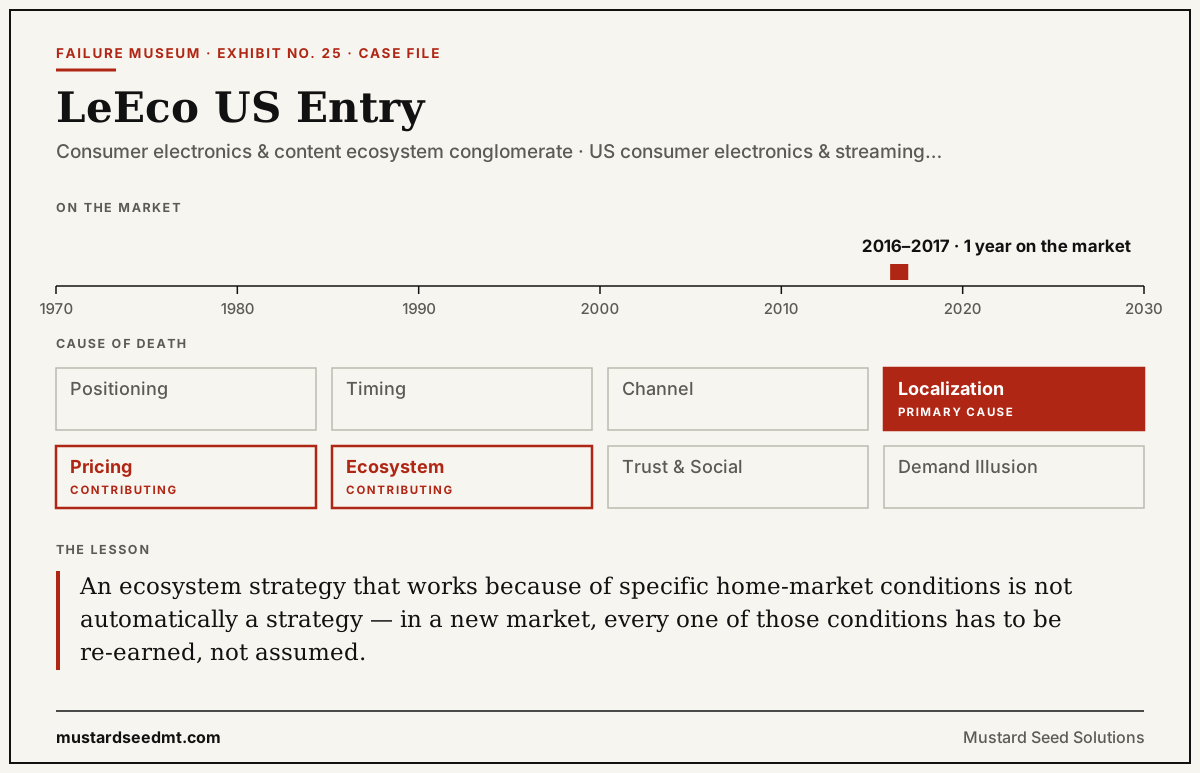
LeEco US Entry: Why It Failed
LeEco's US entry failed primarily because it transplanted a Chinese hardware-subsidized-by-content ecosystem strategy directly into the US market without adapting to US consumers' different brand loyalties, distribution channels, and willingness to adopt an unfamiliar ecosystem — and that localization gap became fatal once LeEco's China parent company's broader overextension (across EVs, sports rights, and other ventures) cut off the capital the slow US ramp needed to survive.
The record suggests the ecosystem-subsidy model that worked in China didn't transfer directly to the US: Chinese consumers' adoption of LeEco's content-plus-hardware bundle depended on specific market conditions (content licensing relationships, consumer payment and subscription habits, competitive landscape) that didn't exist the same way in the US, where consumers already had strong existing brand loyalty to Samsung, LG, and Apple hardware, and to Netflix, Hulu, and other established streaming services LeEco's content library didn't match.
Our read is that the Vizio acquisition attempt reveals LeEco's own recognition of the localization gap — rather than building US distribution and brand trust organically over years, LeEco tried to buy an instant solution to exactly the localization problem this exhibit's cause of death describes, a reasonable strategic instinct that ultimately failed for reasons (parent-company cash crisis) that were more about capital allocation than about the acquisition logic itself.
The timing compounded the localization problem in a way LeEco couldn't control: the parent company's simultaneous, aggressive bets across a Chinese TV/content platform, an EV venture (Faraday Future), sports streaming rights, and the US expansion all drew on the same capital pool, and when that capital pool came under strain in 2017, the slower-to-mature, higher-localization-risk US venture was among the first commitments cut — connecting this exhibit directly to the museum's broader thesis that market entry failures are rarely caused by one single factor in isolation.
What Survived
Vizio remained an independent, US-focused TV brand after the terminated acquisition and continued operating successfully in the US market on its own — the target company's underlying business was sound; it was specifically the cross-border acquisition and ecosystem-transplant strategy that didn't work.
LeEco's broader troubles became a widely cited case study in Chinese outbound investment and localization strategy, frequently referenced in discussions (including within Mustard Seed's own client conversations) about the specific adaptation cross-border technology companies need to make when entering the US or European markets — the exact corridor experience this museum's curators draw on, without making this exhibit only about that corridor.
Era: 2010s
Where It Ended Up: US operations sharply scaled back from 2017 onward amid parent company LeEco's broader financial crisis in China; the planned Vizio acquisition was terminated in 2017
The Lesson
"An ecosystem strategy that works because of specific home-market conditions is not automatically a strategy — in a new market, every one of those conditions has to be re-earned, not assumed."