
For two decades, digital advertising relied on human operators logging into self-serve dashboards. Whether you managed campaigns inside Google Ads, LinkedIn Campaign Manager, or programmatic DSPs, the workflow was identical. A human marketer picked keyword lists, defined audience parameters, uploaded static banners, and manually adjusted bid caps.
That paradigm is now shifting toward autonomous execution.
This month, the IAB Tech Lab opened the formal public comment period for version 3.0 of the Automated Advertising Management Protocol, known as AAMP. Rather than designing another web interface for human media planners, AAMP creates a standardized machine-to-machine protocol. It allows autonomous AI agents to discover inventory, negotiate pricing parameters, verify compliance, and execute media purchases without human intervention.
At the same time, new data from IAB Europe indicates that 58% of advertising leaders expect agentic ad buying to reach operational scale within twelve months. Yet 36% of organizations have zero agentic infrastructure prepared.
For technical B2B companies selling enterprise software, backup solutions, and cloud infrastructure, this transition will dramatically alter customer acquisition costs.
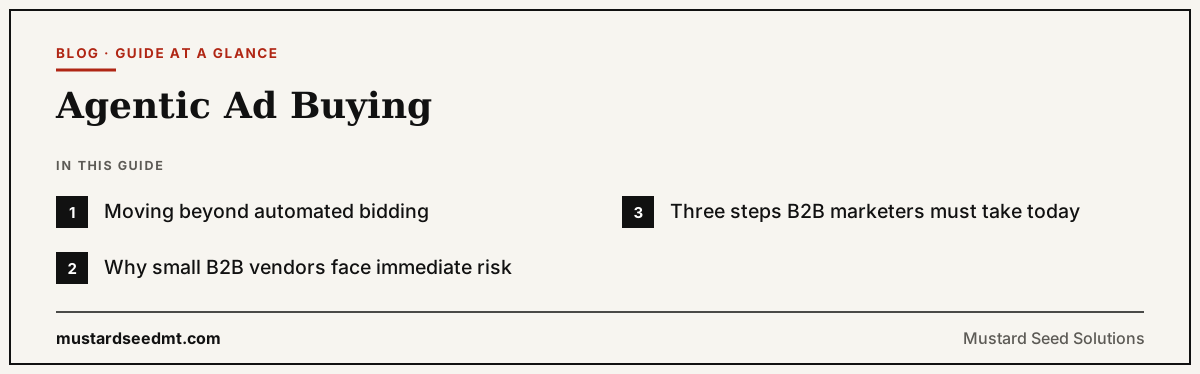
Moving beyond automated bidding
It is important to distinguish agentic ad buying from the algorithmic bidding tools marketers already use, such as Google Performance Max or Meta Advantage+.
Current platform automation operates within walled gardens. Google or Meta adjusts bids dynamically, but only inside their closed ecosystems, and only against their proprietary goals. The advertiser still relies on humans to manage cross-platform allocation, budget approvals, and creative audits.
Agentic media buying operates differently. Under protocols like AAMP, a brand deploys an autonomous buying agent that coordinates decisions across multiple disconnected networks.
The buying agent does not wait for a weekly reporting meeting. It connects directly to your company CRM, monitors pipeline velocity, detects intent signals from first-party data cleanrooms, and buys targeted placements across search, programmatic networks, and generative AI surfaces in real time.
When ad networks negotiate with autonomous agents rather than human buyers, manual bidding tactics become an expensive liability.
Why small B2B vendors face immediate risk
Major enterprise brands are already adapting. Infrastructure providers like Optable are building publisher-side cleanrooms designed specifically for buyer-side AI agents. Ad tech firms like Scope3 recently rebranded as Apostra to focus exclusively on autonomous agent transactions.
Small and mid-sized B2B vendors, however, remain trapped in legacy routines. They continue paying agency retainers for manual campaign management, updating spreadsheets, and optimizing keyword match types.
In an agent-driven media ecosystem, this creates three structural disadvantages:
- Latency: A human campaign manager reviews negative search terms once a week. An autonomous bidding agent identifies wasted spend and reallocates budget within seconds.
- Information Asymmetry: Buying agents evaluate thousands of contextual and privacy-compliant publisher signals simultaneously. Human media planners are limited to the aggregate metrics that platform dashboards choose to display.
- Pricing Squeeze: As programmatic inventory is increasingly auctioned via automated protocols, platform algorithms will favor buyers capable of programmatic machine negotiation. Vendors relying on manual campaign setups will pay higher effective clearing prices for lower-quality impressions.
Three steps B2B marketers must take today
You do not need to build an autonomous media agent tomorrow, but you must prepare your marketing architecture for machine-to-machine transactions.
1. Audit your first-party conversion infrastructure
Autonomous media agents cannot optimize toward vague proxy metrics like form fills or PDF downloads. They require high-fidelity, verified signals: qualified pipeline stages, completed product demos, and contract values.
Ensure your CRM and web analytics pass server-side, privacy-compliant conversion events directly back into ad APIs. If your conversion tracking is noisy or delayed, any automated system will optimize toward low-value leads.
2. Package your positioning for machine ingestion
In an agentic ecosystem, buying and selling agents communicate via standardized schema. If your pricing structure, technical compatibility tiers, and compliance certifications are buried inside unstructured marketing collateral, discovery agents cannot evaluate your offerings.
Publish clear, structured data on your website. Use explicit JSON-LD markup to define product capabilities, deployment models, and service parameters.
3. Re-evaluate agency retainer models
If you currently employ an agency whose primary service is adjusting bids and compiling monthly PDF performance reports, their value proposition is disappearing.
Demand that your marketing partners focus on high-value inputs: positioning clarity, compelling technical messaging, proprietary buyer research, and conversion tracking architecture.
The mechanics of ad distribution are moving to autonomous protocols. The winners in B2B marketing will be the teams that feed those protocols superior data and authoritative technical proof.