
ChatGPT Ads Manager is moving beyond a simple advertising experiment. Recent updates reported by Search Engine Roundtable include a ChatGPT Ads Manager plugin, expanded custom audience controls, richer conversion matching, carousel reporting, budget pacing, new optimization options and expansion into additional markets.
For marketers, the important change is structural. ChatGPT is starting to look less like an isolated AI interface and more like a place where discovery, advertising, product data, measurement and conversion can increasingly connect.
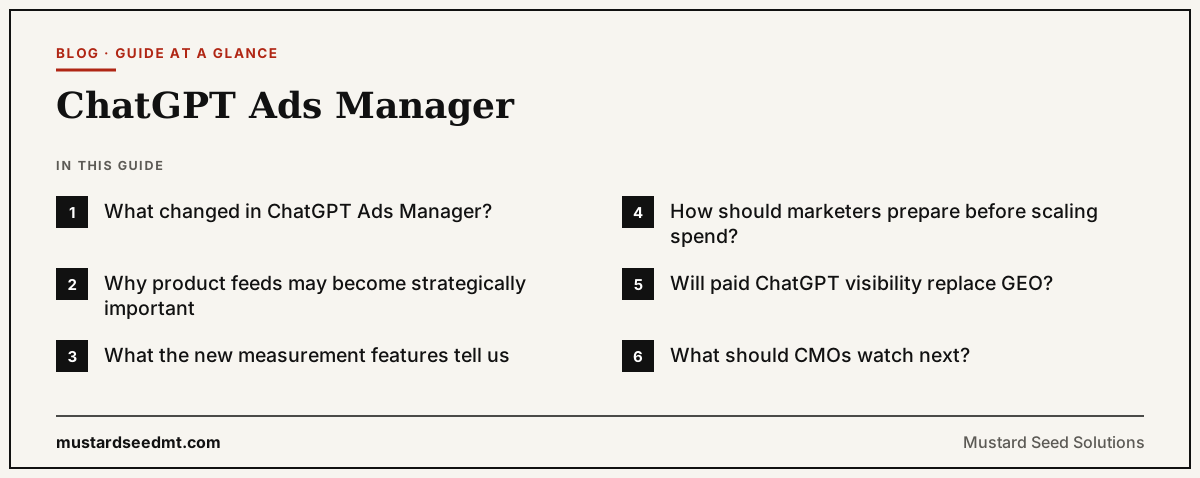
What changed in ChatGPT Ads Manager?
Search Engine Roundtable reported a cluster of updates on September 4, 2026, including a plugin that can create, manage and analyze campaigns from ChatGPT or Codex. The plugin can turn a website or brief into ads, create variants, troubleshoot delivery and recommend changes, while requiring confirmation before changes are applied.
The same report described improvements to custom audiences, conversion matching, carousel reporting and total budget pacing. It also said OpenAI plans additional conversion optimization options and has begun expanding ChatGPT Ads into select countries in Europe, India, the Middle East and North Africa.
The full update is available from Search Engine Roundtable.
Why product feeds may become strategically important
One of the most consequential points in the report concerns product feeds. Search Engine Roundtable cited an analyst who said ChatGPT shopping results were coming from brands that submit product feeds, though the article itself presented this as an analyst observation rather than an official OpenAI confirmation.
That distinction matters. Brands should not treat product feeds as a guaranteed visibility lever until OpenAI defines the relationship clearly, but ecommerce teams should still make feed quality a priority. Product names, descriptions, availability, pricing and identifiers increasingly serve both paid and AI assisted shopping experiences.
What the new measurement features tell us
The update shows that OpenAI is building the plumbing advertisers expect from a mature platform. Conversion matching now supports additional fields, and reporting for multi product carousel ads includes card level impressions and clicks.
That does not mean ChatGPT Ads should be measured exactly like Google Ads or Meta Ads. The user journey can begin with a question, move through an AI answer, continue into a product comparison and only later become a click or conversion.
Marketers should prepare a measurement framework that separates exposure, engagement, assisted conversion and direct conversion rather than forcing every interaction into one last click metric.
How should marketers prepare before scaling spend?
The best preparation is not rushing budget into a new channel. It is making the underlying marketing system strong enough to use the channel when it fits.
- Clean up product and service data
- Define conversion events clearly
- Review first party audience quality
- Make landing pages answer the same questions buyers ask in AI
- Build a baseline for branded and non branded AI visibility
- Decide which outcomes justify paid acquisition
Teams already working on AI visibility have an advantage because the same questions used to understand organic AI discovery can help shape ad messages and landing page content.
Will paid ChatGPT visibility replace GEO?
Paid placement and earned AI visibility solve different problems. Ads can buy distribution when targeting and inventory are available. GEO and AEO aim to improve whether a brand is understood, retrieved, cited and recommended organically.
A strong strategy can use both. Paid media can create immediate reach while owned content, product pages, authority signals and third party evidence strengthen the brand's long term presence in AI answers.
For many B2B companies, the first question should be whether buyers can already find and understand the company in AI systems. If the answer is unclear, an AI visibility review is a more useful starting point than simply adding ad budget.
What should CMOs watch next?
The biggest signal is convergence. AI assistants are bringing search, media buying, product discovery and conversion infrastructure closer together.
CMOs should watch how OpenAI defines ad placement, how product feeds influence shopping visibility, what reporting becomes available and how advertisers can distinguish paid exposure from organic AI recommendation. They should also watch whether optimization starts rewarding the same content and product data quality that supports organic AI discovery.
This is a channel to test deliberately, not a reason to abandon existing search, content or demand generation systems.