
For years, B2B sales leaders operated under the assumption that deals are won during discovery calls, product demonstrations, and vendor bake-offs. If your marketing generated an inbound form fill or your outbound team booked a meeting, your account executives had a fair shot at winning the business.
Recent buyer research shows that reality has shifted decisively.
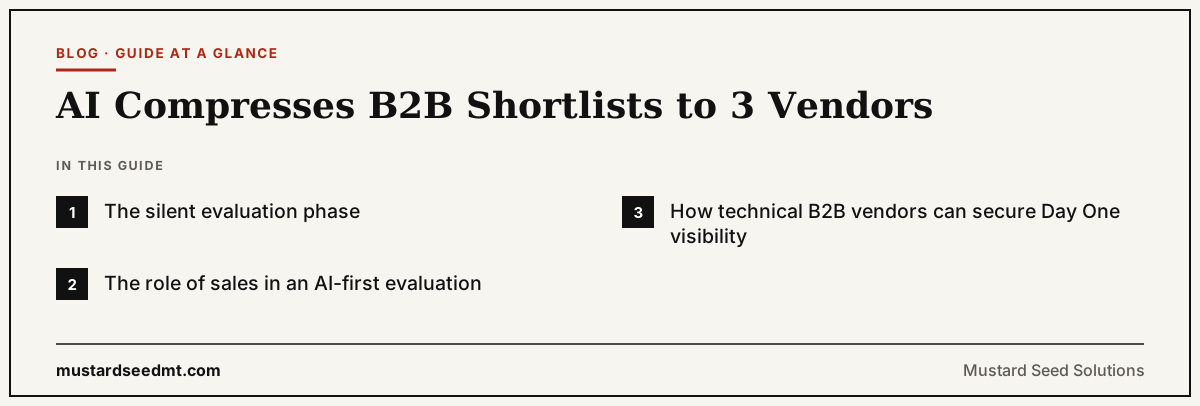
According to research tracking enterprise technology purchases, between 80% and 90% of B2B contracts are awarded to companies that were already on the buyer's Day One shortlist. Even more striking, the average consideration set has compressed from five or six candidates down to approximately 2.5 to 3 vendors.
The primary driver of this compression is the rise of generative AI as an autonomous, silent research layer. Over 90% of B2B technology buyers now use AI answer engines to evaluate technical categories, compare feature sets, and refine requirements before ever contacting a sales team.
If your product does not make that initial three-vendor cut, your sales pipeline is effectively fighting an uphill battle before the first conversation occurs.
The silent evaluation phase
Modern B2B buying committees now consist of eleven to fourteen stakeholders across engineering, security, finance, and operations. Reaching consensus across that many people is notoriously difficult.
To avoid spending hours sitting through generic vendor discovery presentations, committee members use AI assistants like ChatGPT, Claude, and Gemini as internal sounding boards. They feed their exact infrastructure constraints into the model: deployment environments, compliance mandates, API requirements, and budget caps.
The AI model acts as a brutal preliminary filter. It does not browse glossy marketing slogans. It retrieves structured specifications, documentation, and verified third-party analysis. Vendors that lack clear, machine-readable evidence are quietly discarded from the shortlist without ever knowing they were considered.
The role of sales in an AI-first evaluation
This dynamic does not mean sales representatives have become obsolete. In fact, research from Gartner reveals a fascinating development: 69% of B2B buyers specifically turn to sales reps to validate, verify, or challenge the insights they generated through AI.
The nature of the sales conversation, however, has fundamentally changed. Buyers no longer contact a vendor to ask what your product does. They already know what the AI told them. They contact you with specific validation questions: "The AI summary stated that your solution requires an external gateway for multi-cloud replication. Is that accurate, or has your architecture evolved?"
When your sales team operates with traditional discovery scripts, they frustrate buyers who have already completed 80% of their research. Winning vendors equip their reps to act as technical consultants who can validate technical claims and clarify complex edge cases quickly.
How technical B2B vendors can secure Day One visibility
For smaller infrastructure, backup, and specialized software vendors, entering that selective 2.5-vendor shortlist requires a deliberate shift in marketing strategy.
1. Eliminate positioning ambiguity
AI answer engines cannot recommend products they cannot categorize. If your homepage describes your platform as an "all-in-one AI-driven data intelligence engine," models struggle to map your capabilities against concrete buyer prompts like "immutable backup storage for VMware."
State your category, your architecture, and your primary use cases directly. Precision beats clever marketing copy every single time.
2. Expose technical proof directly in accessible HTML
Gated whitepapers and PDF product sheets protect lead forms at the expense of AI visibility. LLM crawlers prioritize clean, accessible HTML documentation and structured JSON-LD schemas.
Ensure that deployment guides, supported integrations, security standards, and performance specifications live directly on public product pages where both buyers and AI crawlers can index them.
3. Build objective comparison pages
When buyers use AI to compare alternatives, the model searches for direct comparative tables. If you do not provide fair, architectural comparisons between your platform and legacy alternatives on your own domain, the model will construct answers using outdated review sites or competitor claims.
The Day One shortlist is where enterprise software deals are won or lost. By aligning your digital presence with how AI models retrieve technical proof, you ensure your company is considered when buyers make their initial three-vendor selection.