
Generative Engine Optimization, commonly shortened to GEO, is the practice of improving a brand’s visibility within AI generated answers.
This article is not another definition of the term. For the concept itself — the research, the engines, and the formal definition — see our in-depth GEO guide. The focus here is practical: what GEO means for how your business presents itself, earns recognition, and measures results.
Traditional search engines normally present users with a list of pages. Generative search tools may instead produce a direct response that summarizes information from multiple sources.
This changes how users interact with search.
A person researching software, professional services, travel, or business strategy may receive a complete answer without visiting several websites. The answer may mention companies, compare products, summarize opinions, or cite selected sources.
GEO focuses on increasing the likelihood that a business, product, or publication will be represented accurately within those responses.
The term is relatively new, but many of the activities connected to it are familiar. Clear content, strong search visibility, trusted external references, accurate company information, and credible brand mentions were already valuable before generative search became popular.
GEO gives businesses a framework for applying those principles to an environment where an AI system may become the first point of contact between the user and the brand.
How generative search changes the user experience
A traditional search process often requires several steps.
The user enters a query, reviews the results, opens one or more pages, compares information, and forms a conclusion.
Generative search can compress this journey.
The system may retrieve information from several sources and present a combined answer. It can explain a subject, compare options, recommend a process, or summarize a market.
This creates convenience for the user, but it creates a new challenge for publishers.
A website may contribute information to an answer without receiving a click. A company may be mentioned without controlling the description. A competitor may appear in a recommendation while another brand is excluded.
Visibility is therefore no longer limited to ranking a webpage.
Businesses must also consider whether AI systems can identify, understand, and accurately describe the brand.
How AI systems obtain information
Generative systems may rely on several types of information.
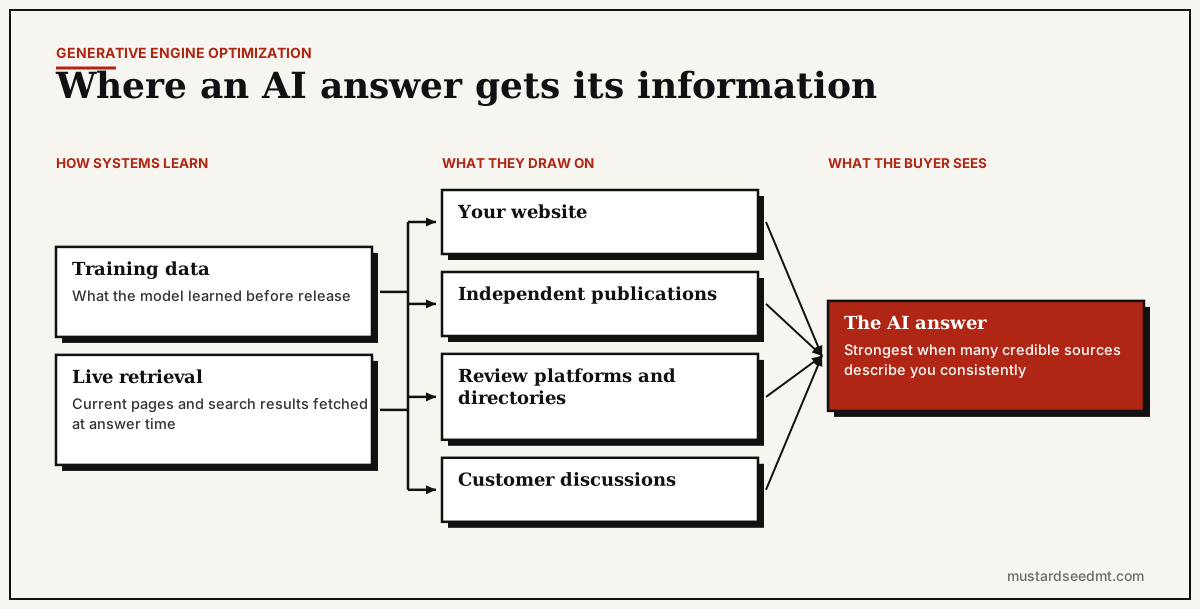
Some knowledge comes from the data used to train the model. Some systems can also retrieve current web pages, search results, product information, reviews, databases, or other external sources.
The exact process varies between platforms and queries.
This is why GEO should not be treated as a single technical formula.
A company cannot add one tag to its website and guarantee inclusion in AI answers. The system may consider the company’s own website, independent publications, review platforms, directories, customer discussions, and other available material.
The broader information environment matters.
When many credible sources consistently describe a company in a similar way, an AI system has more evidence to work with.
When information is limited, contradictory, outdated, or overly promotional, accurate representation becomes more difficult.
GEO begins with clear information
A business should make its identity easy to understand.
Its website should clearly explain what the company does, who it serves, where it operates, and what differentiates its offer.
Important information should not be hidden behind vague slogans.
A software company should describe its product, use cases, integrations, pricing model, and intended users. A consultancy should explain its services, methods, industries, and engagement process. A local business should provide accurate location, contact, service area, and opening information.
Clear writing benefits human visitors, search engines, and generative systems.
The goal is not to write for machines in an unnatural style. The goal is to remove ambiguity.
Search visibility still matters
Generative search does not make traditional SEO irrelevant.
AI systems that retrieve current web information need sources they can discover and process. Search engines and web indexes remain an important part of that infrastructure.
A page that is inaccessible, poorly connected, or absent from searchable indexes has fewer opportunities to influence retrieved answers.
Strong SEO foundations therefore support GEO.
These foundations include crawlable pages, clear internal links, relevant content, sensible website architecture, external recognition, and pages that satisfy real search intentions.
Businesses should be cautious of agencies that present GEO as a complete replacement for SEO.
The delivery format has changed, but discoverability remains necessary.
External sources influence brand representation
A company’s website presents its preferred description of the brand.
Generative systems may also encounter independent descriptions.
These could include news articles, professional directories, customer reviews, discussion forums, comparison sites, research reports, partner pages, and industry publications.
External sources are important because they provide perspectives beyond self published marketing.
A company may describe itself as easy to use, but customer reviews may report a difficult implementation process. It may claim to serve large enterprises, while most public references describe small business customers.
AI generated responses may reflect this wider consensus.
Businesses should therefore view reputation management as part of GEO.
The objective is not to manipulate every external discussion. It is to create a customer experience and public presence that produce accurate, credible information.
Brand mentions can matter even without links
SEO traditionally gives significant attention to backlinks.
Links remain useful because they connect pages and can provide authority, discovery, and referral traffic.
In generative search, unlinked brand mentions may also contribute useful context.
An industry article may name a company without linking to it. A customer may discuss a product in a professional community. A research report may include a provider in a market overview.
These references help establish associations between the brand and its market.
A company that is consistently mentioned in relevant discussions is easier to identify than a company that appears only on its own website.
This is one reason public relations, community participation, customer advocacy, and partnerships can support AI visibility.
Content should answer complete questions
Generative systems are often used for conversational and detailed queries.
Users may ask which product suits a specific situation, how two services differ, what risks they should consider, or how to complete a complicated process.
Businesses should create content that addresses these real questions.
Useful formats include comparisons, implementation guides, case studies, frequently asked questions, definitions, troubleshooting pages, research, and detailed service explanations.
The content should be direct and specific.
A page filled with general claims gives an AI system little factual material to summarize. A page containing clear explanations, limitations, examples, and supporting evidence provides more useful information.
Original information creates differentiation
Generative answers can summarize common information from many websites.
This makes generic content less distinctive.
A company can improve its visibility by publishing information that reflects real experience.
Examples include original research, customer data, industry surveys, case studies, technical documentation, benchmarks, frameworks, and expert observations.
Original information gives other publishers a reason to reference the company. It also creates facts and insights that may appear in future summaries.
The information should be accurate and transparent.
Research methods, sample sizes, limitations, and dates should be explained where relevant.
Consistency reduces confusion
Company information should remain consistent across important sources.
The business name, website address, service description, location, product category, and contact details should not vary unnecessarily.
Inconsistency can create confusion for customers and automated systems.
A company may use one name on its website, another in directories, and a third in product listings. Old descriptions may continue circulating after the business changes direction.
Regular audits can identify outdated profiles, inaccurate descriptions, broken links, and old product information.
Consistency does not mean repeating identical promotional language everywhere. It means maintaining agreement on important facts.
GEO measurement is still developing
Traditional SEO can be measured through rankings, impressions, clicks, conversions, and revenue.
GEO measurement is less straightforward.
AI answers can vary between users, prompts, locations, and platforms. A brand may appear in one response and not another. Citations may change as the system retrieves different sources.
Businesses can still track useful indicators.
These may include referral traffic from AI platforms, branded search growth, mentions in generated answers, citation frequency, visibility for important prompts, and leads that identify AI tools as a discovery source.
Manual testing can provide directional insight, but it should not be treated as a perfect measurement system.
The objective is to identify patterns rather than claim certainty from a small number of prompts.
A practical GEO strategy
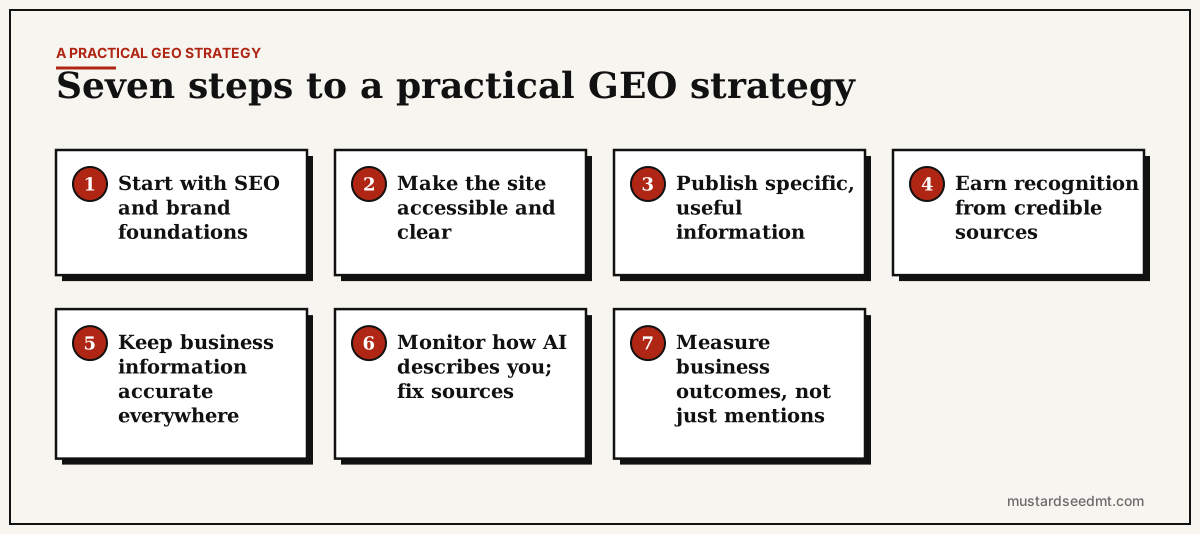
Start with strong SEO and brand foundations.
Make the website accessible, clear, and focused on real customer questions.
Publish content that contains specific and useful information.
Build recognition through credible publications, partnerships, communities, customers, and industry organisations.
Keep important business information accurate across the web.
Monitor how generative systems describe the brand and correct factual problems at their likely sources.
Measure business outcomes rather than only counting mentions.
Generative Engine Optimization is not a magic technical solution.
It is a practical response to a changing discovery environment.
Businesses that are easy to find, easy to understand, and consistently recognised by credible sources are better positioned to appear in both traditional search results and AI generated answers.