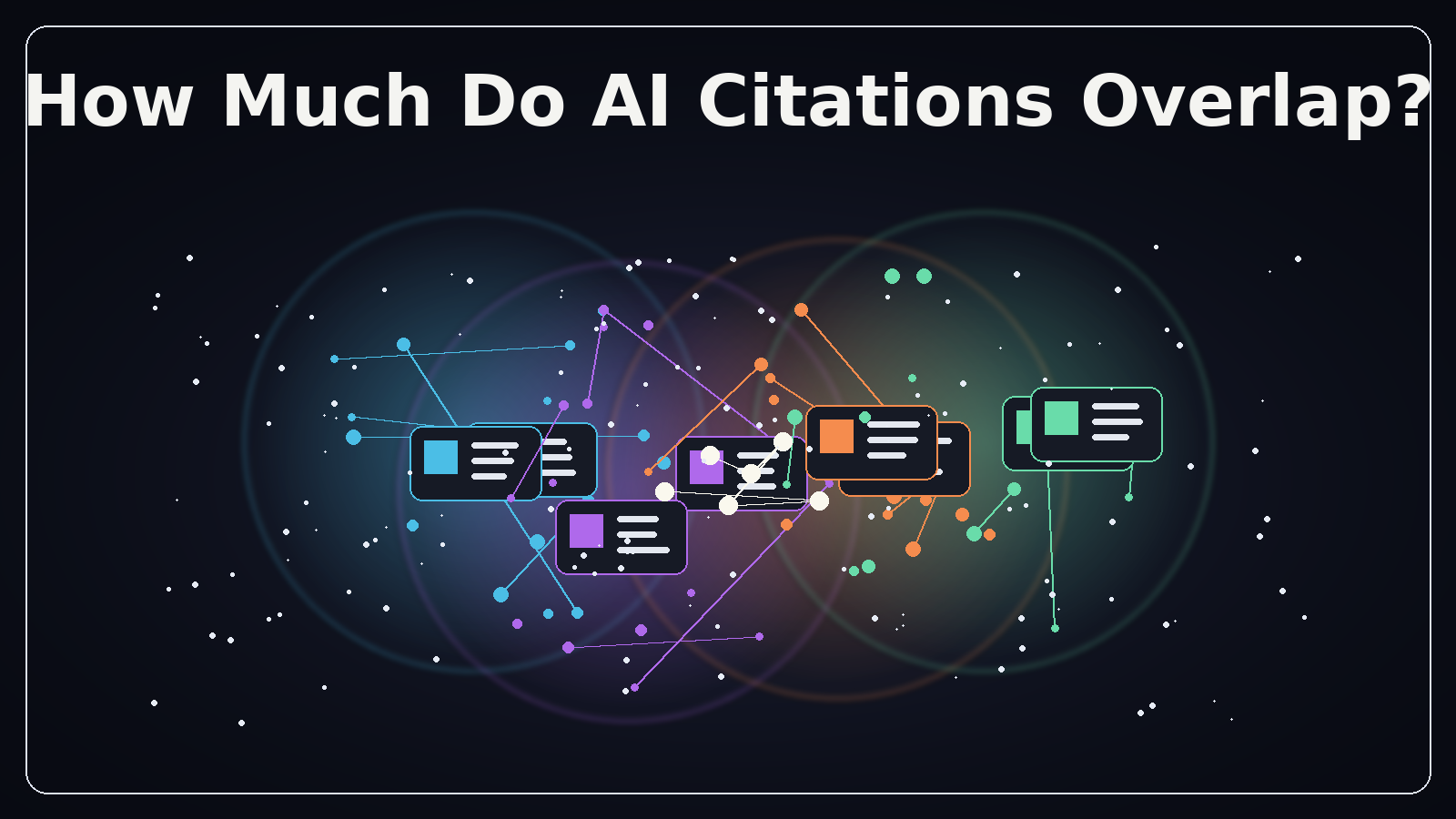
There is no single permanent overlap percentage for ChatGPT, Claude, Gemini, and Perplexity. Citation overlap changes by topic, prompt, model version, search configuration, location, and time.
The consistent finding across recent research is more useful than any one percentage: cross platform source overlap is relatively low. A citation win in one AI engine should not be assumed to transfer to the others.
What does citation overlap actually measure?
Citation overlap measures how often two AI systems use the same sources for the same or equivalent questions.
One common method is Jaccard overlap.
If one system cites five domains and another cites five domains, but only one domain appears in both sets, the overlap is low.
Researchers can measure overlap at different levels:
- Exact URL
- Domain
- Source category
- Brand
- Publisher
- Page type
These produce different numbers.
That is one reason marketers should be cautious when someone says two AI engines have a specific universal overlap rate.
What does recent research show?
A June 2026 study analyzing more than 100,000 prompt responses across multiple AI search platforms reported low cross platform source agreement.
In a smaller CRM reference study within that research, mean pairwise Jaccard overlap across five AI engines was approximately 0.12. The authors explicitly describe the broader cross platform overlap analysis as an area they intend to expand, so that number should be treated as a dataset specific finding rather than a universal benchmark.
You can review the study, Generative Engine Optimization at Scale.
The useful takeaway is that AI engines often build answers from different information environments.
What happens with commercial search questions?
Another 2026 study tested 1,000 ranking style prompts across consumer categories including smartphones, shoes, skincare, electric cars, hotels, credit cards, laptops, and airlines.
The researchers compared the domains cited by web enabled GPT, Claude, Gemini, and Perplexity with Google's top ten results.
The average domain overlap with Google was:
- GPT: 4.0%
- Gemini: 11.1%
- Claude: 12.6%
- Perplexity: 15.2%
These numbers compare each AI system with Google rather than directly measuring all pairwise AI combinations. They nevertheless show that generative search systems can operate in source ecosystems that differ substantially from conventional top search results.
The study is available as Navigating the Shift.
Why is citation overlap so low?
The platforms can diverge at nearly every search stage.
They may differ in:
- Whether they search at all
- How they interpret the prompt
- Which follow up queries they generate
- Which search infrastructure they use
- Which candidate pages are retrieved
- How candidates are reranked
- Which passages are extracted
- How freshness is weighted
- How authority is evaluated
- Which evidence the final answer needs
A small difference early in the pipeline can create a large difference in the final citation set.
This is why two systems can give similar recommendations while citing completely different websites.
Does overlap increase for niche queries?
It can.
The 2026 comparative study found that niche entity queries produced slightly higher alignment among systems than popular entity questions. The authors linked this to narrower topic scope and greater concentration around specialized review sites and discussion threads.
This makes intuitive sense.
If someone asks about the best smartphone, thousands of credible sources are available.
If someone asks about two specialist products serving a narrow use case, the number of relevant sources may be much smaller.
AI retrieval systems have more opportunity to converge when the available information environment is concentrated.
Why does low overlap matter for AEO?
It means there is no single AI ranking.
Your company can perform well in Perplexity and poorly in ChatGPT.
It can appear in Gemini but disappear in Claude.
It can receive citations in all four systems while each platform cites a different webpage about your company.
AEO measurement should therefore treat each major platform as a separate discovery channel.
Track:
- Brand mentions
- Citations
- Source domains
- Competitors
- Recommendation position
- Prompt category
- Search behavior
- Changes over time
Combining all platforms into one visibility score can hide meaningful weaknesses — the per-platform gaps an AI visibility audit surfaces.
What does this mean for content distribution?
Your own website is only one potential information source.
Cross platform visibility becomes stronger when accurate information about your company exists in multiple credible environments.
Those can include:
- Your website
- Industry publications
- Review sites
- YouTube
- Customer communities
- Professional directories
- Comparison pages
- Research reports
- Partner websites
- Relevant press coverage
Different AI engines may reach your brand through different sources.
A distributed information footprint gives your company more opportunities to enter those separate retrieval systems.
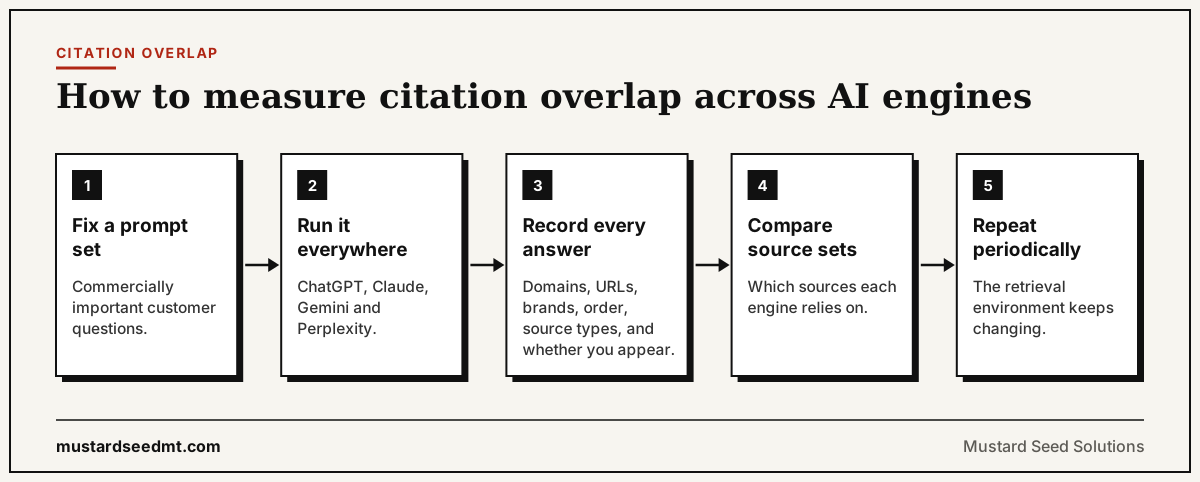
How should businesses measure citation overlap?
Create a fixed prompt set around commercially important customer questions.
Run those prompts across ChatGPT, Claude, Gemini, and Perplexity.
For every answer, record:
- Domains cited
- Exact URLs cited
- Brands mentioned
- Recommendation order
- Source types
- Whether your own domain appeared
- Whether third party pages mentioned you
- Which claims each citation supported
Then compare the source sets.
Repeat the test periodically because the retrieval environment changes.
Our AI visibility advisory focuses on this cross platform view instead of treating AI visibility as one universal ranking.