
At some point, founders and leadership teams realize that marketing needs senior ownership.
The question becomes whether to hire a full time Chief Marketing Officer or bring in a fractional CMO.
Both can provide strategic marketing leadership. The difference is how that leadership is structured, how much capacity you need, and whether the business is ready to support a permanent executive role.
Fractional CMO vs Full Time CMO at a Glance
| Area | Fractional CMO | Full Time CMO |
|---|---|---|
| Commitment | Part time | Full time |
| Cost | Lower total commitment | Higher total commitment |
| Availability | Agreed hours or days | Dedicated |
| Best stage | Early growth, transition, market entry | Larger or more mature marketing organization |
| Flexibility | High | Lower |
| Hiring risk | Lower | Higher |
| Team leadership | Yes | Yes |
| Execution | Usually through team and partners | Usually through internal team and partners |
1. Cost
Cost is one of the most obvious differences.
A full time CMO requires salary, employer costs, benefits, recruiting effort, onboarding, and usually a longer term commitment.
A fractional CMO provides access to senior experience without requiring a full time executive package.
That does not mean a fractional CMO is cheap.
You are paying for senior judgment and experience.
The difference is that the company buys the amount of leadership it currently needs.
For a growing company, this can make the economics easier to justify.
2. Time and Availability
A full time CMO is dedicated to one company.
They can be involved in daily management, internal politics, hiring, meetings, executive planning, campaign reviews, budgeting, and team development.
A fractional CMO works within a defined time commitment.
That requires focus.
Their role is generally more effective when priorities are clear and their time is concentrated on high value decisions.
If your organization needs constant daily executive involvement, a full time CMO may be more appropriate.
If your company needs senior direction several days each month while execution happens through other people, a fractional model may be enough.
3. Business Stage
A fractional CMO often fits companies that have outgrown founder led marketing but are not yet ready for a permanent executive hire.
Common situations include:
- 1A startup has found product market fit and needs a repeatable go to market model
- 2A technology company is entering a new country
- 3A founder is still approving every marketing decision
- 4Several freelancers or agencies are operating without central leadership
- 5The company needs a marketing strategy before building a larger team
- 6Revenue has grown faster than the marketing function
A full time CMO becomes more compelling when marketing has become a large permanent function with significant budget, headcount, organizational complexity, and daily leadership requirements.
4. Strategic Responsibilities
A strong fractional CMO and a strong full time CMO may work on many of the same strategic questions.
These can include:
- 1Who is the priority customer?
- 2How should the company be positioned?
- 3Which markets should receive investment?
- 4Which channels should drive growth?
- 5What should marketing own within the revenue process?
- 6How should the company measure pipeline contribution?
- 7How should content support sales?
- 8Where should AI improve marketing efficiency?
- 9How should agencies and specialists be managed?
- 10What capabilities should be built internally?
The title alone does not determine the strategic quality.
Experience, judgment, company fit, and operating discipline matter more.
5. Team Leadership
A full time CMO can spend more time developing people and managing the organization.
They can be deeply involved in hiring, performance management, career development, compensation, processes, and team culture.
A fractional CMO can still lead and mentor a marketing team, but their time is more limited.
That means the operating model matters.
A fractional CMO works best when someone inside the company can handle day to day coordination or when execution is handled by experienced specialists.
6. Flexibility
Fractional leadership offers flexibility.
A company may need significant strategic support during a market entry, repositioning, funding stage, product launch, or restructuring period.
Later, the requirement may change.
A fractional model allows the company to adjust without immediately creating a permanent executive role.
A full time CMO is a deeper commitment.
That can be exactly what a mature organization needs, but the decision should reflect the actual scale of the marketing function.
7. Hiring Risk
Senior executive hiring is difficult.
A bad CMO hire can cost more than salary.
It can lead to:
- 1Lost time
- 2Team turnover
- 3Poor positioning
- 4Misallocated marketing spend
- 5Weak agency decisions
- 6Delayed growth initiatives
- 7Another executive search
Fractional leadership can reduce some of that risk because the company can access senior capability without making the same long term commitment.
It can also help a company define what it actually needs from a future full time CMO.
8. Execution Capacity
Neither type of CMO should be expected to personally execute every campaign.
Senior marketers create leverage through teams, systems, technology, agencies, and specialists.
The difference is that a full time CMO may have more time to manage a large internal organization.
A fractional CMO often operates with a leaner model.
For example:
Fractional CMO + internal marketing manager + specialist agencies + AI enabled workflows
For some B2B companies, this can provide enough capability without immediately building a large department.
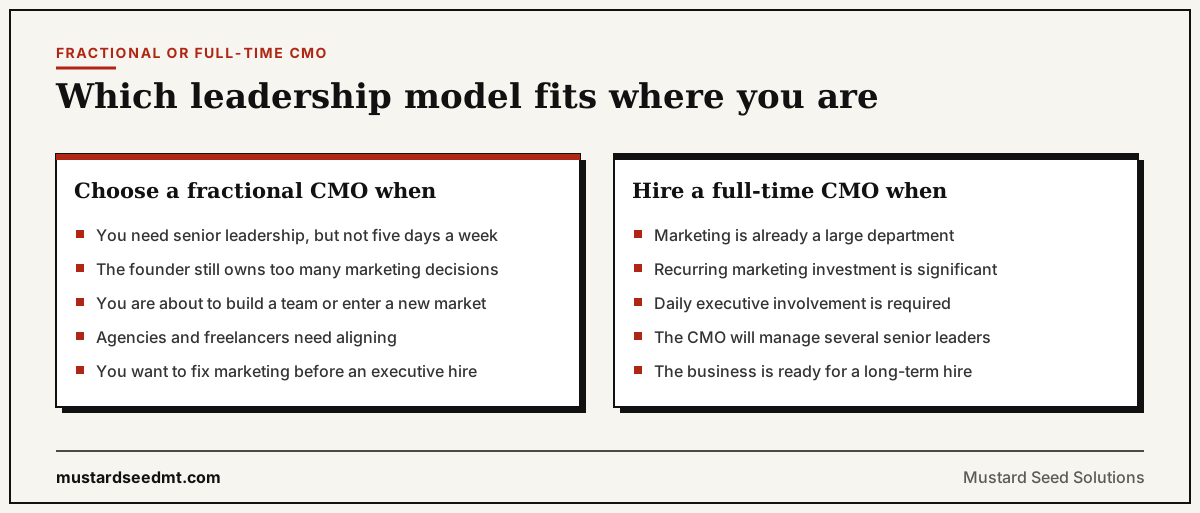
When to Choose a Fractional CMO
Consider a fractional CMO when:
- 1You need senior marketing leadership but not five days per week
- 2The founder still owns too many marketing decisions
- 3You are preparing to build a marketing team
- 4You need help entering a new market
- 5You need someone to align agencies and freelancers
- 6Marketing lacks strategic priorities
- 7You want to improve marketing before committing to an executive hire
- 8You are restructuring the marketing function
When to Hire a Full Time CMO
A full time CMO may be the stronger choice when:
- 1Marketing is already a large department
- 2The company has significant recurring marketing investment
- 3Daily executive involvement is required
- 4The CMO will manage multiple senior marketing leaders
- 5Marketing is central to every major executive decision
- 6The business is ready for a long term executive hire
Can a Fractional CMO Help You Prepare for a Full Time CMO?
Yes.
This is one of the most practical uses of fractional leadership.
Before hiring permanently, a fractional CMO can help:
- 1Clarify the marketing strategy
- 2Define the team structure
- 3Establish KPIs
- 4Improve reporting
- 5Audit agencies and tools
- 6Create a realistic budget
- 7Identify the experience required from the future CMO
The eventual full time executive then inherits a stronger function.
Final Thoughts
The decision between a fractional CMO and a full time CMO is mostly a question of organizational need.
If your business needs senior marketing judgment but does not yet require a dedicated executive every day, fractional leadership can be a practical solution.
If your marketing organization has reached the scale where senior leadership is a continuous full time responsibility, hiring permanently may be the better move.
Mustard Seed Solutions helps B2B technology companies build marketing strategy, strengthen go to market execution, and create a marketing operating model that matches their stage of growth.