

Companies often know they need someone to lead marketing, but the job title is less obvious.
Should you hire a Head of Marketing?
Or should you consider working with a fractional CMO?
The answer depends on the maturity of your business, the size of the marketing function, the amount of daily execution required, and the level of strategic experience you need.
Fractional CMO vs Head of Marketing at a Glance
| Area | Fractional CMO | Head of Marketing |
|---|---|---|
| Typical focus | Executive strategy and leadership | Strategy plus daily management |
| Employment model | Part time external | Usually full time internal |
| Seniority | Executive level | Senior management |
| Daily availability | Limited | High |
| Team management | Yes | Yes |
| Execution involvement | Selective | Usually more hands on |
| Best for | Businesses needing senior leadership flexibly | Businesses needing a permanent operational leader |
1. Strategic Seniority
A fractional CMO is generally expected to operate at executive level.
They should connect marketing decisions to broader business questions such as:
- 1Revenue priorities
- 2Market selection
- 3Positioning
- 4Customer segmentation
- 5Product strategy
- 6Sales alignment
- 7Budget allocation
- 8International expansion
- 9Brand development
- 10Organizational design
A Head of Marketing can also be highly strategic, but the role often includes more operational responsibility.
They may spend more time managing campaigns, reviewing content, coordinating teams, tracking projects, and making sure work gets delivered.
2. Daily Operations
A Head of Marketing is usually inside the company every day.
That makes the role well suited for teams that require continuous coordination.
They can manage:
- 1Weekly campaign execution
- 2Content calendars
- 3Agency briefs
- 4CRM processes
- 5Event preparation
- 6Website projects
- 7Social media
- 8Reporting
- 9Internal stakeholder requests
- 10Team workload
A fractional CMO has less time available.
Their value comes from prioritization, decision making, leadership, and leverage.
If a company expects the fractional CMO to personally run every campaign and approve every social post, the operating model is probably wrong.
3. Cost and Commitment
Hiring a full time Head of Marketing creates a permanent role.
That includes salary, employer costs, recruitment, onboarding, management time, and long term commitment.
A fractional CMO provides senior input without the same full time cost structure.
This can be attractive to companies that need seniority more than they need daily executive capacity.
The tradeoff is availability.
You should not choose fractional leadership simply because it costs less.
Choose it when the company genuinely does not require a full time senior executive.
4. Team Leadership
Both roles can lead marketing teams.
The difference is how closely they are involved.
A Head of Marketing can coach employees daily, review work continuously, manage schedules, and handle operational issues quickly.
A fractional CMO may lead at a higher level by:
- 1Defining team structure
- 2Setting objectives
- 3Mentoring key people
- 4Recruiting specialists
- 5Establishing KPIs
- 6Managing agency relationships
- 7Reviewing priorities
- 8Building operating processes
For a small team, this may be enough.
For a large team with several junior employees who need daily support, an internal Head of Marketing may be more appropriate.
5. Founder Dependency
Many growing companies have a hidden marketing structure:
Founder + freelancers + agencies + one junior marketer.
The founder is effectively the Head of Marketing.
They approve messaging, choose channels, review campaigns, manage agencies, and decide the budget.
This eventually becomes a bottleneck.
A fractional CMO can be useful here because they can remove strategic marketing responsibility from the founder without requiring the company to immediately hire a large permanent team.
A Head of Marketing can also solve the problem, especially if the company needs strong daily execution.
The main question is whether the business needs senior strategic judgment or daily operating capacity most.
6. Market Entry
Market expansion is a good example of where fractional leadership can be valuable.
Entering a new country may require decisions about:
- 1Positioning
- 2Localization
- 3Customer segments
- 4Competitors
- 5Partnerships
- 6Content
- 7Lead generation
- 8Events
- 9Sales support
- 10Local agencies
The company may need experienced leadership intensely during the expansion stage but not require a permanent CMO in that market.
A fractional model can match that situation well.
7. Building the Marketing Function
A fractional CMO can help design the marketing organization before permanent hiring decisions are made.
They can determine:
- 1Which roles should be internal
- 2Which capabilities can remain outsourced
- 3Whether the company needs a marketing manager
- 4Which agency relationships should continue
- 5Which marketing technology is necessary
- 6How performance should be measured
- 7What the budget should prioritize
Once the structure is clear, the company may then hire a Head of Marketing to run the operation daily.
This sequence can reduce hiring mistakes.
When to Choose a Fractional CMO
A fractional CMO may fit when:
- 1You need executive level marketing expertise
- 2The founder is still leading marketing
- 3Your company is entering a new market
- 4You need to redesign the marketing function
- 5Several agencies or specialists require coordination
- 6You need stronger strategy before increasing execution
- 7You do not yet need a senior marketer full time
When to Hire a Head of Marketing
A Head of Marketing may fit when:
- 1You need someone available every day
- 2There is already a steady volume of marketing activity
- 3A team needs daily management
- 4Campaign execution is the main bottleneck
- 5Strategy is reasonably clear
- 6Marketing requires continuous coordination with other departments
- 7You are ready to build a permanent internal function
A Hybrid Model
The two roles can also work together.
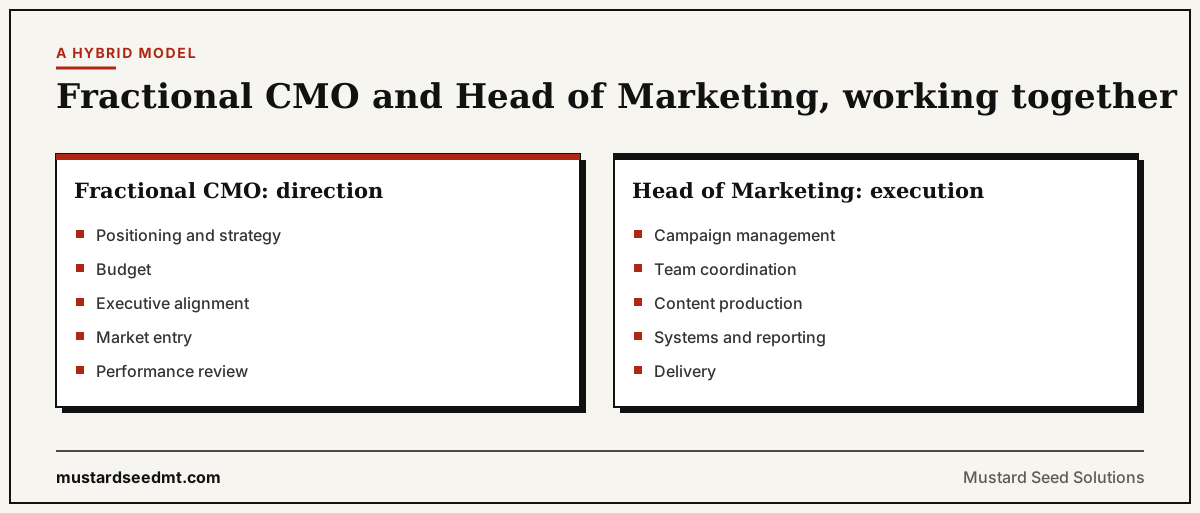
A fractional CMO can provide executive direction while a Head of Marketing owns daily execution.
This can be effective when a company has a capable operational marketing leader who would benefit from more experienced strategic support.
For example:
Fractional CMO: positioning, strategy, budget, executive alignment, market entry, performance review
Head of Marketing: campaign management, team coordination, content production, systems, reporting, delivery
The structure gives the company both senior judgment and daily operating capacity.
Final Thoughts
The right question is not which title sounds more senior.
The right question is what work needs to be done.
If your company needs an experienced marketing executive to create direction, align the organization, and build the function without a full time commitment, a fractional CMO may be the better fit.
If you already have strategic clarity and need someone to run marketing every day, a Head of Marketing may be more appropriate.
Mustard Seed Solutions helps B2B technology companies create practical marketing strategies and build flexible marketing models around the capabilities they actually need.