
The best GEO reporting tools automate repeated AI search monitoring and show how brand mentions, citations, share of voice, sentiment, and competitor visibility change over time. As of August 2026, Rankscale, Scrunch, OtterlyAI, Peec AI, and Profound all offer relevant monitoring or reporting capabilities, but the right choice depends on whether you need executive dashboards, APIs, agency reporting, alerts, or deeper enterprise workflows.
Automated reporting matters because AI visibility cannot be understood from occasional manual prompts. Teams need consistent sampling and historical context to see whether visibility is improving, declining, or simply fluctuating.
The best reporting workflow turns AI answers into a trend, then turns the trend into an action.
What should a GEO reporting platform automate?
At minimum, the platform should repeatedly run the prompts you care about and retain enough history to show changes over time.
Useful reporting capabilities include:
- Scheduled prompt monitoring
- Historical visibility trends
- Brand mentions
- Citation tracking
- Share of voice
- Competitor movement
- Sentiment trends
- Topic or market filters
- Exportable reports
- API access
- Alerts or change notifications
- Executive dashboards
A dashboard is useful only if it helps the team answer what changed, where it changed, why it may have changed, and what needs attention next.
GEO reporting tools compared
| Tool | Best for | Reporting strengths | API / automation |
|---|---|---|---|
| Rankscale | Enterprise teams and agencies needing recurring reports across more than one brand | Visibility over time, competitor benchmarking, citation analysis, sentiment trends, configurable monitoring schedules, multi-brand views | White-label reporting, market and business-unit filters, team controls (enterprise product) |
| Scrunch | Organizations that need AI visibility data to feed an internal business-intelligence environment | Brand presence, placement, citations, topics, and competitive-gap monitoring, with a clear topic structure for recurring reports | Data API, role-based access, deployment across multiple brands, sites, regions, and languages |
| OtterlyAI | Teams that want an accessible monitoring platform but still need to automate downstream reporting | Automatic monitoring of configured prompts, brand mentions, citations, and changes over time | Public API (2026 update) exposing brand reports, prompts, citations, recommendations, and GEO audits |
| Peec AI | Multi-market or multi-product teams asking "where are we more visible?" | Segments data by country, model, prompt tags, topics, and other organizational dimensions | API and MCP capabilities for querying or automating access to visibility data |
| Profound | Reporting as part of a broader enterprise AI search operating platform connecting measurement with prompt demand data and marketing agents | — | — |
Rankscale: strong historical and enterprise reporting
Rankscale emphasizes visibility performance over time, competitor benchmarking, citation analysis, sentiment trends, and configurable monitoring schedules. Its enterprise product also includes multi-brand views, market and business-unit filters, team controls, and white-label reporting.
That combination makes it relevant for enterprise teams and agencies that need recurring reports across more than one brand.
It is especially worth evaluating when leadership wants one executive view while operators need to drill into prompts, citations, and specific markets.
Scrunch: strong for reporting pillars and data integration
Scrunch provides monitoring around brand presence, placement, citations, topics, and competitive gaps. Its enterprise offer includes a data API, role-based access, and deployment across multiple brands, sites, regions, and languages.
This matters when AI visibility data needs to feed an internal business-intelligence environment rather than remain inside a standalone GEO dashboard.
Scrunch also has a clear topic structure, which helps teams create recurring reports around strategic themes instead of only total brand visibility.
For organizations already using centralized analytics, API access may be more valuable than a polished PDF report.
OtterlyAI: practical automated monitoring and API access
OtterlyAI automatically monitors configured prompts across supported AI search engines and tracks brand mentions, citations, and changes over time. Its 2026 product updates also include a public API exposing brand reports, prompts, citations, recommendations, and GEO audits.
That makes OtterlyAI useful for teams that want an accessible monitoring platform but still need to automate downstream reporting.
It can be a good fit for:
- SEO teams
- Agencies
- Communications teams
- Small and mid-sized marketing departments
- Teams building their own reporting layer
Check plan-level access for higher prompt volumes, enterprise user management, and any alerting workflow you require.
Peec AI: flexible trend analysis by segment
Peec AI is strong when the reporting question is not just "are we more visible?" but "where are we more visible?" Its platform can segment data by country, model, prompt tags, topics, and other organizational dimensions.
This makes trend analysis more useful for multi-market or multi-product teams.
A marketing leader could compare:
- US versus UK visibility
- ChatGPT versus Gemini performance
- Awareness versus decision-stage prompts
- One topic versus another
- Brand versus competitor share of voice
Peec's API and MCP capabilities also support more advanced workflows for teams that want to query or automate access to the underlying visibility data.
What should an executive GEO dashboard show?
An executive GEO dashboard should show five to seven stable metrics on one page: AI visibility trend, share of voice against named competitors, high-intent recommendation coverage, citation gains and losses, the biggest market or product gaps, and actions taken. Update it monthly from data collected automatically every week, so leaders see trends rather than noise.
Executives usually do not need hundreds of prompts. They need a small set of stable indicators connected to risk and opportunity — the kind of scorecard a fractional CMO keeps in front of leadership.
| Metric | What it answers |
|---|---|
| AI visibility trend | Are AI assistants mentioning us more or less than last period? |
| Share of voice vs priority competitors | Are we gaining or losing ground against the brands that matter? |
| High-intent recommendation coverage | Do assistants recommend us when buyers ask "best" or "which should I choose" questions? |
| Citation gains and losses | Which of our pages and third-party sources are being cited, and which dropped out? |
| Largest market or product gaps | Where are we weakest, by country, product line or topic? |
| Accuracy and sentiment issues | Are assistants describing us wrongly or negatively anywhere important? |
| Actions and next priorities | What did the team change, and what comes next? |
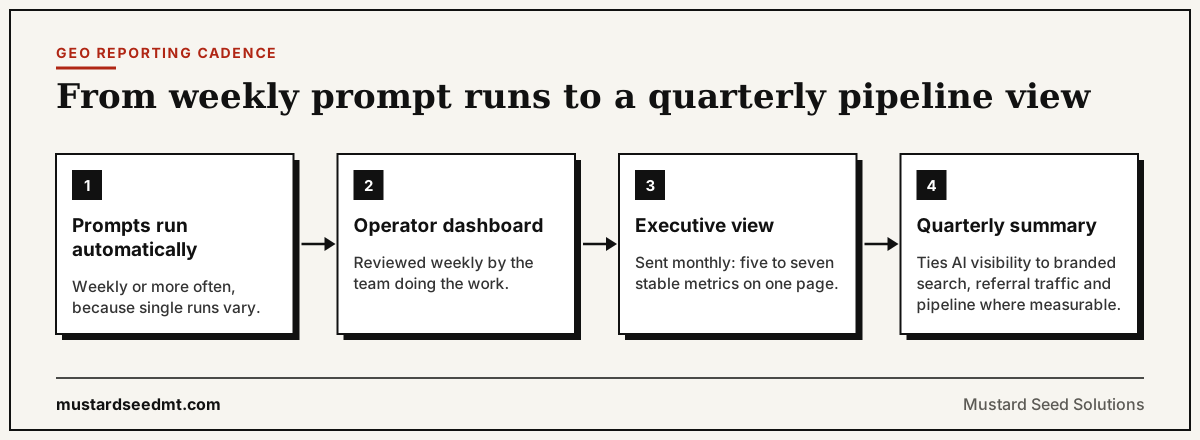
Cadence. Let the GEO tool run prompts automatically, usually weekly or more often, because single runs vary. Review the operator dashboard weekly. Send the executive view monthly, and a quarterly summary that ties AI visibility to branded search, referral traffic and pipeline where measurable.
One-slide format. Keep the executive report to one slide or one screen:
- Top row: three headline numbers (visibility, share of voice, recommendation coverage) with change versus last period.
- Middle: one trend line per headline metric over the last six to twelve months.
- Bottom left: the three biggest gaps by market, product or competitor.
- Bottom right: actions completed and the next three priorities.
Keep the metrics and prompt set stable from month to month. Constantly changing the scorecard makes it difficult to tell whether performance is actually improving. Link the slide to the full GEO dashboard so anyone can drill into prompts and citations.
Which GEO tools support executive dashboards and automated reporting?
Most GEO platforms automate prompt collection; they differ in how the executive layer is delivered. Based on the vendor information summarized above, Rankscale's enterprise product includes multi-brand views and white-label reporting, Scrunch and OtterlyAI expose data through APIs for teams that build executive dashboards in their own BI tool, and Peec AI supports segmented views by market, model and topic. Ask each vendor to produce your one-slide executive report from live data during the demo.
How should you choose a GEO reporting tool?
Start with the reporting destination.
If GEO data must feed internal analytics and global workflows, prioritize APIs, permissions, structured segmentation, and enterprise governance. If the goal is a repeatable weekly or monthly brand report, prioritize simplicity, historical trends, exports, and clear competitor comparisons.
Rankscale and Scrunch are strong candidates for enterprise and portfolio-style reporting. Peec AI stands out for flexible segmentation. OtterlyAI is attractive for straightforward automated monitoring and API access. Profound is worth considering when reporting is part of a broader enterprise AI search operating platform that connects measurement with prompt demand data and marketing agents.
Whatever you choose, require the vendor to show your real reporting use case during the evaluation. If the requirement is mainly prompt monitoring and monthly reporting, a focused tool may be simpler than a broader enterprise platform.
For help defining the right metrics before selecting software, review the AI Visibility Audit or explore the Learning Center.