

The best global GEO tools let marketing teams measure AI visibility by country, language, market, model, and topic instead of relying on one blended global score. As of August 2026, Peec AI, Scrunch, Rankscale, AthenaHQ, and OtterlyAI all offer useful capabilities for international AI visibility programs, but they differ in how deeply they support regional segmentation and enterprise workflows.
A global brand can appear strongly in one market and barely appear in another. The same prompt can also produce different answers when the language, location, product category, or AI engine changes.
That makes regional measurement a core GEO requirement for companies operating across Europe, Asia, North America, or multiple language markets.
What should a global GEO tool track?
A global GEO platform should make regional differences visible rather than hiding them inside one average. At minimum, teams should be able to organize prompts and results around the markets where customers actually buy.
Look for capabilities such as:
- Country and region filters
- Language-specific prompt tracking
- Separate prompt sets by market
- Competitor benchmarking by country
- Brand visibility by AI engine
- Topic or product segmentation
- Historical trends by region
- Exportable or API-accessible reporting
- Workspaces or permissions for regional teams
A useful test is simple: can your Poland team, UK team, and US team each see their own AI visibility while headquarters still gets a consolidated view?
How do you measure AI visibility by country or market?
Measure AI visibility by country with prompts written in each market's language, a country or location setting on every prompt run, and the AI engines that buyers in that market actually use. Report each market separately before rolling markets up, so a strong home market does not hide a weak one.
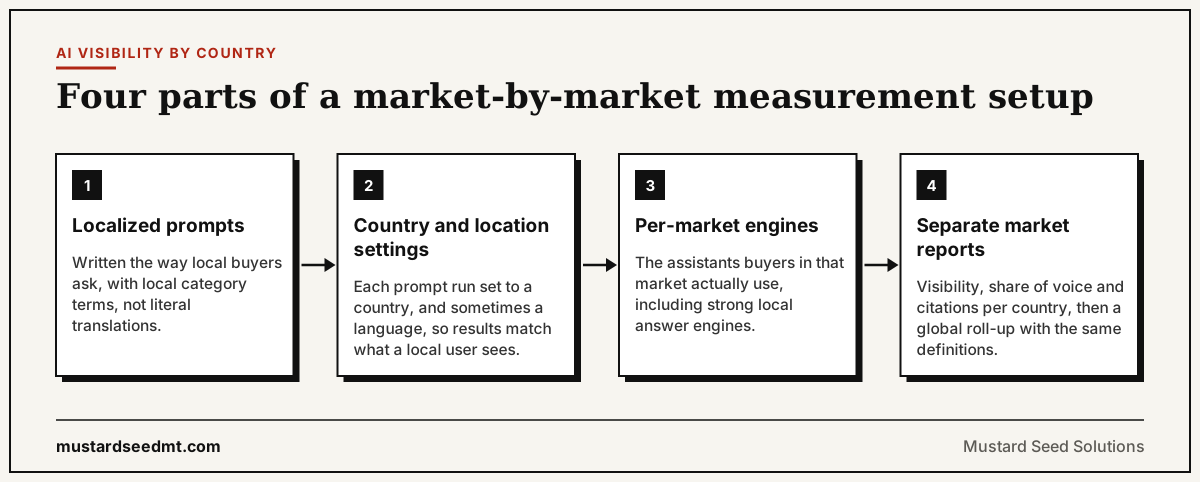
A market-specific measurement setup has four parts:
- Localized prompts in the local language. Write prompts the way local buyers ask, with local category terms, not literal translations.
- Country and location settings. AI answers can change with the user's location. Market-specific AI visibility tools let you assign a country, and sometimes a language, to each prompt so results reflect what a user in that market would see. Ask vendors how they set location (for example by proxy or IP location) and which countries they support.
- Per-market engines. ChatGPT, Google AI Overviews, Gemini, Perplexity and Copilot cover most Western markets, but some markets have strong local answer engines. Check whether your tool covers them, or sample them separately.
- Separate market reports. Show visibility, share of voice and citations per country, with local competitors, then a global roll-up with the same metric definitions.
| Market | Local AI answer surfaces to consider |
|---|---|
| United States, UK, most of Europe | ChatGPT, Google AI Overviews and AI Mode, Gemini, Perplexity, Microsoft Copilot |
| South Korea | Naver's AI Briefing, which Naver says runs on its HyperCLOVA X model, alongside global assistants |
| Russia | Yandex Neuro and Alice, built on YandexGPT |
| Mainland China | Baidu search with ERNIE built in, plus chat apps such as DeepSeek and Doubao; ChatGPT and Gemini are not officially offered there |
Coverage of these local engines varies between GEO tools. If a priority market depends on one, confirm coverage in the demo or sample it manually.
Which GEO tools are strongest for multi-country tracking?
Peec AI is particularly strong when market segmentation is central to the program. Its public product documentation supports filtering visibility by country, model, prompt tags, topics, and audience dimensions. This makes it practical for comparing the same category across markets or separating awareness prompts from purchase-intent prompts.
Rankscale is a strong fit for brands that want broad country coverage combined with centralized enterprise management. Its enterprise product materials emphasize tracking across many countries and languages, with data that can be sliced by market, business unit, engine, and timeframe.
Scrunch is well suited to organizations that need global deployment across brands, sites, regions, and languages. Its enterprise positioning also includes role-based access and a data API, which matters when regional teams need access without giving every user the same permissions.
AthenaHQ is worth evaluating for enterprises that want a shared GEO framework across multiple brands, regions, languages, or markets. Its published guidance emphasizes separating performance by market while using standardized KPIs centrally.
OtterlyAI is a practical option for teams that want dedicated country monitoring without a heavy enterprise implementation. It supports automated prompt monitoring and country-specific tracking, making it useful for smaller international teams and agencies.
Global GEO tools compared (August 2026)
| Tool | Best for | Regional segmentation strengths | Enterprise features |
|---|---|---|---|
| Peec AI | Programs where market segmentation is central | Filtering visibility by country, model, prompt tags, topics, and audience dimensions | — |
| Rankscale | Broad country coverage with centralized enterprise management | Tracking across many countries and languages, sliced by market, business unit, engine, and timeframe | Centralized enterprise management |
| Scrunch | Global deployment across brands, sites, regions, and languages | Multi-brand, multi-region, multi-language deployment | Role-based access and a data API |
| AthenaHQ | Enterprises wanting a shared GEO framework across brands, regions, languages, or markets | Separates performance by market | Standardized KPIs used centrally |
| OtterlyAI | Dedicated country monitoring without heavy enterprise implementation | Automated prompt monitoring and country-specific tracking | — |
How should you structure regional prompt tracking?
Do not simply translate one English prompt list into several languages. A stronger setup starts with common global questions, then adds market-specific questions that reflect local terminology, competitors, regulations, buyer priorities, and product availability.
For example, a cybersecurity vendor might track a common global theme such as "best zero trust platform for a mid-market company" across several countries. It should then add local variants around procurement rules, language preferences, regional competitors, and compliance requirements.
A practical prompt structure includes:
- Global category prompts used in every market
- Local category language
- Country-specific competitors
- Product or use-case prompts
- Local purchase constraints
- Language variants
- Regional comparison prompts
- Brand perception questions
This gives you both a comparable global baseline and a realistic local view — the same discipline a go-to-market consultant applies when a brand enters a new region.
How do you track region-specific product features in AI answers?
Track region-specific product features with prompts that name the feature and the market together, then check whether AI answers say the feature exists, is available in that country and is described correctly. Optional features and regional variants are often missing or wrong in AI answers because most sources describe the global product.
A simple routine:
- List features or variants that differ by market, such as local payment options, data residency, language support, regional pricing tiers or certifications.
- Write one or two prompts per feature per market and tag them by feature and country, for example "Does [brand] offer EU data residency?" or "best [category] with [local payment method] in Poland."
- Score each answer: feature mentioned, availability stated correctly, details accurate, source cited.
- When answers are wrong, fix the source: a clear availability table on the local product page, localized feature pages and consistent wording in documentation and partner listings.
What metrics should regional teams compare?
Visibility percentage alone is not enough. A market can have a healthy mention rate while still losing the highest-intent prompts to competitors.
Track several dimensions together:
- Brand visibility
- Share of voice
- Citation frequency
- Recommendation frequency
- Competitor presence
- Sentiment or description quality
- Cited domains
- Prompt coverage
- Changes over time
For global reporting, keep the metric definitions consistent across markets. Regional teams can then add local interpretations without changing what the core KPIs mean.
Can AI visibility tools show regional audience behavior and preferences?
Yes, indirectly. AI visibility tools show how assistants answer buyers in each market: which brands they recommend, which buying criteria they stress, which local sources they cite and which questions come up. Read side by side by country, these answers reveal regional preferences that a single global report hides.
What to compare across markets:
- Buying criteria in answers. One market's answers may stress price, another compliance, another local support or language.
- Cited sources. Local review sites, media and directories show which sources shape opinion in that market.
- Recommended competitors. Local brands that appear often signal where buyers have different preferences.
AI answers reflect the sources engines use, not survey data about your buyers, so pair them with local search demand, analytics and sales feedback.
When should a company use separate regional workspaces?
Separate workspaces make sense when markets have different teams, brands, languages, agencies, or compliance requirements. They are less useful when they force headquarters to manually merge reports every month.
A good enterprise setup usually needs two levels of visibility. Regional users should be able to work inside their own market, while global leaders should be able to compare markets in one portfolio view.
Before buying a platform, ask how it handles:
- Shared prompts versus local prompts
- Central versus regional permissions
- Multi-brand structures
- Market-level competitors
- Local language tracking
- Executive rollups
- Data export and APIs
If these workflows require spreadsheets and manual reconciliation, the software may not scale well internationally.
How should you choose the right platform?
Choose based on the operating model, not the longest feature list. A centralized global marketing team has different needs from a federation of regional teams or an agency managing several international clients.
Peec AI is compelling when granular segmentation by country, topic, tag, and model matters. Rankscale and Scrunch deserve close attention when enterprise rollups, multi-brand management, and team controls matter. AthenaHQ fits teams designing a formal global GEO operating model, while OtterlyAI can be attractive when the priority is straightforward monitoring across countries without excessive complexity.
Capabilities and plan limits change quickly, so verify the exact regions, languages, refresh schedules, API access, and workspace permissions before signing a contract.
For a broader evaluation framework, see the AI Visibility Audit and the Learning Center.