
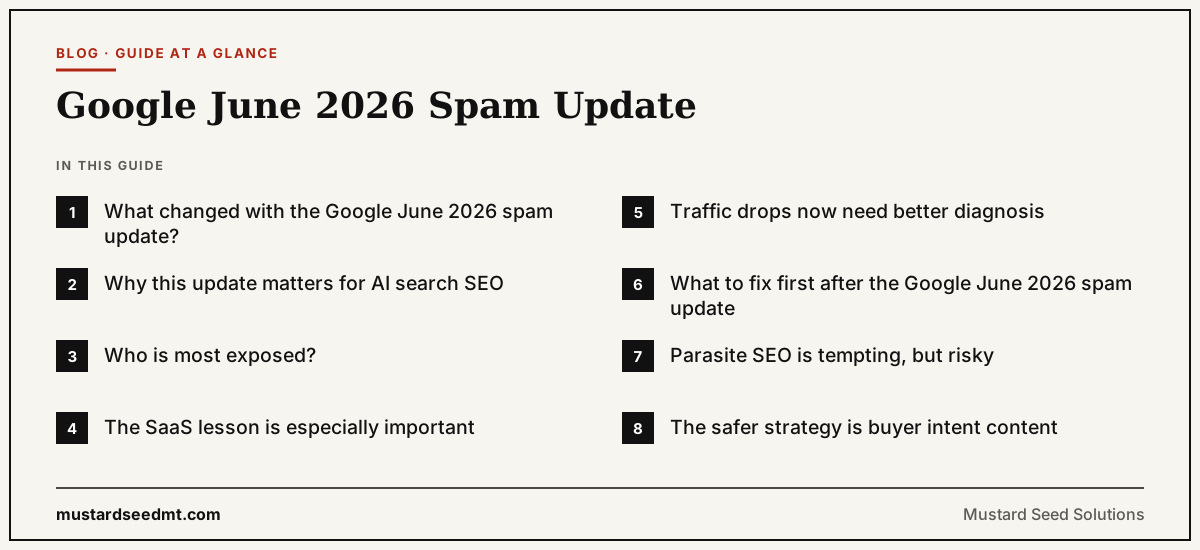
The Google June 2026 spam update moved fast, but the message is not subtle. Google is going after pages built to manipulate rankings, AI answers, and trust signals instead of helping real searchers.
The update started on June 24, 2026 and finished on June 26, according to the script source. It applied globally and across all languages. That short rollout does not mean the impact was small.
This update also landed right after weeks of search volatility, including the May 2026 core update and more unconfirmed movement around mid June. For business owners, marketers, and SEO teams, the bigger issue is clear: Google is now policing classic spam and AI search manipulation at the same time.
What changed with the Google June 2026 spam update?
The Google June 2026 spam update appears to target sites that rely on scale, shortcuts, and artificial authority. That includes scraped content, scaled AI pages, expired domain abuse, thin affiliate content, fake expertise, and pages built mainly to influence AI generated answers.
Google described it as a normal spam update, but the reaction from the SEO community was stronger than usual. Some sites saw sharp traffic movement. Others had trouble separating ranking losses from changes in impressions, clicks, Discover visibility, AI Overviews, and the search results layout.
That distinction matters. A traffic drop does not always mean your rankings collapsed. It may mean Google is showing your pages less often, users are clicking less because AI Overviews answer the query, or ads and forum results are taking more space.
Why this update matters for AI search SEO
AI search SEO is now part of the spam conversation. Google’s spam policies have expanded to include attempts to manipulate generative AI responses in search.
That changes the risk profile for many tactics that used to feel clever. A page written only to get quoted by AI, a fake authority profile designed to influence trust, or a keyword stuffed social post engineered to trigger an AI Overview may now sit closer to spam than strategy.
The uncomfortable truth is that AI search did not remove SEO risk. It created new surfaces where low quality tactics can spread faster. Google is responding by asking whether a page deserves to be trusted, cited, and shown inside a search experience that is becoming more AI driven every month.
Who is most exposed?
The most exposed sites are the ones that were built around shortcuts. They may have traffic, but they do not have much substance behind the traffic.
| Site type | Risky pattern | Better approach |
|---|---|---|
| Ecommerce | Thin product pages and copied manufacturer descriptions | Original product details, buying guidance, pricing, availability, returns, and comparisons |
| SaaS | Generic alternatives posts and fake integration pages | Product documentation, pricing pages, use cases, implementation guides, and customer proof |
| Finance | Generic explainers, fake author profiles, outdated rate pages | Real credentials, current data, transparent methodology, and useful calculators |
| Local business | Fake city pages and review spam | Real business profiles, clear contact details, local proof, citations, and useful service pages |
| Publishing and affiliate | Rewritten articles with no testing, reporting, or opinion | Original analysis, data, expert commentary, and research |
The pattern is simple. If the page exists because someone found a loophole, it is more vulnerable. If the page exists because a real buyer, reader, or customer needs it, it has a better chance.
The SaaS lesson is especially important
SaaS companies should pay close attention because many B2B sites have become bloated with low value comparison content. The script calls out generic comparison pages, AI written alternative posts, programmatic feature pages, copied review style roundups, and fake integration pages as obvious weak spots.
This matters because many SaaS teams publish pages around every competitor, every integration, every use case, and every feature without adding anything useful. That may create a large content footprint, but it does not create trust.
A stronger SaaS SEO strategy is built around real product value. Pricing pages, implementation guides, customer results, documentation, feature explanations, and honest comparison pages are much harder to dismiss as spam because they help buyers make decisions.
Traffic drops now need better diagnosis
After a Google update, the worst move is panic editing every page without knowing what actually changed. You need to separate ranking loss from search layout changes.
If impressions dropped, Google may be showing your pages less often. If rankings dropped, Google may have reassessed the page or site. If clicks dropped while rankings stayed stable, the results page may have changed around you.
AI Overviews, more ads, more forum results, more answered content, and more zero click behavior can all reduce traffic even when a page technically still ranks. That means your diagnosis needs to look at Search Console, rankings, click through rate, query mix, the live search results page, and your visibility in AI answers.
What to fix first after the Google June 2026 spam update
Start with the pages that look most manufactured. These are usually easy to find because they have weak evidence, repeated phrasing, thin sections, and a structure that feels written for an algorithm instead of a person.
- Remove or rewrite thin AI generated pages that add no original value.
- Improve pages with real experience, product detail, examples, methodology, or proof.
- Audit comparison and alternative pages for accuracy, fairness, and useful buyer context.
- Clean up keyword stuffing, city page duplication, and doorway style content.
- Review link building practices and stop anything based on mass exchanges or cheap spam links.
- Check whether Googlebot and human users see the same content to avoid cloaking issues.
- Update outdated pricing, product, rate, and availability pages where trust matters.
One practical editing trick from the script is simple: read the page out loud. If the writing sounds unnatural, repetitive, or stuffed with phrases no human would say, the page probably needs work.
Parasite SEO is tempting, but risky
Parasite SEO means using another site’s authority to rank content that would be harder to rank on your own domain. The script mentions platforms like social networks, video sites, review sites, publishing platforms, forums, and document hosting pages as common examples.
The tactic is popular because user generated content often ranks quickly and can sometimes get cited by AI systems. But that does not make it safe. When a post exists mainly to manipulate rankings, reputation, or AI responses, it can become part of the same spam pattern Google is trying to control.
There is a legitimate version of being visible on third party platforms. Publishing useful posts, customer proof, educational videos, and credible commentary can help discovery. The line gets crossed when the goal becomes manipulation rather than usefulness.
The safer strategy is buyer intent content
The strongest long term SEO strategy is still straightforward: create pages for people who are already looking for what you offer but do not know your brand yet.
That means targeting real search intent. Not vague awareness topics forever. Not thousands of pages with slightly different keywords. Not fake expertise. Real pages that answer buyer questions, compare options honestly, explain fit, and help someone decide whether your business is relevant.
This is where SEO and AI visibility overlap. A page that clearly explains the problem, the solution, the tradeoffs, the proof, and the next step is more useful to search engines, AI systems, and human buyers.