A consulting proposal is the confirmation of a conversation you've already had, not a cold sales pitch. The best proposals reflect the client's situation back to them, focus on the outcome they want, and make saying yes easy.
This guide covers the exact sections a winning proposal needs, a copy-paste structure, and the mistakes that quietly lose deals.
First: never propose before you understand
The single biggest mistake is sending a proposal before a real discovery conversation. If you don't yet know the client's problem, goal, and budget, you're guessing, and guessing proposals lose. Have the conversation first; the proposal formalises it.
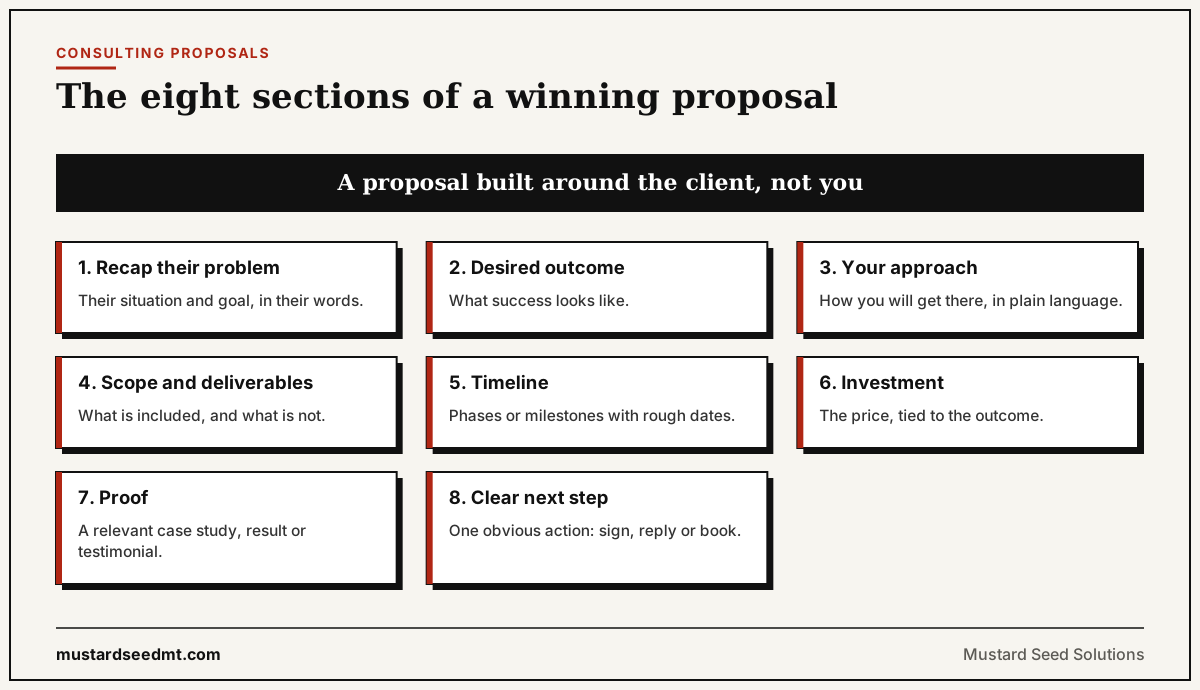
The 8 sections of a winning proposal
1. Recap their problem
Open by restating the client's situation and goal in their words. This proves you listened and frames everything that follows around them, not you.
2. Desired outcome
State the result they want and what success looks like. Anchor the proposal to outcomes, not just activities.
3. Your approach
Explain how you'll get them there, in plain language. Enough detail to build confidence, not so much that it reads like a manual.
4. Scope & deliverables
List exactly what's included — and, briefly, what's not. Clear scope prevents the disputes that sink solo projects.
5. Timeline
Give phases or milestones with rough dates. Clients want to know when, not just what.
6. Investment
Present the price as an investment tied to the outcome. Offer one option, or a few tiered packages, and keep it clear.
7. Proof
Add a short case study, result, or testimonial relevant to their situation. Proof reduces the perceived risk of hiring you.
8. Clear next step
End with one obvious action — sign, reply, or book a call. Don't leave them wondering what happens next.
Each section answers a question the client is already asking; the order moves from their problem to your price to the next step.
Keep it short and skimmable
Clients skim. For a solo consultant, one to three focused pages beats a long document. Make the outcome, scope, price, and next step easy to find at a glance.
You've won when the client reads it and thinks "this is my situation, the price makes sense for that outcome, and I know what to do next." A tailored, low-risk proposal beats a long, salesy one.
Pricing is its own skill. If you're unsure what to put in the investment section, see how to price your services.
Frequently Asked Questions
How do I write a consulting proposal?
Lead with the client's problem and desired outcome, then your approach, scope and deliverables, timeline, investment, proof, and a clear next step. Keep it focused on their result rather than your process. A good proposal is a confirmation of a conversation you've already had, not a cold pitch.
How long should a consulting proposal be?
As short as it can be while still being clear — often one to three pages for a solo consultant. Clients skim. A tight, well-structured proposal that's easy to say yes to beats a long document that buries the offer.
Should I include pricing in the proposal?
Yes. Present the price as an investment tied to the outcome, ideally after you've established the value. Offer one clear option or a few tiered packages. Leaving price out usually slows the decision rather than helping it.
When should I send a proposal?
After a discovery conversation where you understand the client's problem, goals, and budget — not before. A proposal should confirm and formalise what you already discussed. Sending one cold, without that conversation, dramatically lowers your win rate.
What makes a consulting proposal win?
It clearly reflects the client's situation, focuses on their outcome, removes risk with proof, makes the scope and price easy to understand, and ends with one obvious next step. Winning proposals feel tailored and low-risk, not generic and salesy.
What are common proposal mistakes?
Making it about you instead of the client, vague scope that invites scope creep, too much jargon, burying or hiding the price, no proof, and no clear call to action. Sending a proposal before truly understanding the client's needs is the biggest one.