Discovery Call Questions (and How to Run the Call)
A discovery call has one job: to understand the client deeply enough that your proposal almost writes itself. The best consultants don't pitch on this call. They ask good questions, listen, and qualify the fit.
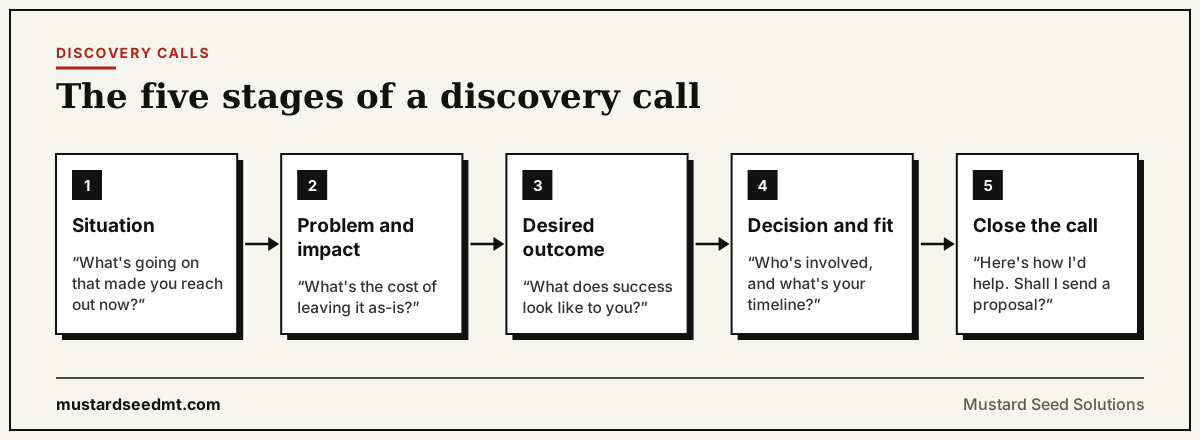
Below is a five-stage structure with the questions that matter at each step.
The 80/20 rule of discovery
Spend about 80% of the call listening and 20% talking. Your job is to draw out the problem, its impact, and the outcome they want. You earn the right to propose by understanding them first.
Questions by stage
Situation
"What's going on that made you reach out now?"
"How are you handling this today?"
"Who else is affected by this?"
Problem & impact
"What's the cost of leaving it as-is?"
"What have you already tried?"
"What happens if this isn't solved in 6 months?"
Desired outcome
"What does success look like to you?"
"How would you measure that?"
"What would change for you if this worked?"
Decision & fit
"Who's involved in the decision?"
"What's your timeline?"
"Do you have a budget range in mind?"
Close the call
"Is there anything I haven't asked that I should?"
"Based on this, here's how I'd help — shall I send a proposal?"
Qualifying protects your time, and theirs. Not every caller is a fit. Ask about timeline, budget, and decision process early. A clean "not now" beats a bad-fit project you regret taking.
Once the call ends well, move straight to a consulting proposal that reflects exactly what you heard.
Ask about timeline, budget and decision process early. A clean “not now” beats a bad-fit project.
Frequently Asked Questions
What questions should I ask on a discovery call?
Cover five areas: the client's situation, the problem and its impact, their desired outcome, the decision process and budget, and a clear close. Good discovery questions are open-ended and focused on understanding the client deeply — not on pitching your service early.
How do I run a discovery call?
Listen far more than you talk. Move through situation, problem and impact, desired outcome, then decision and fit, and end by confirming a next step. Aim to spend most of the call understanding the client; you earn the right to propose by understanding them first.
How long should a discovery call be?
Usually 20 to 45 minutes. Long enough to genuinely understand the situation and qualify fit, short enough to respect everyone's time. If it needs longer, that's often a sign the project warrants a paid scoping session.
Should I pitch on a discovery call?
Not heavily. The discovery call is for understanding, not pitching. Once you understand the problem and goal, you can briefly say how you'd help and offer to send a proposal. Pitching too early, before you understand them, is the most common discovery-call mistake.
How do I qualify a client on the call?
Ask about the decision process, timeline, and budget range, and listen for fit with the work you do best. Qualifying protects your time and theirs — not every enquiry is a good match, and identifying that early is a feature, not a failure.
How do I end a discovery call?
Summarise what you heard, confirm you can help, and state one clear next step — usually sending a proposal or booking a follow-up. Don't leave it vague. A confident, specific close turns a good conversation into actual work.