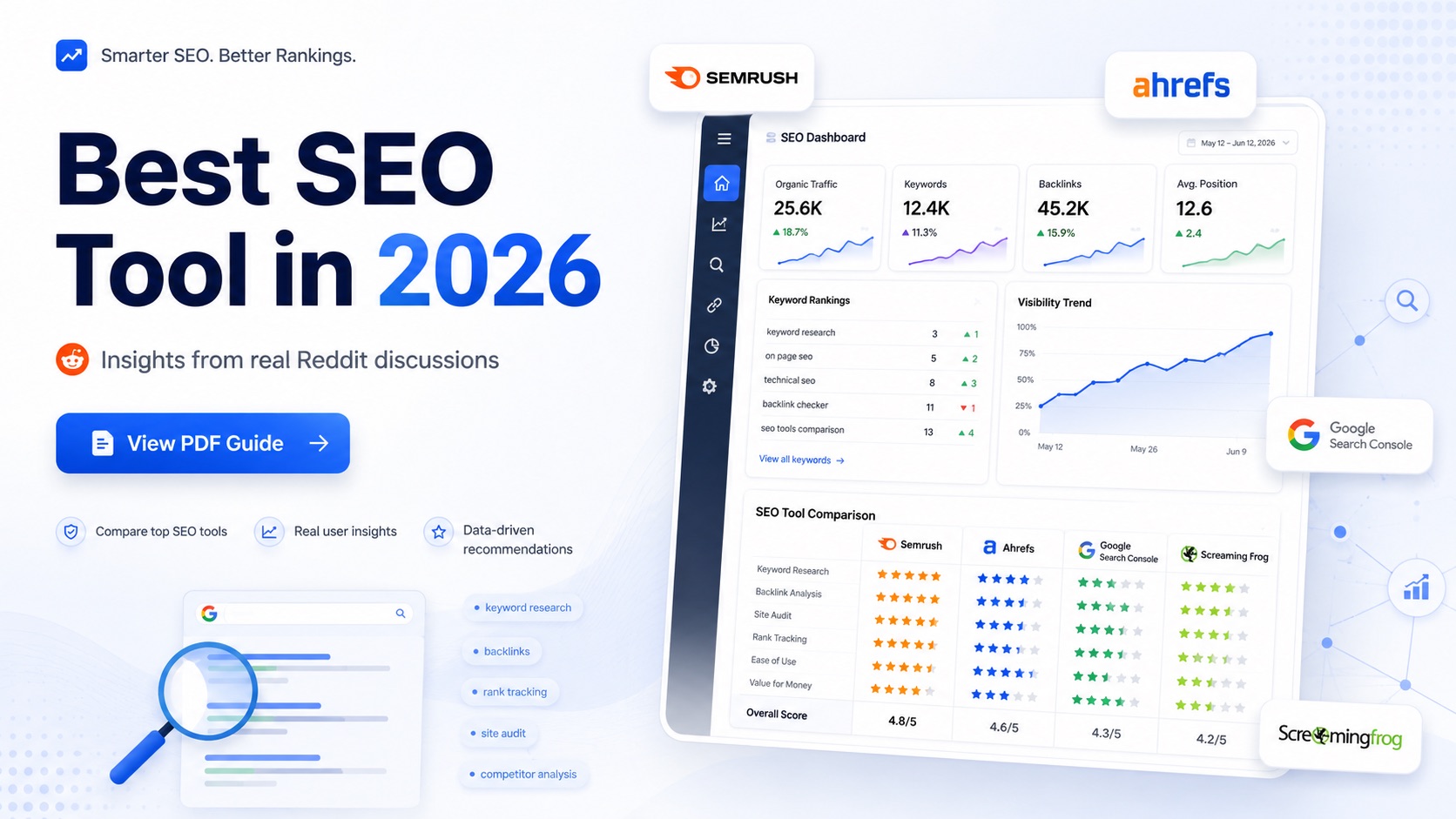
A Reddit best SEO tool 2026 discussion started with a simple buying question and quickly turned into a much more uncomfortable debate about wasted software spend. The strongest takeaway was that there is no universal winner: Ahrefs, Semrush, SE Ranking, Screaming Frog, AI assistants, and smaller workflow tools all solve different problems, while many marketers still buy large platforms before defining what work is actually stuck.
The discussion focused on a familiar frustration. SEO platforms now overlap across keyword research, backlinks, technical audits, content optimization, competitor analysis, reporting, rank tracking, AI visibility, and outreach. A business can easily end up with multiple subscriptions that all produce data, but still leave the team unsure what to do next.
That is the real commercial question behind the comparison. The best SEO tool is not automatically the one with the longest feature list. It is the one that removes a real bottleneck, fits the operating workflow, and helps the business move from insight to action.
Why did Ahrefs and Semrush still dominate the Reddit SEO tools discussion?
Ahrefs and Semrush dominated because they cover enough of the SEO workflow that buyers can imagine using one platform instead of assembling a large stack. Several participants leaned toward Ahrefs for backlink analysis, keyword research, site audits, and competitor research, while others gave Semrush the edge as a broader marketing and SEO suite.
The case for Ahrefs was often pragmatic. Commenters described it as strong where many SEO teams care most, especially backlinks and competitive research, while being good enough across the rest of the workflow. That matters because a tool does not need to be perfect at everything to be valuable. It may only need to prevent the buyer from immediately adding two more subscriptions.
Semrush attracted support for a different reason. It was seen as a broad all around suite that can cover keyword research, audits, rank tracking, competitor analysis, content work, and reporting from one place. Agencies and businesses with more varied workflows may find that breadth attractive because the platform can support several types of work under one account.
Yet the Reddit discussion never produced a clean victory. Some people preferred Ahrefs, some preferred Semrush, and others argued that the comparison itself was too simplistic. One tool can be better for backlinks, another for reporting, another for technical work, and another for budget-conscious teams.
That lack of consensus is useful. It shows why choosing software based on brand reputation alone is risky. The buyer still needs to define the job.
What made people question the value of all in one SEO platforms?
The strongest criticism was not that the large platforms are bad. It was that they can overwhelm users with more information than they can act on. One participant argued that big tools often throw so much data at users that many do not know where to begin.
That criticism should worry any small business owner paying premium monthly fees. A dashboard can surface hundreds of keywords, lost links, site health warnings, competitor gaps, ranking movements, traffic estimates, content ideas, and technical issues. The data can be accurate and still fail to create direction.
This is where SEO software buying often becomes emotionally misleading. Purchasing a platform feels like progress because the account is new, the reports are detailed, and the business suddenly has more visibility. But visibility into work is not the same as completing work.
A company may already know that important pages need better internal links. It may know that weak content needs rewriting. It may know that competitors have stronger authority. Another report that confirms the problem can be useful, but it may not change the operating reality.
The Reddit SEO software debate repeatedly returned to this gap between research and execution. Once opportunities have been identified, the harder problem is often follow through. Teams need to publish, fix, update, pitch, follow up, build relationships, and repeat the process long enough to matter.
That is why a smaller focused tool can sometimes create more value than a massive suite. The right tool may solve the part of the workflow that is actually failing.
Why did SEO workflow tools become part of the argument?
Workflow tools entered the debate because link building and outreach expose the limits of pure research platforms. Finding prospects is one job. Managing campaigns, follow ups, status changes, relationships, and repetitive tasks is another.
Several comments discussed outreach-focused tools alongside the larger SEO suites. The underlying argument was that once research stops being the bottleneck, execution software may produce a better return than adding another analytics platform.
That point is especially relevant to solopreneurs and small teams. A small business can lose hours every week moving between spreadsheets, inboxes, notes, and disconnected tools. A focused workflow that reduces repetitive work may be more valuable than another database with millions of keywords.
This does not mean every specialized tool is worth buying. The discussion itself showed how quickly recommendations can become controversial when promotion feels repetitive. One participant directly challenged repeated product mentions as spam. That moment exposed another problem in software buying: users often cannot tell whether a recommendation is genuine, affiliated, promotional, or simply enthusiastic.
The practical response is to evaluate tools against a defined workflow. What task consumes time? What step is repeatedly dropped? What work is delayed because the current process is clumsy? A tool that removes that friction deserves consideration.
A tool that merely adds more information to an already crowded stack probably does not.
Is the real mistake buying software before defining the SEO workflow?
Yes. The strongest thread running through the discussion was that the buyer should define the workflow before buying the tool. A business focused on technical SEO does not have the same needs as an agency producing client reports. A link building team does not have the same bottleneck as a local business tracking rankings.
One commenter proposed a practical stack built around Google Search Console, GA4, Screaming Frog, and one paid platform such as Ahrefs, Semrush, or SE Ranking. The attraction of that approach is not that it is universally correct. It is that every component has a clear job.
The same principle applies to smaller businesses trying to improve organic growth. Start by identifying the work that matters most:
- Find and prioritize search opportunities.
- Fix technical issues that block performance.
- Build topic depth around commercial priorities.
- Improve internal linking and conversion paths.
- Earn authority through relevant mentions and links.
- Track whether visibility turns into business outcomes.
Once the workflow is clear, the software choice becomes much easier. A large suite may still be the best answer. But it becomes a deliberate answer rather than an expensive guess.
Mustard Seed takes the same workflow-first approach in its marketing and advisory services. The point is not to collect more tools. The point is to connect search visibility to a business outcome.
How should small businesses compare Ahrefs vs Semrush 2026?
Small businesses should compare Ahrefs vs Semrush 2026 based on the work they actually perform every month. The discussion suggested that Ahrefs may be especially attractive when backlinks, competitor research, and core SEO analysis are central, while Semrush may appeal to teams that want a broader marketing and reporting environment.
Budget also matters. Several participants mentioned SE Ranking as a value option when a business still needs rank tracking, audits, keyword research, and reporting but cannot justify the largest plans.
The better comparison is therefore not “Which tool is best?” It is “Which tool replaces the most manual work and reduces the fewest important capabilities for this business?”
A useful buying test is to review the last month of SEO work. Which tasks were completed? Which reports were actually used? Which decisions came from the current tools? Which features were ignored? Which tasks still required manual spreadsheets or repeated switching between systems?
That review often exposes software waste quickly. If a team pays for a platform because it might someday use a feature, the feature is not yet creating value. If a tool directly changes what the business can execute this month, the case is stronger.
Which SEO tool for which job (per the 2026 debate)
| Tool | Strongest at | Best for | Caveat |
|---|---|---|---|
| Ahrefs | Backlinks, competitor research, core SEO analysis | Buyers who want one platform instead of assembling a stack | Strong on fundamentals, but the discussion never produced a clean "winner" over Semrush |
| Semrush | Broad, all-around suite across keyword research, audits, rank tracking, content and reporting | Agencies and teams with varied workflows | Breadth over specialization — some overlap with dedicated tools elsewhere in a stack |
| SE Ranking | Rank tracking, audits, keyword research, reporting | Budget-conscious teams that still need core SEO work | Framed as a value option, not a feature leader |
| Google Search Console + GA4 + Screaming Frog | Free technical and analytics foundation | Small businesses before adding a paid suite | Needs pairing with one paid platform (Ahrefs, Semrush, or SE Ranking) for full workflow coverage |
| AI assistants (e.g. Claude) | Interpreting data and prioritizing what to act on | Teams that want help deciding what deserves attention first | Not a replacement for a crawler, backlink index, or rank tracker |
| Outreach & workflow tools | Managing campaigns, follow-ups, and repetitive link-building tasks | Teams whose bottleneck is execution rather than research | Recommendations in the discussion sometimes blurred into promotion |
What does AI visibility change about the best all in one SEO tool?
AI visibility makes the all in one promise harder to believe. Traditional SEO platforms already compete across keywords, links, technical audits, content, rankings, competitors, and reporting. Now businesses also want to understand citations, mentions, prompt visibility, and how their brands appear in AI-driven discovery.
The Reddit discussion mentioned newer AI visibility options and beta tools, while also expressing concern that these products are becoming expensive. This creates a familiar risk: a business adds another dashboard to track another category without changing execution.
AI visibility can matter, but measurement should still connect to action. A company needs to know what it will do differently when a tracker shows weak visibility. Will it improve entity clarity? Strengthen source quality? Build better supporting content? Earn more relevant third-party mentions? Update pages that are already close to being cited?
Without an action path, a new metric can become another source of anxiety.
Businesses exploring AI visibility should start with a clear question and a testing process. Mustard Seed’s AI visibility audit work is built around that principle: understand where visibility matters, identify the likely gaps, and connect findings to content and distribution decisions.
Why did Claude and other AI assistants appear in the SEO tool debate?
AI assistants appeared because users increasingly want interpretation, prioritization, and help with execution rather than raw data alone. Some participants mentioned Claude by itself. Others suggested combining a traditional SEO platform with an AI assistant.
That does not make an AI assistant a replacement for a crawler, backlink database, rank tracker, or Search Console. It does show a shift in expectations. Users want help understanding what the information means and what deserves attention first.
This pressure may change how traditional SEO platforms compete. A tool that simply surfaces more issues can feel less valuable than one that helps a user make a decision. The future of SEO software may therefore be less about adding another report and more about reducing the distance between data and action.
Small businesses should be careful here too. AI can accelerate analysis and drafting, but it can also create confident recommendations that are not grounded in the business context. The best workflow combines data, judgment, and testing.
What should a business do before paying for another SEO platform?
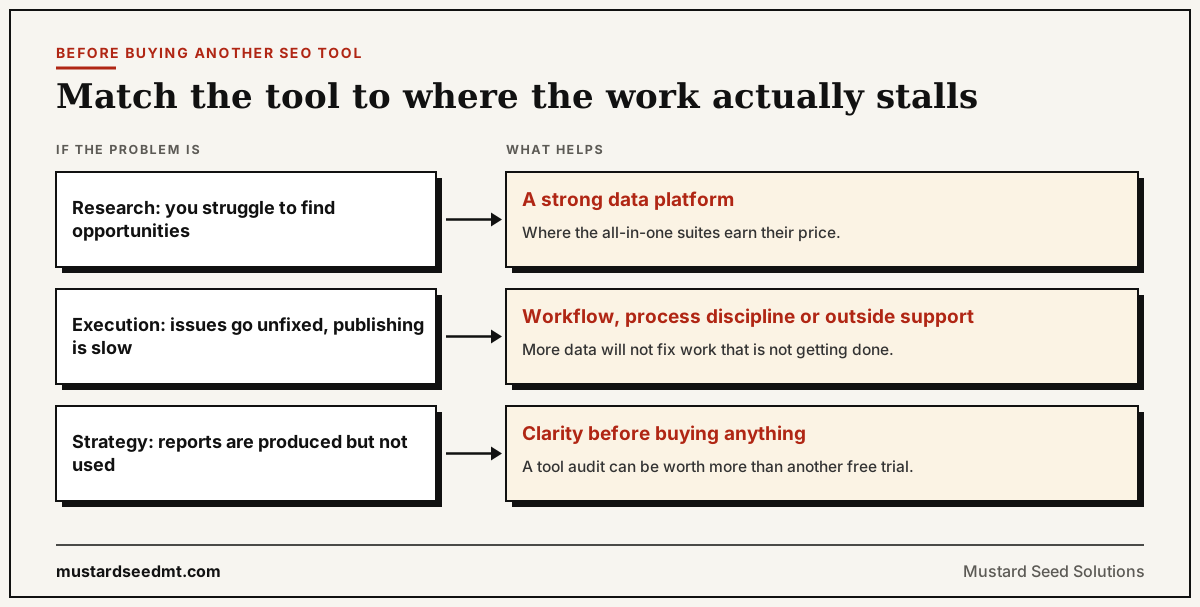
Before paying for another platform, identify where SEO work repeatedly stalls. This is the clearest lesson from the Reddit best SEO tool 2026 discussion.
A business should ask:
- Are we struggling to find opportunities?
- Are technical issues going unfixed?
- Are we publishing too slowly?
- Are we failing to build links and relationships?
- Are reports being produced but not used?
- Are we measuring AI visibility without a response plan?
The answer should shape the tool choice. A business with a research problem may need a strong data platform. A business with an execution problem may need workflow automation, process discipline, or outside support. A business with a strategic problem may need clarity before it buys anything.
That is why a tool audit can be more valuable than another free trial. Review what the stack already does, what the team actually uses, and which business outcome each subscription supports.
The uncomfortable possibility is that the company does not need another platform at all.