
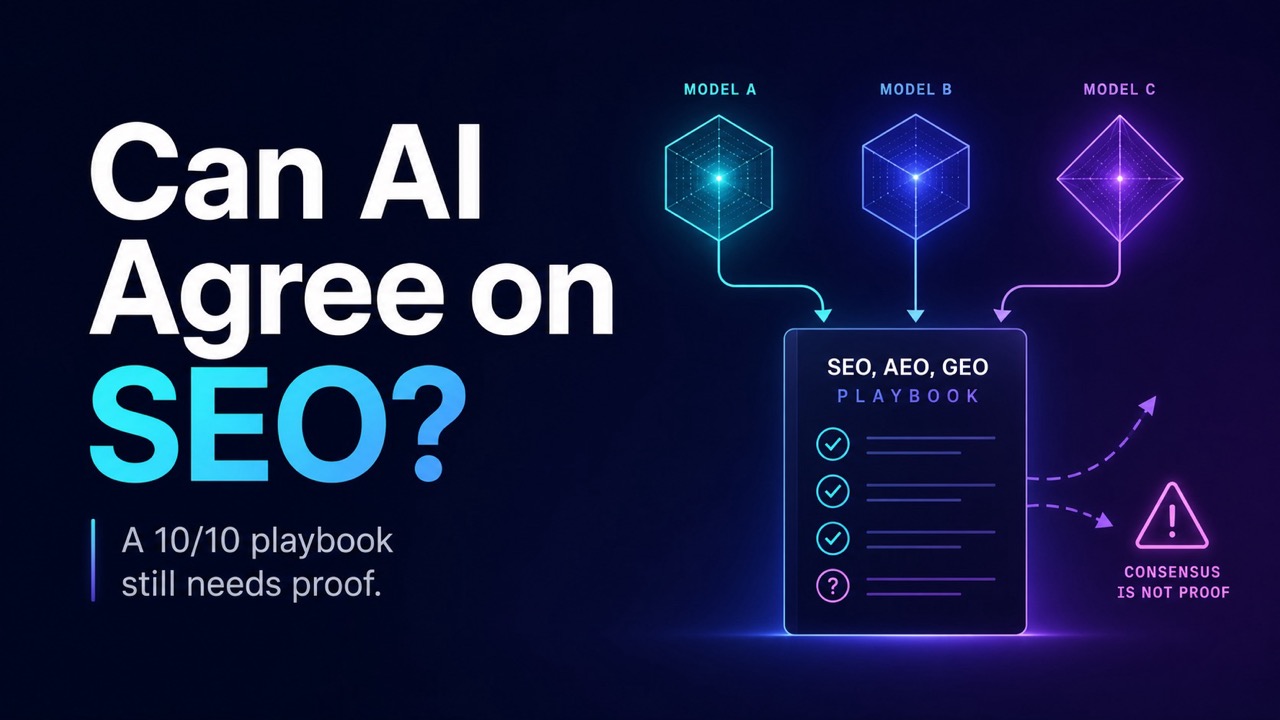
A Reddit SEO AEO GEO playbook discussion began with an ambitious experiment: pass one framework back and forth between ChatGPT, Claude, and Gemini until the models repeatedly challenge, revise, and eventually score it above 9 out of 10. The strongest takeaway was not that AI consensus creates truth. It was that multiple models can be useful as critics and hypothesis generators, while real rankings, citations, conversions, crawl behavior, and repeatability still have to judge the strategy.
The person behind the experiment had spent hundreds of hours testing SEO approaches for clients and kept noticing the same pattern. One model approved what another challenged. One system emphasized a signal that another treated as secondary. Every apparent answer contained another correction.
That frustration is familiar to anyone working with AI-assisted strategy. The models can sound equally confident while prioritizing different things. The experiment therefore tried to turn disagreement into a quality-control system rather than choosing one model as the winner.
Why did the 10/10 playbook experiment sound so attractive?
The experiment sounded attractive because SEO, AEO, and GEO now overlap across a huge number of uncertain signals. Traditional SEO already covers technical health, content, links, authority, crawling, indexing, internal structure, rankings, and conversions. AI visibility adds questions about citations, mentions, entity clarity, retrieval, and prompt-level discovery.
A single model can miss context. A single consultant can also miss context. Letting several models challenge each other seems like a reasonable way to expose blind spots earlier.
The process described in the discussion was more sophisticated than asking three systems the same question and taking a vote. The idea was to pass the framework repeatedly between ChatGPT, Claude, and Gemini, let each critique the others, and refine the output until the gaps were harder to find.
Perplexity was also considered as another perspective. Later comments suggested that the project was moving toward a multi-agent structure with layers and gates rather than a static document.
That is an important distinction. A static guide says what to do. An adversarial review system asks where the logic breaks.
The second idea is much more interesting because it turns model diversity into a source of questions.
Why is LLM agreement not the same as evidence?
LLM agreement is not evidence because several models can converge on the same conventional wisdom, including outdated or context-poor ideas. The strongest criticism in the Reddit AI SEO discussion was that internal consistency does not prove real-world performance.
Several commenters attacked the idea of a 10 out of 10 score directly. Different models use different knowledge bases, training periods, retrieval systems, and priorities. They are not synchronized. Even when they agree, that agreement may simply reflect patterns that are common across the material they learned from.
This creates a difficult ambiguity. Consensus can mean a strategy is strong. It can also mean the strategy is popular.
Those outcomes look similar inside a chat window.
One commenter made the distinction especially clear: model agreement may show that the advice is internally coherent, but the harder test is whether rankings move, citations appear, conversions improve, and the result can be repeated.
The original poster eventually agreed with much of that criticism. In later replies, the models were reframed as tools for forming hypotheses. Real validation would come from observable outcomes.
That is the right hierarchy. AI can reduce the search space. Reality still decides.
Where did model disagreement become more valuable than consensus?
Model disagreement became valuable when the discussion recognized that forcing consensus can remove the most interesting ideas. One participant warned that consensus content often becomes generic because the process filters out extremes.
That criticism changes how multiple models should be used.
If ChatGPT, Claude, Gemini, and Perplexity all recommend the same broad idea, the overlap may be useful. But if three agree and one strongly objects, the objection may deserve more attention than the consensus. It can reveal an edge case, a missing assumption, an outdated source, or a context-dependent strategy.
The original poster increasingly moved in this direction. Later comments described some of the most interesting findings as the places where the models did not agree. Those disagreements highlighted questions that deserved testing instead of blind adoption.
This is a better use of AI diversity. The goal is not to average away every conflict. It is to map uncertainty.
A practical workflow might look like this:
- Ask several models to analyze the same strategy under the same constraints.
- Record where they agree.
- Record where they disagree.
- Identify the assumptions behind each disagreement.
- Turn the disagreement into a testable hypothesis.
- Validate against live search and business outcomes.
That process is slower than taking the smoothest answer and publishing it. It is also far more defensible.
What should validate an SEO AEO GEO strategy?
An SEO AEO GEO strategy should be validated by observable outcomes, not by model scores. The discussion repeatedly pointed toward Search Console data, ranking movement, conversions, crawl and indexing behavior, AI citations, mentions, prompt visibility, referral traffic, and repeatability.
This is where many AI-assisted strategies become weak. They sound coherent, but they do not define what would prove them wrong.
A strong GEO testing framework needs explicit checks. If a content change is expected to improve citation visibility, track whether citations actually change. If a schema update is supposed to improve discoverability, measure whether visibility changes across relevant queries and prompts. If an entity strategy is expected to strengthen brand recognition, track branded and non-branded mentions over time.
The goal is not to collect more metrics. It is to connect a hypothesis to an observable outcome.
That principle also matters for small businesses. An independent consultant or one-person company can easily spend weeks refining an AI-assisted strategy that has never been tested against the market. A simpler experiment with clear success criteria may create more value.
Mustard Seed’s AI visibility audit work follows the same logic. AI visibility should be treated as a business problem with testable assumptions, not as a collection of impressive-sounding theories.
Why did the discussion turn into a fight about giving away expertise?
The debate shifted because one commenter questioned why anyone would spend hundreds of hours developing a method and then publish the entire playbook for free. That triggered a broader argument about what expertise is actually worth in an AI-heavy market.
One side argued that the playbook is not the moat. Execution is. Everyone can read the same framework and still produce different outcomes because consistency, quality, volume, timing, relationships, and judgment create the gap.
From that perspective, sharing the framework can build credibility. A consultant who publishes a method and still gets hired demonstrates that the work is harder than reading a checklist.
The other side pushed back. Detailed implementation guides can increasingly be fed into AI systems and transformed into custom workflows. An expert may therefore give away hundreds of hours of work and make their own knowledge easier to commoditize.
The strongest alternative was to focus on judgment. Clients may care more about why an expert trusted one result, rejected another, changed direction, or disagreed with consensus.
That idea clearly influenced the original poster. The playbook began to look less like the valuable asset and more like a snapshot of current thinking. The reasoning behind it was harder to copy.
Is judgment becoming more valuable than the checklist?
Yes. The discussion repeatedly moved toward the idea that judgment is the durable advantage. A checklist can be copied, summarized, automated, or fed into another model. Judgment is harder because it depends on context and the ability to recognize when the checklist stops fitting.
This does not make frameworks useless. Good frameworks reduce avoidable mistakes and make execution more consistent. But a universal 10 out of 10 implementation guide is unlikely to survive every client, site, market, model update, and competitive situation.
The more valuable content may therefore explain:
- Why one result was trusted over another.
- Which experiments failed.
- Where model agreement still felt suspicious.
- Which assumptions were rejected.
- What evidence changed the strategy.
- Which conclusions remain uncertain.
That type of content demonstrates expertise because it exposes decision-making rather than simply presenting a polished answer.
For consultants and small businesses, this has a practical marketing implication. Publishing every operational detail may not be necessary. Publishing the reasoning can often create more trust because it shows how decisions are made under uncertainty.
Mustard Seed’s advisory work is built around that kind of judgment. The value is not another generic checklist. It is deciding what matters for a specific business and what should be ignored.
What role should traditional SEO fundamentals still play?
Traditional SEO fundamentals still matter because experiments and hacks carry risk. One commenter argued that useful content from real experts remains the strongest long-term strategy, while another warned that flashy shortcuts can work until they stop working.
The original poster pushed back by pointing to intense competition. If everyone has access to similar tools, simply following standard best practices may not create an advantage. There may be overlooked gaps that produce outsized gains.
Both concerns are reasonable.
A strong strategy can have a stable foundation and an experimental layer. The foundation protects the site through clear structure, useful content, technical health, internal linking, and credible signals. The experimental layer searches for asymmetry.
The mistake is treating every experiment as a best practice or treating every best practice as untouchable.
This is another place where a testing framework is more useful than a perfect playbook. The business can keep durable fundamentals while testing uncertain ideas in a controlled way.
Could the best playbook actually be a testing system?
Yes. The strongest version of the project may be a system for generating, challenging, and validating hypotheses rather than a document that claims universal certainty.
Several commenters suggested exactly that direction. A better playbook would show where models agree, where they disagree, and what real data confirms or disproves.
That structure has several advantages:
- It preserves model diversity.
- It avoids confusing consensus with truth.
- It creates explicit tests.
- It documents failed assumptions.
- It can evolve as models and search systems change.
The original poster was already moving toward this approach by documenting identical prompts across different LLMs and comparing outcomes from the same tests.
That is far more useful than another “ultimate guide.” It creates a body of work that can be reproduced, challenged, and improved.
The perfect playbook may not be a list of answers.
It may be a disciplined way to keep finding better questions.