
When Salesforce rolled out commercial pricing for Agentforce this autumn, enterprise software leaders paid attention. The headline narrative sounded irresistible to finance leaders looking to trim customer acquisition budgets: autonomous agents executing CRM tasks, customer service triage, and sales follow-ups for roughly ten cents per action.
On paper, the unit economics look like an open-and-shut case for dismantling outbound development teams.
In practice, technical B2B companies are discovering that the advertised per-action rate represents only the visible tip of an expensive operational iceberg. Deploying autonomous agents inside complex B2B sales cycles introduces infrastructure dependencies, consumption penalties, and governance overhead that transform the real cost equation.
If you run marketing, sales engineering, or pipeline operations for a technical software or infrastructure vendor, here is the economic reality behind the marketing brochures.
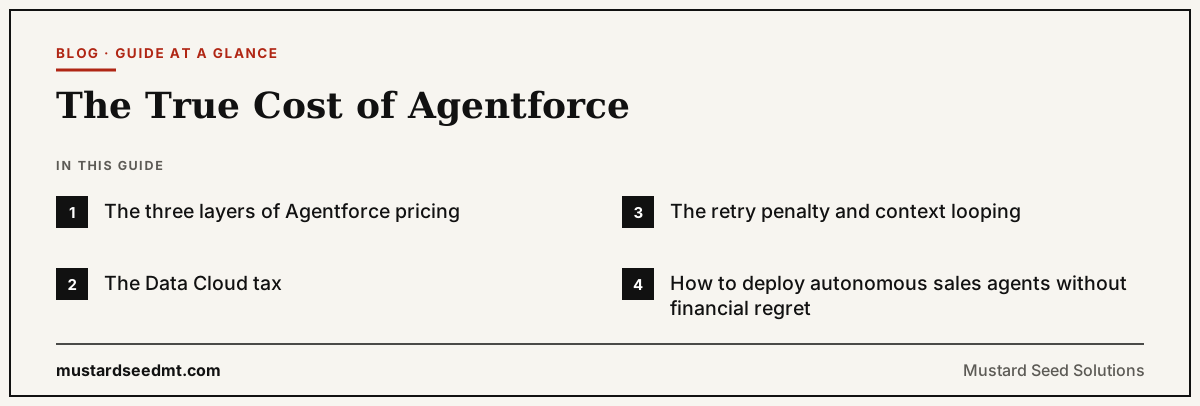
The three layers of Agentforce pricing
Salesforce structured Agentforce across three consumption models designed to meet different operational use cases:
- Flex Credits: Sold at $500 per 100,000 credits. A standard automated action consumes 20 credits, which yields the marketed $0.10 rate. Voice interactions consume 30 credits or roughly $0.15.
- Per-Conversation Rates: Primarily used for customer-facing service agents, priced at a flat $2 per 24-hour interaction session.
- Per-User Add-on Licenses: Flat-rate access starting at $125 per user each month for Sales and Service Cloud, climbing to $550 per user each month for bundled Agentforce 1 tiers.
While those baseline figures appear transparent, they obscure the critical prerequisite required to make an autonomous agent functional: foundational data grounding.
The Data Cloud tax
An autonomous agent is only as competent as the context window it retrieves. In a transactional retail environment, an agent needs minimal grounding to check order status or issue a shipping return. In technical B2B infrastructure, the agent must evaluate complex licensing agreements, deployment prerequisites, custom pricing tiers, and integration parameters.
To supply that context, Salesforce requires customers to implement Data Cloud (formerly Data 360). Data Cloud charges for data ingestion, profile unification, and continuous vector indexing.
Before an autonomous sales agent sends a single outbound email or replies to a prospective buyer, your company is burning consumption credits to keep your technical documentation, opportunity histories, and contact graphs continuously synchronized. For mid-market B2B vendors, the monthly cost of maintaining Data Cloud pipelines frequently exceeds the actual Flex Credit consumption of the agents themselves.
The retry penalty and context looping
A second hidden multiplier is the reality of non-deterministic reasoning. When human sales reps review an inbound lead, they intuitively evaluate context, notice missing details, and adjust their tone.
When an autonomous agent encounters ambiguous buyer input, it executes multi-step reasoning chains. If the buyer asks a multi-part comparative question ("Can your solution handle encrypted replication on Azure while keeping snapshot metadata local?"), the agent does not execute one clean action.
It searches external knowledge bases, retrieves technical documentation, checks opportunity history, and verifies compliance rules. Each tool call, retrieval step, and verification loop draws down additional credits. A single complex prospect inquiry can easily consume eight to twelve distinct actions, turning a ten-cent interaction into a two-dollar computational expenditure.
Worse, unused Flex Credits expire at the conclusion of your contract year. Over-budgeting leads to forfeited capital, while under-budgeting risks throttling customer communications at critical pipeline milestones.
How to deploy autonomous sales agents without financial regret
Autonomous agents will undoubtedly reshape B2B customer acquisition. The solution is not to avoid the technology, but to deploy it with rigorous operational discipline.
1. Clean your positioning before automating your inbox
If your product documentation is fragmented across outdated PDFs, conflicting Confluence pages, and internal Slack threads, your agent will hallucinate and enter expensive retry loops. Clean, structured, public-facing technical specifications are the best defense against wasted agent consumption.
2. Restrict autonomous execution to deterministic workflows
Do not allow autonomous agents to conduct open-ended cold outbound prospecting without strict guardrails. Use them for deterministic, high-value tasks: transcribing call notes, summarizing technical requirements, and routing validated leads to senior sales engineers.
3. Calculate total cost of ownership
When presenting an AI automation initiative to your executive team, build your business case on total cost of ownership. Include Data Cloud synchronization fees, prompt engineering audits, and human review overhead alongside your per-action credit estimates.
Automation does not eliminate the need for authoritative technical positioning. It magnifies it. The companies that succeed with autonomous agents will be the ones that ground them in precise, machine-readable truth.