
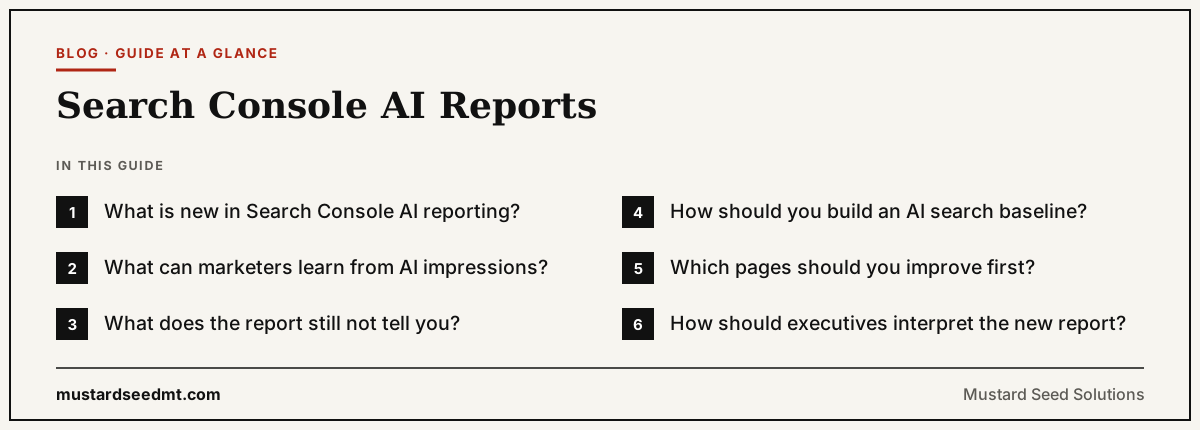
Google says Search Console AI reports reached websites worldwide on August 31, 2026. The reporting gives site owners a clearer view of impressions in Google's AI search experiences, but it still leaves important measurement gaps.
The right response is to use the report as one layer of an AI visibility scorecard. It can show exposure, but companies still need separate measurement for citations, brand accuracy, referral traffic, conversions and competitive share of voice.
What is new in Search Console AI reporting?
Search Engine Journal reported on September 5 that Google's Search Console AI reports and Search AI opt out control had reached all websites worldwide. The article cites August 31 as the date the rollout reached global availability.
Separate reporting on the rollout notes that the AI reporting focuses on impressions in AI Overviews and AI Mode while not exposing the same level of click and query detail marketers would ideally want. That makes the report useful for visibility measurement without making it a complete attribution system.
See the Search Engine Journal update.
What can marketers learn from AI impressions?
AI impressions can help answer a basic question: is Google using or surfacing your site within its AI search experiences often enough to matter?
A trend upward can indicate that more of your content is entering AI answer surfaces. A flat or declining trend may indicate weak topic coverage, poor crawl access, limited authority or simply a mismatch between your content and the questions users ask.
The number becomes more useful when segmented against page type. Product pages, service pages, research, guides and comparison content can behave very differently in AI search.
What does the report still not tell you?
AI exposure is not the same as a click, a citation or a conversion. Search Console alone cannot tell you everything a buyer saw in an AI answer, how your brand was described or which competitor received the recommendation instead.
A practical AI visibility program should therefore track additional signals:
- Brand mentions across AI assistants
- Citation URLs
- Accuracy of company descriptions
- Prompt category share of voice
- AI referral traffic
- Leads influenced by AI discovery
- Pages most frequently used as evidence
This broader measurement model is central to AI visibility auditing.
How should you build an AI search baseline?
Choose a fixed reporting period and capture current Search Console AI impressions before making major changes. At the same time, create a prompt set based on real buyer questions rather than generic questions about your company.
Record whether your brand appears, which pages are cited and which competitors are present. Then review the same prompt set and Search Console trend on a recurring schedule.
The point is consistency. AI outputs can vary, so a single screenshot is weak evidence. Repeated measurement is much more useful for seeing directional change.
Which pages should you improve first?
Start with pages that already earn search impressions or have clear commercial value. A page with existing visibility and weak engagement may have more upside than a brand new article with no demand.
Prioritize pages that:
- Answer high value buyer questions
- Explain a service or product clearly
- Compare alternatives
- Include original evidence or first party data
- Receive impressions but weak clicks
- Support an important commercial page
Then improve answer clarity, internal linking, evidence, freshness and calls to action. The Learning Center should support commercial pages rather than operate as a disconnected content library.
How should executives interpret the new report?
Executives should see Search Console AI reporting as evidence that AI search visibility is becoming measurable infrastructure. It is not yet a complete revenue metric.
A useful executive dashboard separates three levels: visibility, engagement and business outcome. AI impressions belong in the visibility layer. Clicks and visits belong in engagement. Leads, opportunities and revenue belong in business outcomes.
The goal is to understand the relationship between those levels without pretending every AI impression has a direct monetary value.