
The Promise
Essential was founded by Andy Rubin, widely credited as a co-creator of Android, carrying real technical credibility into a premium smartphone launch. The Essential Phone (PH-1) featured a distinctive titanium-and-ceramic build and one of the industry's first near-bezel-less screens, at a moment when that design language was still novel.
The company raised roughly $330 million from investors betting on Rubin's Android pedigree and the product's genuine hardware ambition to carve out space in a market dominated by Apple and Samsung.
The Entry
Essential launched the PH-1 in 2017 at $699, initially sold direct-to-consumer online with limited carrier support, entering a market where the large majority of US smartphone buyers were accustomed to buying subsidized or carrier-financed phones through Verizon, AT&T, T-Mobile, or Sprint retail stores and websites.
The device also launched with camera software widely criticized as unfinished at review time, and the highly touted 360-degree camera accessory shipped later than promised — quality and channel problems arriving simultaneously rather than one compensating for the other.
Essential Phone: Why It Failed
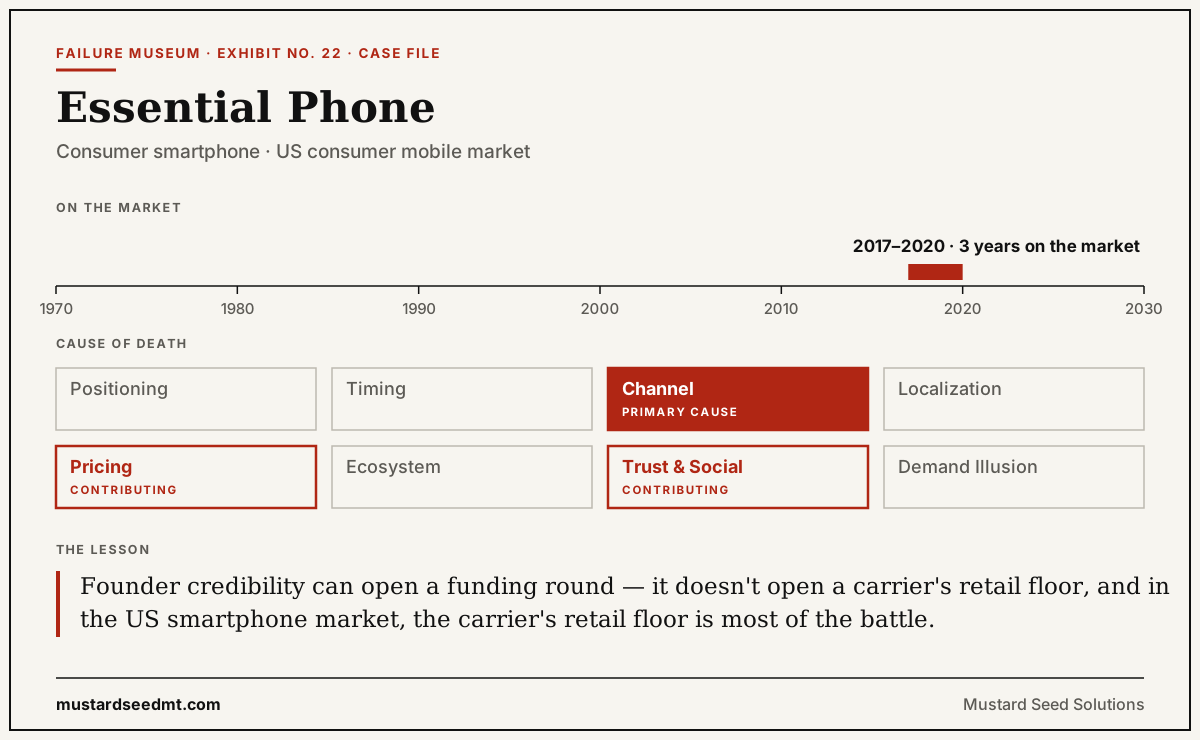
The Essential Phone failed primarily because it launched with weak, limited carrier distribution in a US market where most premium smartphone buyers purchase through carrier stores and financing plans, and a new, unproven brand asking a flagship-level price without flagship-level carrier support or an already-earned reputation for reliability gave most buyers little reason to choose it over an established iPhone or Galaxy.
The record suggests the channel gap was the most direct, structural problem: US consumers overwhelmingly buy premium phones through a small number of carrier relationships that provide financing, trade-in programs, and physical retail presence — Essential's limited initial carrier support meant most buyers simply never encountered the phone as a purchase option at all, regardless of its hardware merits.
Our read is that the channel problem compounded a trust problem the museum's Google Stadia exhibit shows in a different context: Andy Rubin's personal credibility as an Android co-creator earned the company investor funding and press attention, but founder credibility in engineering circles doesn't automatically transfer to ordinary consumers' trust in a brand-new phone brand's long-term software support and resale value — the same category of trust gap, just rooted in brand unfamiliarity rather than a company's shutdown track record.
Pricing reinforced both problems: at $699, Essential asked buyers to pay flagship-level prices for a first-generation product from an unproven brand with a software track record (the delayed camera fixes, the late 360 camera accessory) that gave early reviewers real reason for caution — a combination that made the value proposition harder to defend than either the channel or trust problem would have been alone.
What Survived
Essential's near-bezel-less design language, an industry first at its 2017 launch, was widely adopted across the smartphone industry within a year or two, becoming close to a universal design standard for premium Android phones — the hardware design itself was validated by the market even though the company that pioneered it wasn't.
Rubin's subsequent "Project Gem" (a compact, unconventional-form-factor phone) was cancelled before shipping when Essential shut down in 2020, but some of Essential's hardware and software talent moved on to other companies working on later premium Android and foldable devices.
Era: 2010s
Where It Ended Up: Essential shut down in 2020 after one phone generation and one cancelled second device ("Project Gem")
The Lesson
"Founder credibility can open a funding round — it doesn't open a carrier's retail floor, and in the US smartphone market, the carrier's retail floor is most of the battle."