
The Promise
Google Glass was a genuine engineering achievement: a full computer, camera, and heads-up display shrunk into a pair of glasses light enough to wear all day. It promised a version of computing that got out of the way — no phone to pull out, no screen to look down at, information available with a glance and a voice command.
Announced in 2012 with a skydiving demo at Google I/O and sold from 2013 through the invite-only "Explorer Program" at $1,500, Glass was positioned as the vanguard of a real category: ambient, wearable computing that would eventually replace the smartphone's dominance over people's attention.
The Entry
Google went to market with Glass before the category existed, which was itself a deliberate bet — get real developers and real users building the ecosystem early. The Explorer Program required an application, a steep price, and a pickup event at a Google office, all of which built genuine excitement in tech and media circles.
But the same program that built hype among early adopters put the device into the world in its most confrontational form: a camera, worn on the face, in restaurants, bars, and public restrooms, with no reliable visual indicator to bystanders about whether it was recording. Google shipped a product whose core interaction — quietly capturing whatever the wearer was looking at — required the surrounding public's trust, and never really asked for it.
Google Glass (Consumer): Why It Failed
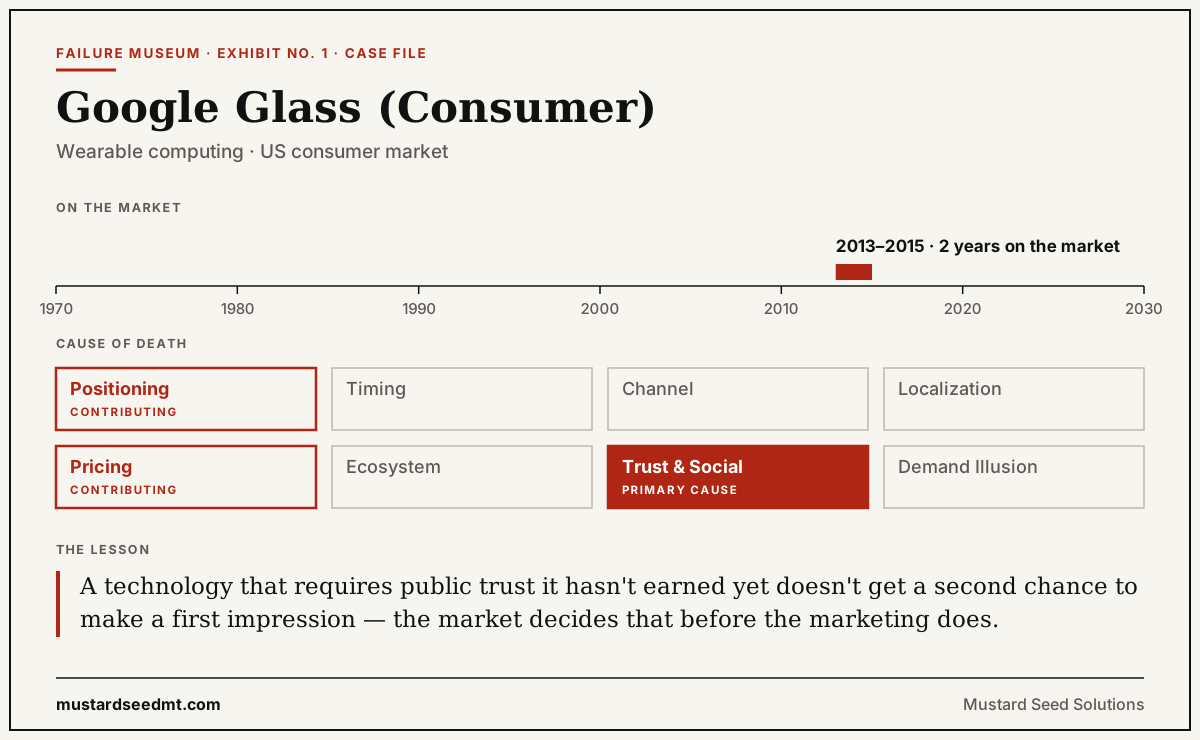
Google Glass failed because the public rejected the presence of an always-available camera on a stranger's face, not because the underlying technology didn't work. The trust failure showed up as social stigma (the term "Glasshole" entered common usage within months of launch) strong enough that bars and venues began banning the device outright.
The record suggests Google underestimated how much a technology's social acceptability depends on the people around the user, not just the user. A smartphone's camera is understood, bounded, and requires a deliberate act to use. Glass made recording ambient and unannounced, which meant every person nearby had to simply trust that they weren't being filmed — a trust Google had done nothing to earn for this specific, novel capability, and had no camera-status indicator good enough to substitute for it.
Positioning compounded the trust problem. Glass was marketed with visionary, lifestyle-forward messaging — the future of everyday computing — for a device whose actual early utility was narrow (notifications, photos, simple lookups) and whose social cost to wear in public was high. That gap between the sweeping promise and the awkward daily reality made the backlash, once it started, difficult to argue against: Glass never established a use case compelling enough to be worth the social friction it created everywhere the wearer went.
Price reinforced the isolation: $1,500 put Glass in the hands of a narrow, visible, often tech-industry-coded early-adopter population, which made the backlash feel personal and class-coded ("tech bro surveillance") rather than abstract — a dynamic a lower-priced, more broadly distributed launch might have diffused.
What Survived
Google didn't abandon the technology — it re-scoped it. Glass Enterprise Edition, launched in 2017, dropped the consumer framing entirely and sold directly into warehouses, manufacturing floors, and field service, where hands-free lookup and a camera are expected parts of the job and there's no ambient public to object. That version quietly persisted for six more years before Google discontinued it in 2023, having found a real if narrower home.
The broader wearable-camera-and-display category Glass tried to create did eventually arrive, just later and framed differently: Meta's Ray-Ban smart glasses (2023-) ship with a visible recording light and lean into a familiar, non-threatening form factor (ordinary-looking sunglasses) rather than Glass's visibly futuristic prism display — arguably a direct correction of the exact trust problem that killed the original.
The full timeline: unveiled at Google I/O in 2012, sold to consumers through the Explorer Program from 2013 to 2015, relaunched for business use as Glass Enterprise Edition in 2017, and retired entirely in 2023 — a full decade of iteration before Google let the idea go.
Era: 2010s
Where It Ended Up: Consumer program discontinued 2015; pivoted to Glass Enterprise Edition, retired entirely in 2023
The Lesson
"A technology that requires public trust it hasn't earned yet doesn't get a second chance to make a first impression — the market decides that before the marketing does."
Sources
Related Exhibits
Google Stadia
The tech worked. The trust that Google would keep it running didn't.
Facebook Portal
An excellent video-calling camera from the one company nobody wanted watching the living room.
Peloton Tread+
The company's answer to a safety regulator was to dispute it. Three weeks later it recalled 125,000 treadmills.