
The Promise
Stadia let players stream console-quality games instantly to any screen — phone, laptop, TV — with no console purchase and no download, using Google's data-center infrastructure to do the actual game rendering. The core streaming technology genuinely worked, with reviewers at launch noting surprisingly low latency for a fundamentally hard technical problem.
Google backed the launch with real investment: a dedicated first-party game studio (Stadia Games and Entertainment) to build exclusive titles, partnerships with existing publishers, and Google's own data-center scale as a structural advantage no smaller competitor could easily match.
The Entry
Stadia launched in November 2019 with a comparatively thin game library, a $10/month subscription on top of individual game purchases (rather than an all-you-can-play library), and immediate, visible skepticism from the gaming press and community rooted specifically in Google's well-documented history of shutting down products (Google Reader, Google+, Inbox, and others) after a few years.
That skepticism wasn't abstract brand perception — it was a direct, specific objection: gamers were being asked to buy individual games tied to a platform, in a way that meant losing access to purchased titles entirely if Google discontinued the service, a risk buyers explicitly and repeatedly raised from the day of launch.
Google Stadia: Why It Failed
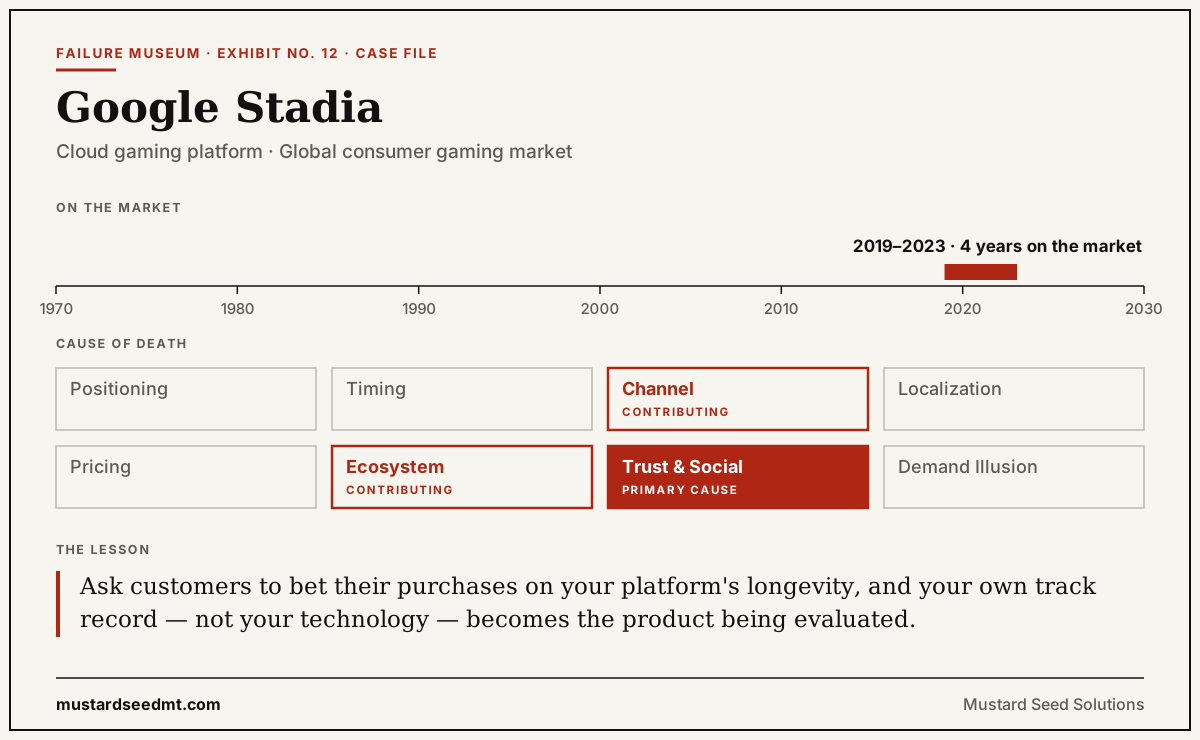
Google Stadia failed primarily because gamers did not trust Google to keep the platform running long enough to justify buying games tied to it — a well-founded skepticism built on Google's own track record of discontinuing products, and that distrust suppressed adoption regardless of the streaming technology's genuine technical quality.
The record suggests this is a rare case where the failed trust wasn't really about the product itself, but about the company behind it: Google's pattern of discontinuing services (Reader, Google+, Inbox, Allo, and numerous others documented in real time by sites tracking Google's shutdowns) had, by 2019, created a specific, well-earned consumer expectation that Google-run consumer services carry meaningful platform risk — a reputation problem no amount of Stadia-specific marketing could fully offset.
Our read is that the purchase model made the trust problem financially concrete rather than abstract: buying individual games (rather than a subscription library) meant a Stadia shutdown would mean losing money already spent on a library of owned titles — precisely what happened when Google announced Stadia's closure in 2022, offering refunds for hardware and software purchased, which retroactively validated the exact risk gamers had raised from day one.
Channel and ecosystem problems compounded the trust issue: Stadia's game library at launch was thin relative to existing consoles and PC storefronts, meaning the platform needed a strong trust argument to justify buying in early — precisely the argument Google's reputation could not supply.
What Survived
Google refunded customers for Stadia hardware and all software purchases upon shutdown in 2023, a decision explicitly framed as addressing the trust concern raised at launch, though for a discontinued product the gesture arrived after the market had already made its judgment.
The underlying cloud-streaming infrastructure didn't disappear — Google repositioned the technology as "Google Cloud gaming infrastructure," licensing it to other companies including AT&T (for a 5G gaming demo) and fitness company Peloton, moving from a consumer-facing gaming platform (where Google's trust deficit was the core problem) to a B2B infrastructure play (where it isn't).
Era: 2020s
Where It Ended Up: Shut down in January 2023; underlying streaming technology licensed to other companies (AT&T, Peloton) as "Google Cloud gaming infrastructure"
The Lesson
"Ask customers to bet their purchases on your platform's longevity, and your own track record — not your technology — becomes the product being evaluated."
Sources
Related Exhibits
Google Glass (Consumer)
The future arrived wearing a camera on its face. The public asked it to leave.
Facebook Portal
An excellent video-calling camera from the one company nobody wanted watching the living room.
Peloton Tread+
The company's answer to a safety regulator was to dispute it. Three weeks later it recalled 125,000 treadmills.