
The Promise
Iridium's engineering ambition was staggering even by satellite-industry standards: a constellation of 66 low-earth-orbit satellites providing telephone coverage to literally every point on the planet, including oceans, poles, and deserts with no terrestrial cellular infrastructure at all. Conceived by Motorola engineers in the mid-1980s, it represented a real, working solution to a real problem — coverage where cellular networks would never reach.
The technical execution was successful: the satellites launched, the network worked, and calls could genuinely be placed and received from almost anywhere on Earth, a capability no terrestrial cellular network could or can still fully replicate.
The Entry
Iridium launched commercial service in November 1998 after roughly a decade of development and an estimated $5 billion in constellation-building costs. Handsets cost around $3,000, and calls cost $3 to $8 per minute — pricing set years earlier, during the initial planning phase, before the full scale of terrestrial cellular's rapid 1990s expansion and price collapse was clear.
By the time Iridium actually launched service, terrestrial cellular coverage had expanded dramatically and cellular handset and call prices had fallen sharply, shrinking the addressable market of people who both needed truly global (not just national) coverage and were willing to pay a multi-thousand-dollar handset premium and per-minute rates far above cellular.
Iridium (1998 Launch): Why It Failed
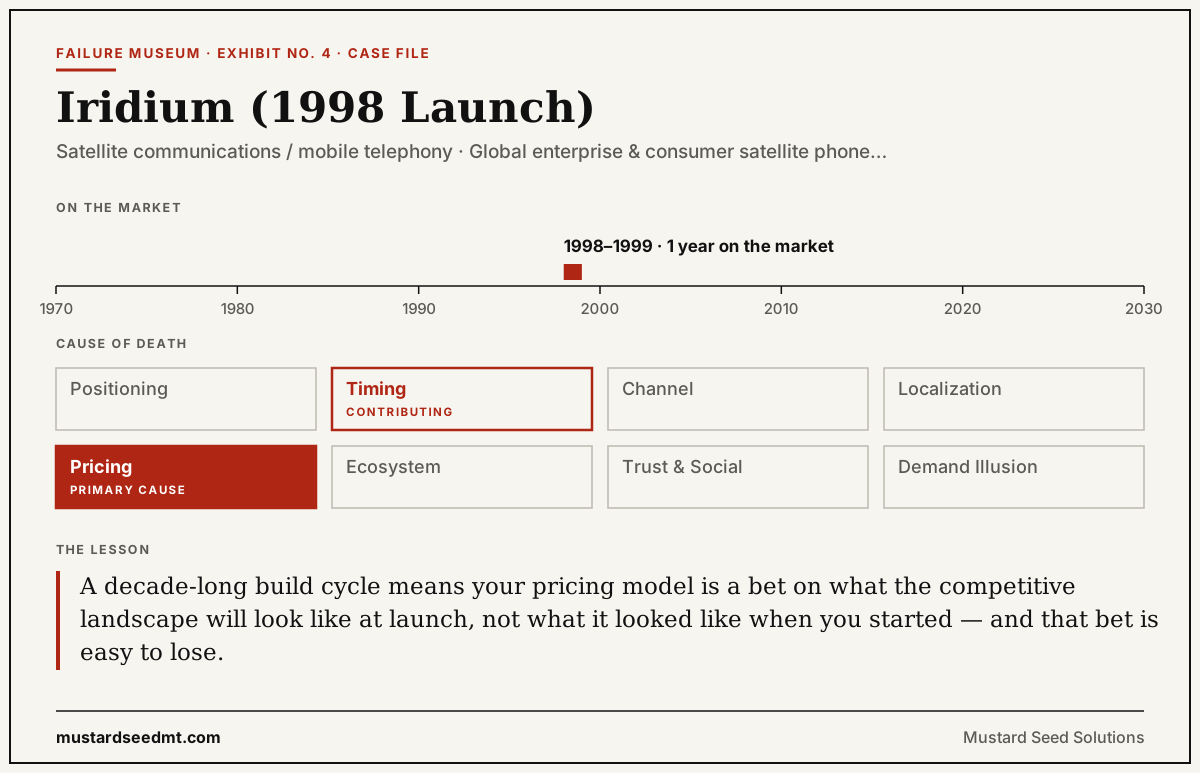
Iridium's original commercial launch failed because its pricing — set years before launch based on a market landscape that no longer existed by 1998 — required a genuinely narrow customer (someone needing truly global coverage, able to afford $3,000 handsets and dollars-per-minute calls) at exactly the moment terrestrial cellular's rapid expansion was making that same narrow customer's ordinary phone dramatically cheaper and nearly as capable for most of their actual calling needs.
The record suggests the ~decade-long gap between Iridium's initial business-case planning (mid-1980s) and its actual commercial launch (1998) is the central story: cellular networks expanded far faster and further than 1980s planners anticipated, which meant the addressable market of people who truly needed satellite-only coverage — as opposed to merely wanting it as a novelty — had shrunk substantially by the time Iridium's fixed cost structure and pricing finally reached the market.
Handset design compounded the pricing problem: early Iridium phones required a clear line of sight to satellites, meaning they often didn't work indoors or in dense urban areas — precisely the environments where a majority of calls, even from business travelers, are actually placed — which meant customers were paying a premium for coverage that, in daily practice, was frequently unavailable exactly where they needed it most.
Our read is that this is fundamentally a packaging failure layered on a pricing failure: the product was packaged and priced as if "works absolutely everywhere" was worth an enormous premium to a broad market, when in practice the number of buyers whose calling needs were genuinely underserved by cellular — as opposed to merely appreciating the idea of satellite coverage — was small enough that the venture couldn't cover its ~$5B fixed cost at the volumes it achieved.
What Survived
The original entity's bankruptcy did not end satellite telephony — a new company bought the intact, functioning satellite constellation and infrastructure for roughly $25 million (a small fraction of its build cost) and relaunched as Iridium Communications, which has operated as a genuine, profitable business ever since, serving maritime, aviation, government, and enterprise customers who have a real and specific need for guaranteed global coverage and can price that value correctly against a narrower, better-targeted customer base.
Iridium's original satellites ("Iridium NEXT" replaced them in 2017-2019) remain the backbone of global satellite communications used today for maritime shipping, remote scientific research, disaster response, and military applications — precisely the segments where "works absolutely everywhere" is worth the premium, rather than the broad consumer/business-traveler market the original launch mispriced itself toward.
Era: pre-2000
Where It Ended Up: Original Motorola-backed entity filed Chapter 11 in 1999; assets bought for ~$25M and relaunched as Iridium Communications, which operates profitably today serving enterprise, government, and maritime customers
The Lesson
"A decade-long build cycle means your pricing model is a bet on what the competitive landscape will look like at launch, not what it looked like when you started — and that bet is easy to lose."