The Promise
Jawbone was, alongside Fitbit, one of the earliest and most credible consumer wearable-fitness pioneers, launching the UP fitness band in 2011 — years before Apple Watch or most mainstream competitors entered the category — and building a reputation for genuinely thoughtful industrial design across its Bluetooth speakers and wearables product lines.
The company raised an eventual total of roughly $930 million across its lifetime from major investors, reflecting real, sustained confidence in its design capability and market position as a category pioneer.
The Entry
Jawbone competed directly against Fitbit (which eventually went public and captured the larger share of the fitness-tracker market) and, later, Apple Watch, in a hardware category with historically thin margins, high return rates, and — as the category matured — rapidly commoditizing feature sets across competitors.
Jawbone's early UP bands also faced well-publicized quality and reliability issues, including product recalls, at a formative moment when establishing a reputation for reliability mattered most for a young hardware brand competing against better-capitalized, more established rivals.
Jawbone: Why It Failed
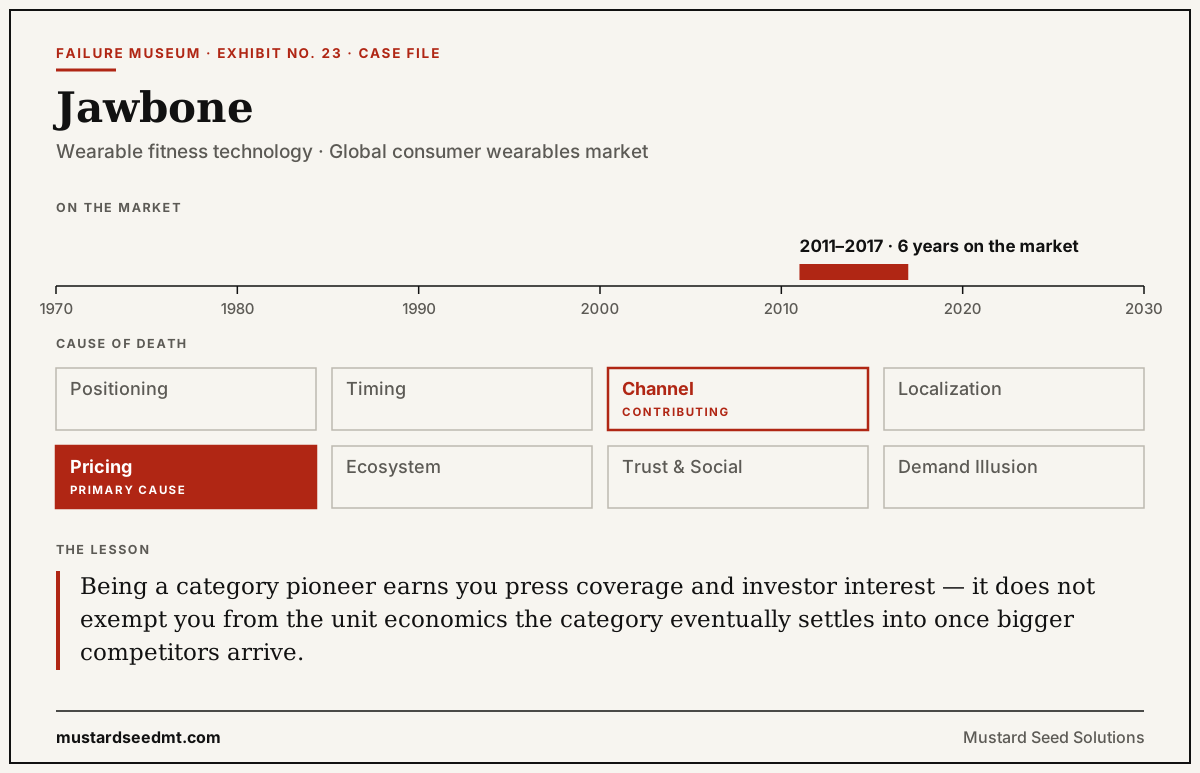
Jawbone failed because consumer wearable hardware carries structurally thin margins, and the company never closed the unit economics gap between its cost of design, manufacturing, support, and returns and what it could charge in an increasingly commoditized, competitive category — a gap that a design reputation alone, without Fitbit's or Apple's channel scale and manufacturing efficiency, couldn't close.
The record suggests the wearables category's economics were brutal for every non-dominant player: hardware margins in consumer electronics are notoriously thin even for market leaders, and a company without Fitbit's larger retail distribution or Apple's platform-level ecosystem advantages had to compete on design and features alone, in a category where those advantages erode quickly as competitors copy successful features within a product cycle or two.
Our read is that early reliability problems (product recalls on the original UP band) did lasting reputational damage precisely because they arrived at the formative moment when Jawbone most needed to establish itself as the trustworthy category leader — ceding that early reputational battle to Fitbit meant competing from a weaker channel and brand position for the remainder of the company's life, even as Jawbone continued shipping genuinely well-designed later-generation devices.
As Apple Watch and, later, cheaper commodity trackers from a wide range of manufacturers entered the market, Jawbone was squeezed from both directions — unable to command Apple's platform-ecosystem premium pricing, and unable to match the lowest-cost commodity trackers on price — a classic middle-market squeeze that ultimately made the underlying pricing and packaging problem unsolvable with the capital remaining.
What Survived
Jawbone's founder, Hosain Rahman, redirected the company's remaining engineering talent and IP into a new venture, Jawbone Health Hub, focused on clinical and health-monitoring hardware sold through healthcare channels rather than direct consumer retail — a deliberate pivot away from the consumer hardware margin problem that killed the original company.
The broader consumer wearables category Jawbone helped pioneer went on to become a genuinely large, durable market, ultimately dominated by Apple Watch and Fitbit (later acquired by Google) — validating the underlying product thesis even as Jawbone itself didn't survive to benefit from the category's eventual scale.
Era: 2010s
Where It Ended Up: Wound down operations in 2017; assets and some engineering talent moved to a new health-focused venture (Jawbone Health Hub) by the founder
The Lesson
"Being a category pioneer earns you press coverage and investor interest — it does not exempt you from the unit economics the category eventually settles into once bigger competitors arrive."