
SEO for Solopreneurs: A Practical Guide
You do not need an agency or a big budget to get found in search. This guide covers the SEO fundamentals that actually move the needle for a one-person company — and a realistic plan to do them yourself. The two free tools you'll rely on most are Google Search Console and Google's Search Central documentation.
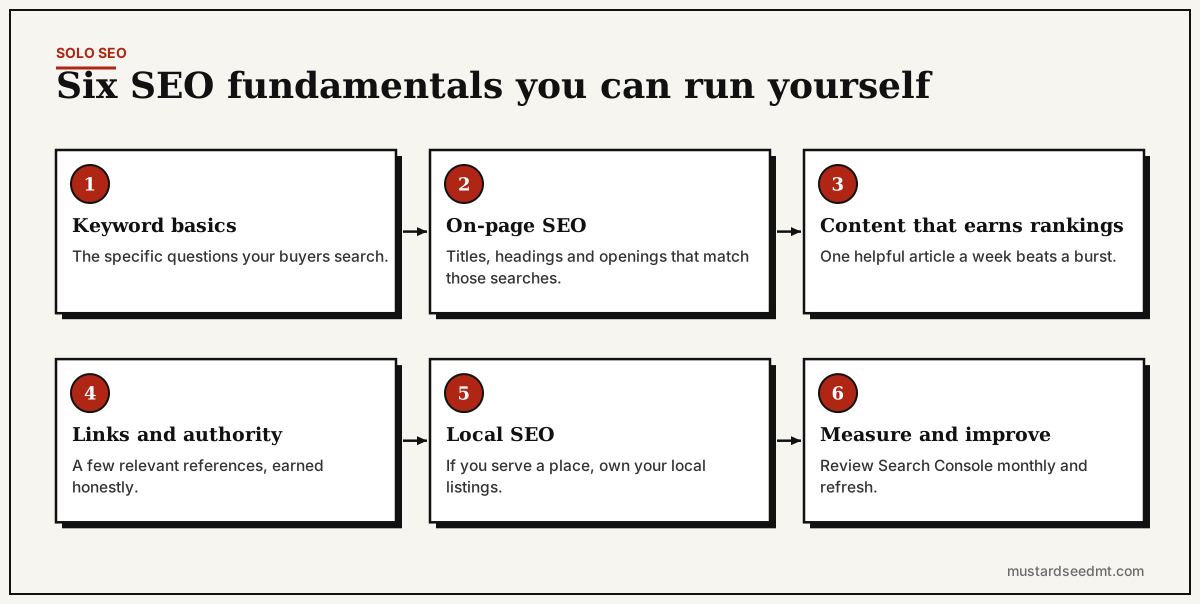
1. Keyword basics
SEO starts with the words your buyers actually type. As a solopreneur, you win on specific, lower-competition phrases — not broad head terms owned by big brands.
- Target long-tail phrases ('bookkeeper for etsy sellers', not 'bookkeeping')
- Match search intent: informational, commercial, or transactional
- One primary keyword per page, plus a few close variations
- Use the words your clients use, not industry jargon
2. On-page SEO
On-page SEO is what you control directly on each page. It is the highest-leverage work for a small site and costs nothing but attention.
- Unique, descriptive title tag (~55–60 characters)
- Useful meta description that earns the click
- One clear H1, logical H2–H3 structure
- Descriptive URLs and image alt text
- Answer the query fully and specifically
3. Content that earns rankings
Search engines reward helpful, specific, trustworthy content. Solopreneurs have an edge: real experience and real client questions to answer.
- Write pages around real buyer questions
- Add proof, examples, and specifics only you have
- Build topic clusters that link to each other
- Refresh older pages instead of only adding new ones
4. Links and authority
Links and mentions tell search engines others trust you. You do not need thousands — for a solo business, a handful of relevant, real ones matter.
- List your business in relevant directories
- Earn mentions from partners, clients, and local press
- Use internal links to connect related pages
- Be active where your audience already is
5. Local SEO (if relevant)
If you serve a local area, local SEO is often the fastest path to clients. It is less competitive than national terms.
- Set up and complete a Google Business Profile
- Collect genuine reviews consistently
- Add location to your titles and content where natural
- Keep your name, address, and phone consistent everywhere
6. Measure and improve
You cannot improve what you do not measure. Two free tools cover almost everything a solopreneur needs.
- Install Google Search Console and submit your sitemap
- Watch queries where you rank position 8–20 — those are winnable
- Add analytics and define what counts as a conversion
- Review monthly; double down on what works
A realistic 8-week SEO plan
SEO rewards consistency, not intensity. This cadence fits around real client work.
Weeks 1–2
Foundations
Keyword list, Search Console set up, sitemap submitted, titles and meta on key pages
Weeks 3–4
Core pages
Optimise homepage and main service pages around primary keywords
Weeks 5–8
Content
Publish 1 helpful article per week answering real buyer questions
Ongoing
Compound
Internal-link new content, refresh old pages, review GSC monthly
The solopreneur SEO advantage: big brands chase broad terms. You can win the specific, high-intent questions they ignore — because you actually know the answers your buyers need.
When to DIY vs. when to get help
Everything above is built so you can run it yourself — no agency, no retainer. But DIY still costs your most limited resource: time. If you would rather hand keyword strategy, on-page fixes, and content planning to someone else while you focus on clients, that is a different kind of help than this guide.
Want it done for you? Mustard Seed's Solo Business Marketing advisory packages SEO direction, content, and website work built specifically for solopreneurs and one-person companies.
Solo Business MarketingFrequently Asked Questions
Can a solopreneur do SEO without an agency?
Yes. The fundamentals — keyword research, on-page optimisation, helpful content, and Search Console — are all learnable and free to do yourself. Solopreneurs often outrank bigger competitors on specific terms because they answer real questions in detail.
Should a solopreneur hire SEO services or do it themselves?
Both are valid, depending on your time and stage. DIY costs no money, only time, and works well if you can commit a few hours a week for several months. Hiring it out costs money but saves your time, and often moves faster on keyword strategy, technical fixes, and consistent content output. If you would rather hand it off, Mustard Seed's Solo Business Marketing advisory offers done-for-you SEO, content, and website work built for solopreneurs.
How long does SEO take to work?
For a new site, expect 3–6 months before meaningful movement, and longer for competitive terms. SEO compounds: early effort pays off slowly, then accelerates as your site gains trust and content depth.
What is the single most important SEO task?
Publishing genuinely helpful pages that match what your buyers search for, each with a clear title and structure. Great content aimed at winnable keywords beats every technical trick.
Should I target broad or specific keywords?
Specific. A young, low-authority site cannot win broad head terms dominated by large brands. Specific long-tail phrases have less competition and higher intent, so you can actually rank and attract the right buyers.
Do I need to blog for SEO?
Not strictly, but helpful articles are one of the most reliable ways for a solo business to rank for buyer questions and build topical authority. Quality and relevance matter far more than frequency.
Is local SEO different?
Yes. Local SEO focuses on your Google Business Profile, reviews, local relevance, and consistent business details. For location-based businesses it is usually the fastest route to new clients.
Related resources
Get found without an agency
Want a clear SEO direction for your solo business?
Mustard Seed Solutions helps solopreneurs choose winnable keywords, structure pages, and build content that gets found in search and AI answers.
Book a consultation