Website Conversion Checklist for Solo Businesses
Traffic is wasted if visitors leave without acting. This checklist covers the six things that decide whether a solo business website turns visitors into leads — clarity, trust, action, structure, experience, and follow-up. Work through it on every important page. Page speed counts here too — see Google's Core Web Vitals guidance for the technical side.
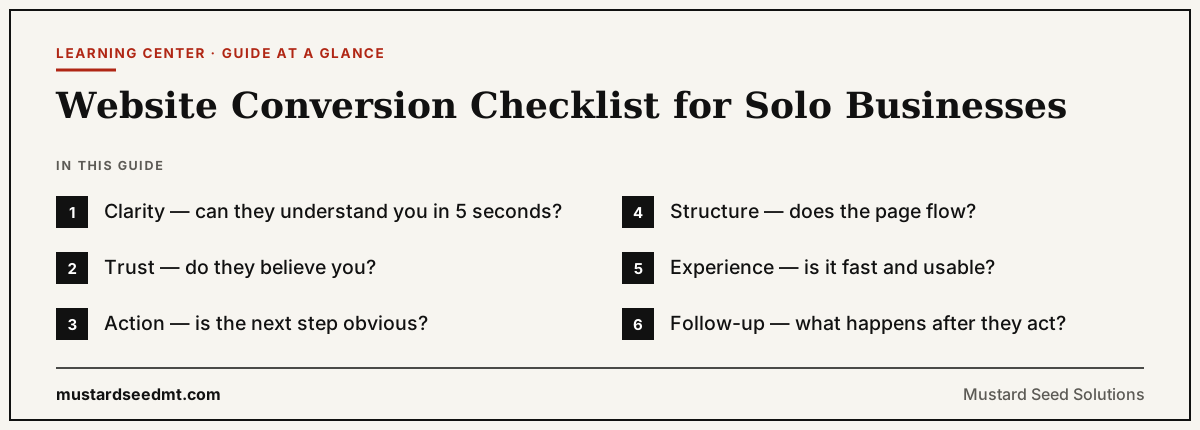
Clarity — can they understand you in 5 seconds?
- Headline states what you do and who it's for
- A sub-line explains the specific benefit or outcome
- No jargon — uses the words your buyers use
- Visitor knows they're in the right place immediately
- One clear primary message per page
Trust — do they believe you?
- Testimonials or client results are visible
- A real founder photo and name appear
- Proof sits near every important claim
- Credentials, logos, or case studies are shown
- Contact details and a real business presence exist
Action — is the next step obvious?
- One primary call to action, repeated down the page
- CTA button stands out visually
- CTA text is specific ('Book a free call', not 'Submit')
- A secondary, lower-commitment option exists (e.g. a guide)
- Forms ask only for what you truly need
Structure — does the page flow?
- Logical order: problem → offer → proof → action
- Scannable sections with clear subheadings
- Short paragraphs and generous white space
- Each page has one job and one main CTA
- Internal links guide to the next logical step
Experience — is it fast and usable?
- Loads quickly (compressed images, no bloat)
- Looks and works well on mobile
- Navigation is simple with few menu items
- Text is large enough and high-contrast
- No broken links, forms, or booking flows
Follow-up — what happens after they act?
- A thank-you page or confirmation message
- Leads land somewhere you'll actually see them
- A simple follow-up email or sequence is set up
- Conversion events are tracked in analytics
- You review what converts and improve monthly
If you only fix three things: make the offer clear in the first screen, put proof next to your main claim, and make one CTA impossible to miss. Those three move conversions more than anything else.
Frequently Asked Questions
What is a good website conversion rate for a small business?
It varies by industry and traffic source, but many small service websites convert 1–5% of visitors into enquiries. Rather than chasing a benchmark, focus on improving your own rate over time by fixing clarity, trust, and CTA issues.
What hurts website conversions the most?
The biggest killers are an unclear offer, weak or missing proof, a hidden or vague call to action, slow load times, and a poor mobile experience. Most lost conversions trace back to confusion or lack of trust.
How many calls to action should a page have?
One primary call to action, repeated a few times down the page, plus optionally one lower-commitment secondary option. Multiple competing CTAs split attention and reduce conversions.
Do I need a separate landing page to convert?
Not always. A well-structured homepage or service page can convert well. Dedicated landing pages help when you run ads or campaigns and want the message to match the source exactly.
How do I know if my changes are working?
Define what counts as a conversion (a booking, form, or call), track it in analytics, and compare before and after changes. Change one major thing at a time so you can tell what made the difference.
Related resources
Turn visitors into leads
Want a second pair of eyes on your website?
Mustard Seed Solutions helps solopreneurs tighten messaging, trust signals, and calls to action so more visitors become enquiries.
Book a consultation