
The Wedge: How Stripe Got Its First Customers
Stripe got its first customers by personally installing its own product on other founders' laptops. Patrick and John Collison didn't publish an API and wait; inside Y Combinator's small, dense founder network, they would sit down with another startup and integrate Stripe's payment code into that company's product themselves, in the room, in minutes — a practice widely retold inside YC as the "Collison installation."
The problem was narrow on purpose: existing payment processing required a merchant account, a multi-week approval process, and a contract negotiated with a bank — friction that a developer prototyping a startup idea over a weekend had no patience for. Stripe's first wedge wasn't "better payments" in the abstract; it was solving that one friction point for the one population who felt it most acutely and was easiest to reach in person: other early-stage founders one desk over.
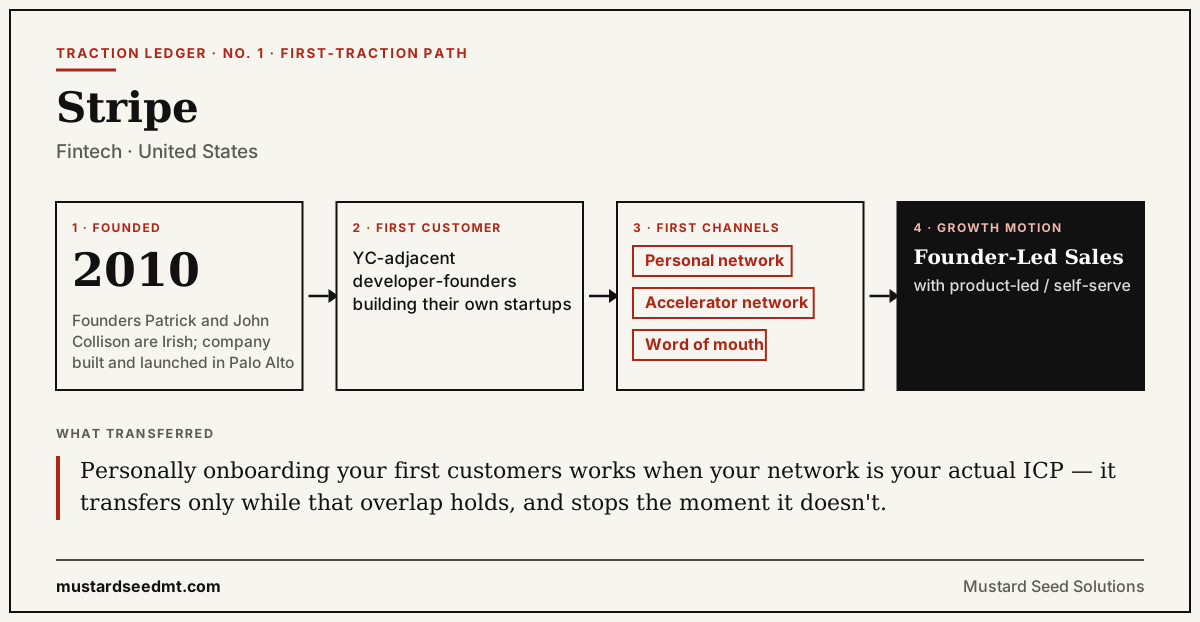
Founders Patrick and John Collison are Irish; company built and launched in Palo Alto (2010).
Stripe's First Channel
The first channel was the Y Combinator batch itself — a physical room of founders building products that needed to accept money, sitting near two founders who had already built the thing that let them do it. Because the Collisons could reach this population directly and repeatedly, the channel cost almost nothing except their own time, and every install doubled as a support call and a product feedback session.
Word of mouth did the rest inside the same network: YC founders talk to each other and to later batches, so an integration done for one startup became a recommendation to the next. The channel worked specifically because the ICP was small, technical, and clustered — the same mechanism would not have reached a retail merchant, which is precisely why Stripe stayed inside developer-first accounts for years before expanding upmarket.
The Motion: Founder-Led Sales
The founder-led installs were the wedge, but the motion that scaled was the product itself: a REST API with clear documentation, a sandbox to test against, and a pricing page that required no phone call to understand. Once a developer had one integration working, adding Stripe to the next project was near-zero-effort — the product, not a salesperson, carried the second and third sale.
Pricing was designed to remove a second decision entirely: a flat 2.9% + 30¢ meant a developer never had to negotiate, request a quote, or loop in someone with purchasing authority. That legibility was itself a growth mechanism, because it let the product be adopted by an individual engineer without an approval process — the same self-serve logic that later defined product-led growth as a category.
As the customer base matured past early-stage startups, the sales-assisted layer reappeared for larger accounts, but the core mechanism — try it, integrate it, get billed automatically — never changed. The founder-led phase was best understood as bootstrapping trust and initial liquidity for a motion that was product-led from day one in its actual mechanics.
The Turn — the motion held
The motion held. What changed was scope, not mechanism: Stripe expanded from a single payments API into billing, fraud tools, incorporation (Atlas), lending (Capital), and tax — each new product re-using the same self-serve, developer-first entry point rather than requiring a new go-to-market motion of its own.
Era: 2005-2014
Where It Ended Up: Private; still independent, one of the most highly valued private technology companies
What Transferred
"Personally onboarding your first customers works when your network is your actual ICP — it transfers only while that overlap holds, and stops the moment it doesn't."
Sources
Related Entries
Mailchimp
An email tool built as a side favor for the founders' own web-design clients, sold profitably for a decade before adding a free tier.
Personal networkSubstack
A publishing platform that launched with exactly one writer, recruited personally by a co-founder, and earned nothing until he did.
Personal networkConvertKit
An email tool that grew by sending a hundred personal emails, then offering to do the switching work by hand, free.
Cold email