
The Wedge: How Mailchimp Got Its First Customers
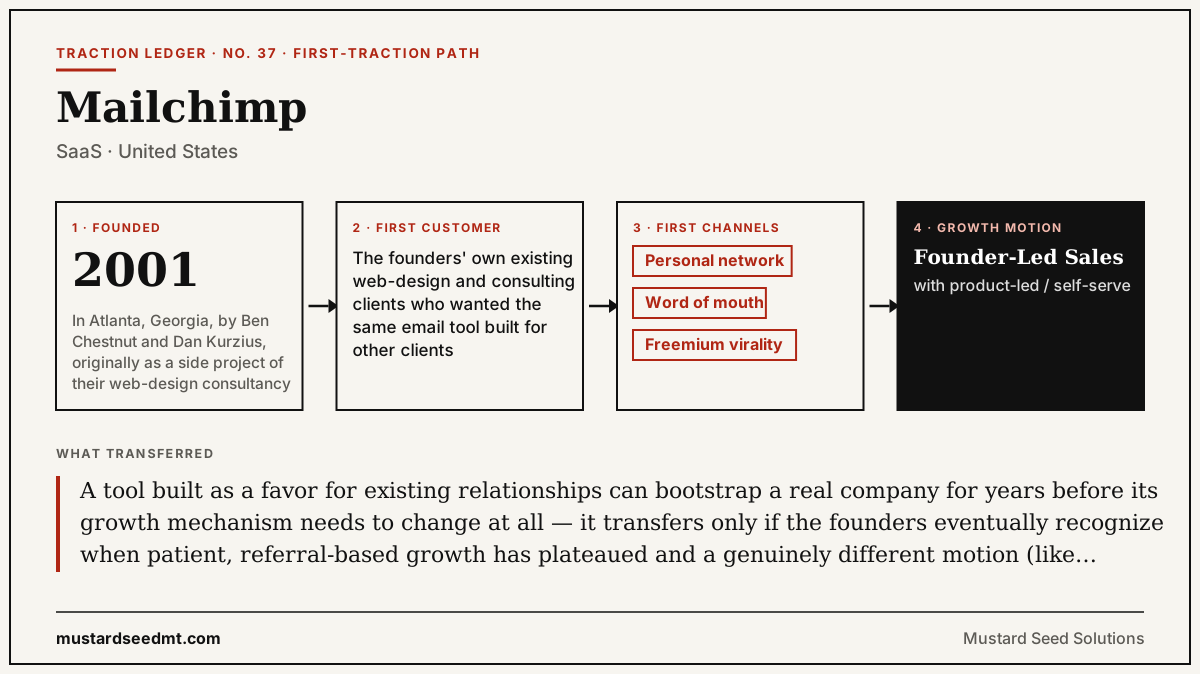
Mailchimp began inside a web-design and consulting business, Rocket Science Group, run by Ben Chestnut and Dan Kurzius; email marketing software was originally built as a utility for their own consulting clients, not as a standalone product with its own customers.
The first real Mailchimp customers were those same consulting clients, who wanted access to the same email tool the founders had already built and used internally — the product effectively sold itself to an audience that already trusted the founders through an unrelated existing relationship.
Founded in Atlanta, Georgia, by Ben Chestnut and Dan Kurzius, originally as a side project of their web-design consultancy (2001).
Mailchimp's First Channel
The channel was the founders' own existing client relationships from their design consultancy — a direct, personal, founder-led sales motion built entirely on trust already established through unrelated work.
Word of mouth extended this slowly beyond the original client base over the following years, as the product remained a paid-only, bootstrapped side business without significant marketing investment for most of its first decade.
The Motion: Founder-Led Sales
For roughly its first eight years, Mailchimp operated as a modest, profitable, paid-only tool sold primarily through founder relationships and referrals — a long, patient bootstrapped phase unusual in duration among the entries in this ledger.
In 2009, the company added a free tier, a decision that is widely credited with driving a dramatic acceleration in signups and adoption — converting the motion overnight from founder-led referral sales to a genuinely self-serve, freemium product-led engine.
The freemium relaunch let small businesses and individuals try real email marketing capability with no upfront cost, expanding the addressable market far beyond the founders' own reachable network of consulting clients and referrals.
The Turn
There were two distinct turns: first, the company eventually discontinued its original web-design consulting business entirely to focus solely on the software once demand for it clearly exceeded the consultancy's own scope; second, and much later, the 2009 freemium pricing relaunch functioned as its own "turn" in growth mechanism, shifting the primary motion from founder-led referral sales to self-serve product-led growth nearly a decade after founding.
Era: pre-2005
Where It Ended Up: Acquired by Intuit in 2021
What Transferred
"A tool built as a favor for existing relationships can bootstrap a real company for years before its growth mechanism needs to change at all — it transfers only if the founders eventually recognize when patient, referral-based growth has plateaued and a genuinely different motion (like freemium) is needed to keep growing."
Sources
Related Entries
Stripe
Payments for developers who'd rather write seven lines of code than sign a bank contract.
Personal networkSlack
An internal messaging tool built for one gaming studio's own team, released after the game itself failed.
Personal networkZoom
Reliable video calling built by a former WebEx engineer who thought existing video conferencing was too frustrating.
Freemium virality