
An AEO experimentation roadmap is a phased plan for testing changes that might raise how often AI answer engines mention and cite your brand, then checking whether that visibility turns into business. It runs baseline, hypothesis, test, measure visibility, measure conversions and scale, usually over about 90 days, with one change tested at a time.
The link to conversions is measurement you set up before the test starts: AI referral sessions segmented in GA4, one primary conversion tagged, assisted conversions, and branded search volume tracked alongside citations. Without that, a test can show that visibility moved but not that it paid. Each test names a prompt group, one intervention, and the metric expected to move, and it is judged on repeated AI responses, not on one answer or one visibility score.
The AEO experimentation roadmap: six phases and what to measure
| Weeks | Phase | What you do | What you measure | Decision at the end |
|---|---|---|---|---|
| 1–4 | Baseline | Fix a prompt set of 30–60 real buyer questions. Run it weekly across the engines that matter to you. Change nothing. Set up the AI referral channel and conversion tracking now. | Mention rate, citation rate and recommendation rate, and how much each moves week to week with no intervention. Baseline AI referral sessions, conversions and branded search volume. | Which prompt groups are weakest, and how big a change has to be before it counts as more than noise |
| 5 | Hypothesis | Pick one weak prompt group. Write one hypothesis: this change, to these pages, should move this metric. Pick a comparable control group you will leave alone. | Nothing new. Write down which metric should move and in which direction. | Is the hypothesis specific enough that a result could prove it wrong? |
| 6–11 | Test | Make the change to the test group only. Log every other change to the site, the market, or the models while it runs. | The same weekly prompt runs, test group against control. Confirm the changed pages were recrawled. | — |
| 12 | Measure visibility | Compare test against control, and both against the baseline range. | Mention, citation and recommendation rate, and whether the page you changed is the one being cited | Did visibility move beyond the normal baseline range? |
| 13 | Measure conversions | Compare the business signals for the test pages against the baseline and the control. | AI referral sessions in GA4, conversions from those sessions, assisted conversions, branded search lift | Did a business signal move, or only visibility? |
| 14+ | Scale | Repeat a winner on a second comparable topic before rolling it out. Write up failures too. | The same metrics on the new topic | Make it standard, repeat, or abandon |
Six weeks is a floor, not a target. Pages need to be recrawled after the change and answers need time to settle, and a test that ends before either has happened measures nothing.
AI search is probabilistic. The same prompt can produce different brands, citations, wording, and source selections across repeated runs, which is why the baseline phase is four weeks long and not four days.
That means GEO experimentation needs more discipline than "edit page, check ChatGPT, declare success."
Start with a baseline before changing anything
First capture how the brand appears today. Use a prompt set that represents real buyer questions across awareness, comparison, evaluation, and purchase intent.
Tag prompts by dimensions that matter to the business:
- Topic
- Product
- Persona
- Funnel stage
- Market
- Language
- Competitor set
- Commercial importance
For every prompt, record whether the brand is mentioned, cited, recommended, accurately described, and how it compares with competitors. Keep this baseline long enough to see normal variability before testing changes.
Define a hypothesis you can evaluate
A useful GEO experiment starts with a specific belief about what is missing.
Examples include:
- Adding a concise answer section will improve citation frequency for a defined question group
- Publishing a detailed comparison page will improve presence in evaluation prompts
- Updating outdated product facts will improve description accuracy
- Adding original research will increase third-party references and citations
- Strengthening internal links will improve discovery of a weak topic cluster
- Earning relevant external coverage will improve brand presence for category prompts
Avoid hypotheses such as "improve GEO." They are too broad to test.
A good hypothesis names the prompt group, the change, and the metric expected to move.
Change fewer variables at once
Perfect laboratory control is rarely possible in marketing, but changing everything at once makes learning much harder. If you rewrite the page, change the title, launch digital PR, add schema, publish five supporting articles, and change the prompt set during the same period, you will not know which part mattered.
Where practical, isolate a meaningful intervention.
For content tests, that might mean changing one page or one cluster. For authority tests, it might mean focusing on a specific third-party source category. For technical work, it could mean fixing crawl access before changing the content itself.
Keep a change log with:
- Date
- URL
- Prompt group
- Hypothesis
- Intervention
- Expected metric
- Other major events
This creates an audit trail for later analysis.
Measure repeated responses, not screenshots
AI answers vary naturally, so repeated measurement is essential. Research published in 2026 on AI search visibility specifically warns against relying on one-off observations and recommends treating visibility as a distribution rather than a single point.
See the research paper Don't Measure Once: Measuring Visibility in AI Search.
Track recurring measurements for the same prompt set and compare periods rather than individual answers.
Useful metrics include:
- Mention rate
- Citation rate
- Recommendation rate
- Share of voice
- Description accuracy
- Competitor gap
- Source diversity
- Prompt coverage
- AI referral traffic
- Conversions from AI referrals
The right metric depends on the experiment. A content citation test should not be judged only by total website traffic.
Use control groups where practical
A control does not need to be a perfect scientific control. It can be a similar set of prompts, pages, markets, or topics that you leave unchanged while testing another group.
For example, if you improve five product pages, compare them with five similar product pages that were not changed. If you test a new content format in the UK, compare directional movement with a similar market where the format has not been introduced.
Controls help answer an important question: did the tested group move differently from the background noise?
They are especially useful during periods when AI models or search systems update frequently.
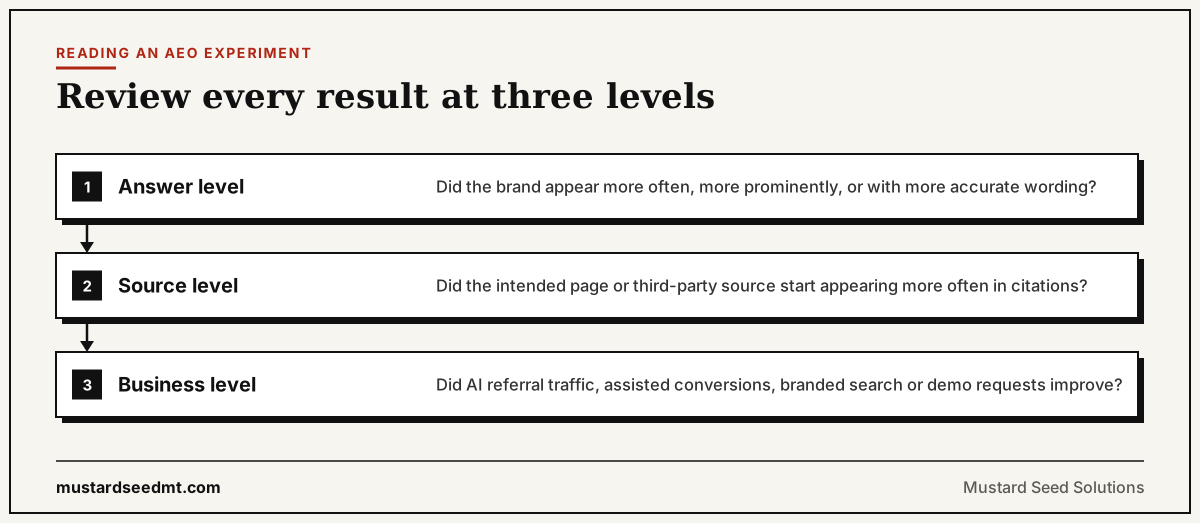
Review results at three levels
Do not stop at one GEO score. Review whether the experiment changed the answer, the source, and the business outcome.
Answer level: Did the brand appear more often, more prominently, or with more accurate wording?
Source level: Did the intended page or third-party source begin appearing more often in citations?
Business level: Did AI referral traffic, assisted conversions, branded search, demo requests, or other commercial signals improve?
A strong result is more convincing when several levels move in the expected direction.
If only the vendor's composite visibility score moves, investigate why before declaring success.
How the roadmap connects AI visibility to conversions
Visibility is an input. The business question is whether it produces enquiries, and most AEO programmes never answer it because nobody set up the measurement before the test started.
Do this in week one, before the baseline:
- Segment AI referrals in GA4. Create a custom channel group with an "AI assistants" channel that matches sessions from chatgpt.com, perplexity.ai, copilot.microsoft.com, gemini.google.com and claude.ai, and order it above Referral. Without it, AI traffic lands in "referral" or "direct" and the test has no business outcome to report.
- Tag the conversion you care about. A demo request, a contact form, a booked call, marked as a key event (GA4's current name for a conversion). Pick one primary conversion per test; more than one lets you choose whichever moved.
- Count assisted conversions. Many buyers visit from an AI answer, leave, and convert later through another channel. GA4's attribution reports, such as conversion paths, show where AI referrals appear earlier in the path.
- Watch branded search. Many AI answers resolve the question without a click, and a buyer who reads your brand in an answer and searches for you by name later arrives as branded search. Track branded query impressions in Search Console and Bing Webmaster Tools alongside AI referrals rather than treating referrals as the whole effect.
The honest expectation is that conversions will be the slowest and noisiest of the three levels. A citation test can move citation rate clearly in six weeks while conversions stay within noise. That is not a failed test, but it is not a proven commercial result either, and the write-up should say which one it is.
Scale winners and document failures
An experiment is valuable even when the expected result does not appear. A documented failure prevents the team from repeating unsupported tactics across dozens of pages.
When a test works, repeat it on another comparable topic before making it a sitewide standard. This reduces the risk of scaling an effect that was actually caused by unrelated factors.
Over time, build an internal GEO playbook containing:
- Tested tactic
- Prompt category
- Market
- AI engines
- Before period
- After period
- Result
- Confidence level
- Next action
This turns GEO from a collection of tips into an organizational learning system.
For help establishing a baseline, start with the AI Visibility Audit and define the prompt set before changing content.