
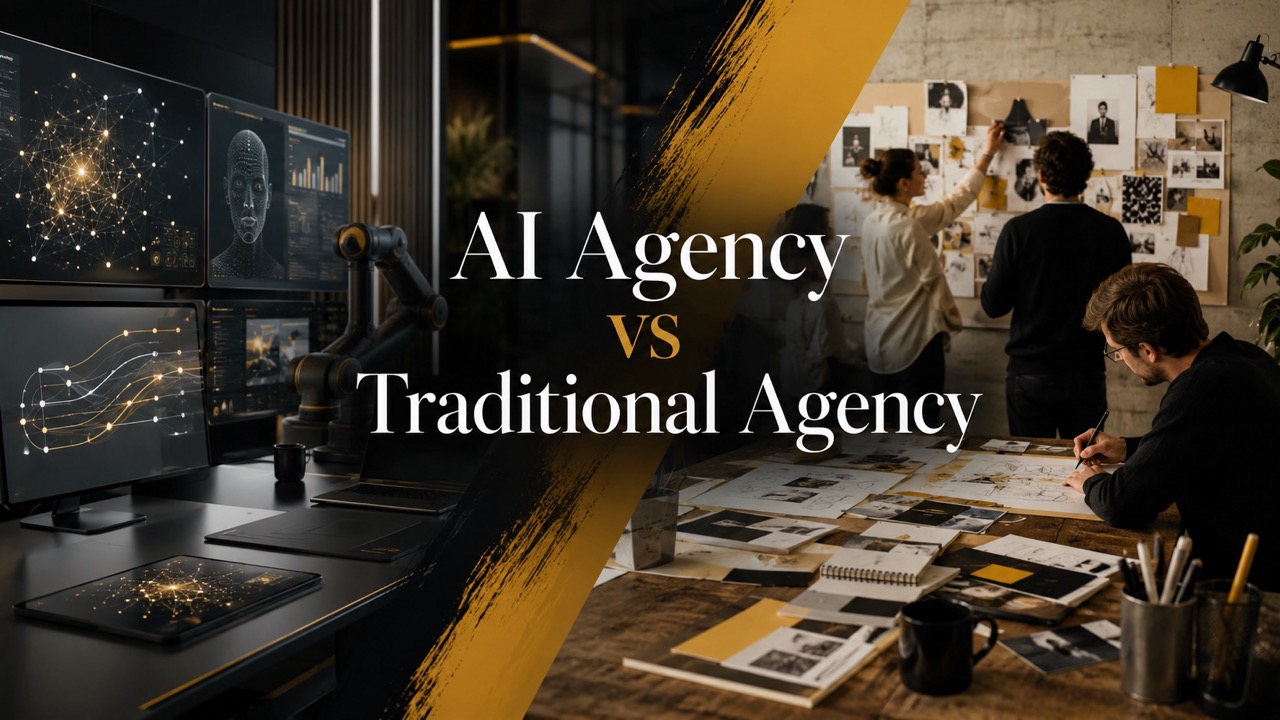
AI is changing how marketing agencies work.
Some agencies now position themselves as AI marketing agencies.
Others continue to operate with more traditional service models while gradually adding AI tools behind the scenes.
For buyers, this creates a new question:
Should we hire an AI marketing agency or a traditional marketing agency?
The answer depends less on the label and more on how the agency uses technology, how strong its strategic thinking is, and whether it can solve your actual marketing problem.
AI Marketing Agency vs Traditional Marketing Agency at a Glance
| Area | AI Marketing Agency | Traditional Marketing Agency |
|---|---|---|
| Production speed | Usually faster | Usually slower |
| Automation | High | Varies |
| Human creative input | Varies | Usually higher |
| Strategy | Depends on agency | Depends on agency |
| Cost structure | Can be leaner | Often more people intensive |
| Personalization | Easier to scale | Often more manual |
| Best use | High efficiency workflows and rapid testing | Deep creative, relationship heavy work |
| Main risk | Generic AI output | Higher cost and slower execution |
1. Speed
AI enabled agencies can often produce work faster.
AI can support:
- 1Research
- 2Drafting
- 3Repurposing
- 4Reporting
- 5Analysis
- 6Campaign variations
- 7Workflow automation
This can compress timelines.
Traditional agencies may rely on more manual processes.
However, speed is useful only when the work is strategically correct.
Producing the wrong campaign faster does not create value.
2. Cost
AI can reduce the amount of manual labor required for some tasks.
That may allow AI enabled agencies to operate with smaller teams.
This can reduce cost in areas such as:
- 1First draft content
- 2Reporting
- 3Research
- 4Campaign variations
- 5Repetitive optimization
- 6Administrative work
Traditional agencies may have higher labor costs because more work is performed manually.
But price should not be the only decision factor.
Senior strategy, expertise, and creative quality often remain human intensive.
3. Content Production
AI marketing agencies can generate content at scale.
That is useful for:
- 1Social media
- 2Email variations
- 3SEO outlines
- 4Product descriptions
- 5Repurposing
- 6Campaign testing
The risk is volume without differentiation.
If an agency's main advantage is simply producing more AI content, that advantage may be temporary.
Strong B2B content still needs:
- 1Expertise
- 2Customer insight
- 3Original examples
- 4Credible evidence
- 5A strong point of view
4. Creative Quality
Traditional agencies often build their reputation around creative teams.
Experienced writers, designers, strategists, directors, and producers can create work with more nuance and originality.
AI can support creative exploration.
But the quality of the final work depends on human direction.
The strongest agencies will probably combine both.
They will use AI to increase speed while keeping experienced creative people responsible for the concept and final judgment.
5. Personalization
AI can make personalization more scalable.
An AI enabled agency may be able to create:
- 1Industry specific messaging
- 2Account specific outreach
- 3Multiple landing page variants
- 4Personalized email sequences
- 5Different campaign versions
Traditional agencies can do the same work, but it may require more manual effort.
For B2B companies using ABM or targeting several verticals, this can create meaningful efficiency.
6. Strategy
This is where buyers should be careful.
AI does not automatically make an agency more strategic.
An agency can use advanced AI tools and still provide weak positioning, poor prioritization, or generic advice, which is why some companies get independent AI marketing advice before they choose an agency at all.
Ask whether the agency understands:
- 1Your business model
- 2Your sales cycle
- 3Your customer
- 4Your market
- 5Your competitive environment
- 6Your revenue goals
The technology should support strategy.
It should not replace it.
7. Data and Analysis
AI enabled agencies may be able to analyze campaign data more quickly.
They can use AI to help identify:
- 1Performance changes
- 2Audience patterns
- 3Conversion issues
- 4Creative trends
- 5Channel opportunities
This can improve reporting.
But clients should still expect the agency to explain what the data means and what decision should follow.
8. Automation
AI marketing agencies may have stronger capabilities around:
- 1Workflow automation
- 2CRM enrichment
- 3Reporting
- 4Lead classification
- 5Content operations
- 6Research
- 7Sales enablement
For companies that want to modernize their marketing operations, this can be valuable.
The agency should be able to explain the process clearly.
Automation should not create a black box.
9. Brand Risk
AI introduces specific risks.
These can include:
- 1Inaccurate claims
- 2Generic writing
- 3Brand inconsistency
- 4Confidentiality concerns
- 5Poor personalization
- 6Low quality automated outreach
Ask the agency how humans review AI output.
A credible agency should have clear quality control.
10. B2B Expertise
For B2B technology companies, industry understanding may matter more than the agency's AI label.
Look for experience with:
- 1Long sales cycles
- 2Multiple stakeholders
- 3Technical products
- 4Enterprise buyers
- 5Sales enablement
- 6Market entry
- 7Account based marketing
- 8Thought leadership
A traditional agency with strong B2B expertise and sensible AI adoption may outperform an AI first agency with little understanding of complex B2B buying.
When an AI Marketing Agency Makes Sense
Consider an AI enabled agency when:
- 1You need more marketing output with a lean budget
- 2You want to automate repetitive workflows
- 3You need many campaign variations
- 4You want to improve content repurposing
- 5You want faster analysis and reporting
- 6You need scalable personalization
When a Traditional Agency May Be Better
A more traditional agency may be stronger when:
- 1The work requires deep creative development
- 2Brand storytelling is the priority
- 3High end production matters
- 4Human relationships and workshops are central
- 5The agency has unusually strong category expertise
The Better Question to Ask
Instead of asking:
Are you an AI marketing agency?
Ask:
How do you use AI to improve the quality, speed, or economics of your work?
Then ask:
- 1Which tasks are automated?
- 2Which tasks remain human?
- 3How is quality reviewed?
- 4How do you protect customer data?
- 5How do you measure impact?
- 6What strategic expertise do you bring?
These questions reveal more than the label.
Final Thoughts
AI marketing agencies and traditional marketing agencies are converging.
The strongest future model is likely to combine AI enabled efficiency with experienced human strategy and creative judgment.
For B2B companies, the right partner is the one that understands the business first and uses technology intelligently second.
Mustard Seed Solutions helps B2B technology companies combine strategic marketing leadership, specialist execution, and AI enabled workflows without losing the human judgment required for positioning, market entry, demand generation, and brand authority.