

AI can support almost every part of marketing.
That does not mean every use case creates equal value.
For B2B companies, the strongest applications are usually the ones that help teams understand customers faster, produce better work with less manual effort, improve sales alignment, and make more informed decisions.
What Are the Best AI Use Cases for B2B Marketing Teams?
The best AI use cases for B2B marketing teams work from material the team already has and produce output a person can check quickly: customer research synthesis, sales call analysis, content outlining and repurposing, SEO and AI visibility planning, account research, sales enablement, reporting, and routine marketing operations. Strategy, positioning, and final approval stay with people.
| Goal | Use cases |
|---|---|
| Understand customers | Customer research synthesis, sales call analysis, account based marketing research |
| Produce and distribute content | Content ideation and outlining, content repurposing, SEO content planning, GEO and AI visibility analysis |
| Support sales and campaigns | Sales enablement, campaign planning |
| Run the marketing function | Reporting and analysis, marketing operations, small team productivity |
Here is each of the 12 use cases in more detail.
1. Customer Research Synthesis
Customer interviews, support tickets, surveys, sales notes, and call transcripts contain valuable insight.
AI can help identify patterns across large volumes of feedback.
For example:
- 1Common pain points
- 2Buying triggers
- 3Objections
- 4Desired outcomes
- 5Competitor mentions
- 6Customer language
This can accelerate positioning, messaging, and content planning.
2. Sales Call Analysis
B2B marketing teams often struggle to stay close to real sales conversations.
AI can help summarize calls and identify recurring themes.
Marketing can learn:
- 1Which objections appear most often
- 2Which use cases generate interest
- 3Which competitors are mentioned
- 4Which messages resonate
- 5Why opportunities stall
This creates a stronger feedback loop between sales and marketing.
3. Content Ideation and Outlining
AI is useful before writing begins.
It can help:
- 1Identify possible article angles
- 2Structure comparison pages
- 3Build FAQ sections
- 4Organize research
- 5Suggest related topics
- 6Generate outline options
This can reduce production time while keeping topic selection and strategic direction human led.
4. Content Repurposing
B2B companies often create valuable long form assets and then underuse them.
AI can turn one asset into many formats.
For example:
Webinar becomes:
- 1Blog article
- 2LinkedIn posts
- 3Newsletter
- 4Sales snippets
- 5Short video scripts
- 6FAQ content
This improves distribution without requiring every asset to start from zero.
5. SEO Content Planning
AI can support SEO workflows by helping teams:
- 1Cluster keywords
- 2Classify search intent
- 3Identify content gaps
- 4Generate internal linking suggestions
- 5Structure topic hubs
- 6Create article outlines
Search data and keyword tools should still provide the evidence.
AI helps organize and interpret it.
6. GEO and AI Visibility Analysis
As buyers use AI assistants for research, marketing teams need to understand how clearly their company is represented online.
AI can help review whether content communicates:
- 1What the company does
- 2Who it serves
- 3Which markets it operates in
- 4What makes it different
- 5Which evidence supports its claims
- 6How it compares with alternatives
This can support GEO and AI search visibility strategies.
7. Account Based Marketing Research
ABM can require significant manual research.
AI can help summarize priority accounts.
Teams can use it to organize information around:
- 1Company strategy
- 2Industry
- 3Recent initiatives
- 4Likely challenges
- 5Relevant products
- 6Possible messaging angles
This can make account planning more efficient.
8. Sales Enablement
AI can assist with:
- 1Competitor battlecards
- 2Objection handling
- 3Meeting preparation
- 4Follow up drafts
- 5Industry specific talking points
- 6Proposal support
- 7Content recommendations
This can help marketing deliver assets that are closer to actual sales needs.
9. Campaign Planning
AI can support campaign development by helping teams brainstorm:
- 1Themes
- 2Audience segments
- 3Messaging
- 4Channel combinations
- 5Content assets
- 6Landing page structures
- 7Testing ideas
The marketer still needs to choose which campaign makes strategic sense.
10. Reporting and Analysis
AI can help explain performance data.
For example:
- 1Which channel improved most?
- 2Where did conversion fall?
- 3Which campaigns created qualified leads?
- 4Which audience segment performed best?
- 5What changed month over month?
This reduces time spent preparing commentary and increases time available for decisions.
11. Marketing Operations
Many marketing operations tasks are repetitive.
AI can assist with:
- 1CRM summaries
- 2Lead classification
- 3Data cleanup suggestions
- 4Meeting notes
- 5Content tagging
- 6Workflow documentation
- 7Brief generation
Automating these processes can create significant productivity gains.
12. Small Team Productivity
This may be the most important use case.
AI allows small teams to handle more research, content, reporting, and administration without immediately adding headcount, which is why many lean teams pair these workflows with an AI marketing consultant rather than a new hire.
A lean B2B marketing structure might include:
- 1Senior marketing leadership
- 2One or two internal marketers
- 3Specialist partners
- 4AI supported workflows
This does not eliminate marketing roles.
It changes the type of work humans should prioritize.
Which AI Use Cases Should You Start With?
Start with tasks that are:
- 1Repetitive
- 2Time consuming
- 3Easy to review
- 4Low risk
- 5Already part of an existing workflow
Good starting points include:
- 1Meeting summaries
- 2Content repurposing
- 3Research synthesis
- 4Reporting commentary
- 5CRM summaries
These areas usually create value quickly without requiring major process changes.
Which AI Use Cases Need More Caution?
Use more control around:
- 1Customer facing communication
- 2Technical claims
- 3Legal or compliance content
- 4Pricing
- 5Thought leadership
- 6Strategic recommendations
- 7Brand positioning
AI can support these tasks.
Humans should remain responsible for the final output.
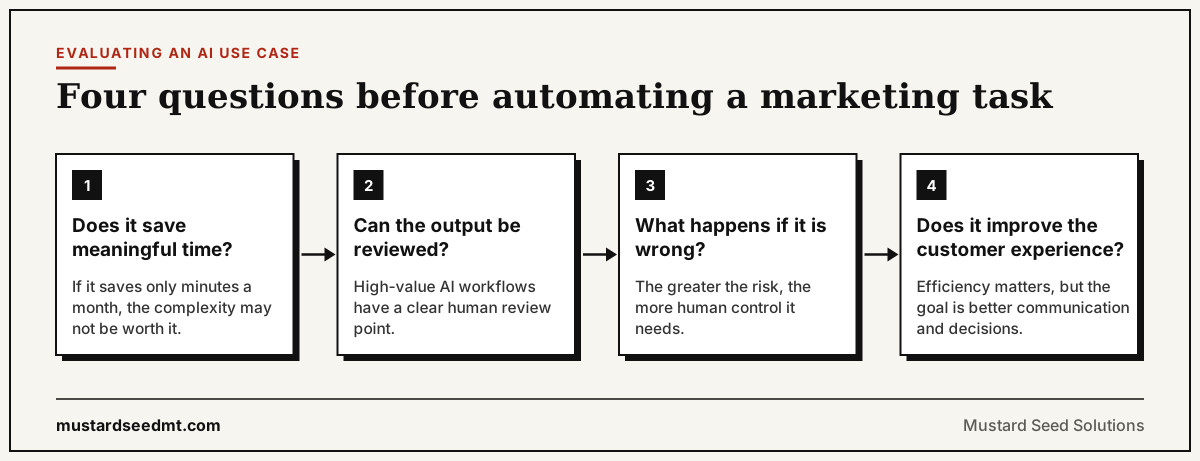
How to Evaluate an AI Use Case
Ask four questions.
1. Does It Save Meaningful Time?
If automation saves only a few minutes per month, the complexity may not be worth it.
2. Can the Output Be Reviewed?
High value AI workflows usually have a clear human review point.
3. What Happens if It Is Wrong?
The greater the risk, the more human control is required.
4. Does It Improve the Customer Experience?
Efficiency matters.
But marketing automation should ultimately support better customer communication and better business decisions.
Final Thoughts
The best AI use cases in B2B marketing are practical.
AI can help teams research faster, turn one asset into many, organize account information, improve sales enablement, analyze performance, and reduce repetitive operational work.
The biggest advantage is not replacing marketers.
It is increasing the leverage of good marketers.
Mustard Seed Solutions helps B2B technology companies identify and implement practical AI marketing use cases across content, GEO, SEO, demand generation, sales enablement, and marketing operations.