
Digital marketing has always used technology.
Search engines, advertising platforms, CRM systems, analytics tools, marketing automation, and social media all changed how companies attract and convert customers.
AI introduces another shift.
The difference is that AI can increasingly assist with tasks that previously depended almost entirely on human analysis, writing, planning, segmentation, and optimization.
That does not make traditional digital marketing obsolete.
It changes how the work can be performed.
Here are 10 key differences between AI marketing and traditional digital marketing.
AI Marketing vs Traditional Digital Marketing at a Glance
| Area | AI Marketing | Traditional Digital Marketing |
|---|---|---|
| Research | AI assisted synthesis and analysis | Manual research and analysis |
| Content | AI supported production and repurposing | Primarily human production |
| Personalization | More scalable | Often rule based |
| Optimization | Faster iteration | More manual |
| Analytics | AI assisted interpretation | Dashboard and analyst driven |
| Automation | Broader workflow automation | Trigger and rule based automation |
| Search | Includes AI discovery and visibility | Primarily search engines |
| Human role | Strategy, judgment, validation | Strategy plus more production |
| Speed | Faster | Usually slower |
| Main risk | Generic or inaccurate output | Higher production cost and slower iteration |
1. Research Can Happen Faster
Traditional marketing research often involves manually reviewing:
- 1Competitor websites
- 2Customer interviews
- 3Search results
- 4Industry reports
- 5Sales notes
- 6Survey responses
- 7Product reviews
AI can assist with summarizing, clustering, comparing, and extracting themes from large volumes of information.
This can accelerate research.
However, faster synthesis does not eliminate the need to verify sources or speak directly with customers.
AI can help organize information.
Human marketers still need to decide what matters.
2. Content Production Is More Scalable
Traditional content marketing relies heavily on human writers, editors, designers, and subject matter experts.
AI can support:
- 1Outlines
- 2Drafts
- 3Social posts
- 4Email variations
- 5Summaries
- 6Repurposing
- 7Headlines
- 8Video scripts
- 9Research notes
This lowers the cost of producing first drafts.
The risk is that easier production can lead to more generic content.
The competitive advantage therefore shifts from simply producing content to producing content with better insight, evidence, positioning, and originality.
3. Personalization Can Go Beyond Simple Segmentation
Traditional digital marketing often personalizes based on rules.
For example:
- 1Industry
- 2Company size
- 3Location
- 4Job title
- 5Website behavior
- 6Lead stage
AI can help marketers work with more variables and create more customized messaging at scale.
For B2B companies, that can support:
- 1Account specific outreach
- 2Industry specific landing pages
- 3Personalized sales enablement
- 4Different content recommendations
- 5More relevant email sequences
The challenge is maintaining quality and avoiding personalization that feels artificial.
4. Optimization Can Become More Continuous
Traditional campaign optimization often follows a cycle:
- 1Launch
- 2Collect data
- 3Review performance
- 4Make changes
- 5Test again
AI can speed up analysis and help marketers identify patterns faster.
It can assist with:
- 1Ad copy variations
- 2Audience analysis
- 3Landing page testing
- 4Email optimization
- 5Content performance analysis
- 6Campaign reporting
The marketer's role increasingly becomes deciding which recommendations are worth acting on.
5. Analytics Becomes More Conversational
Traditional analytics often requires marketers to navigate dashboards and build reports.
AI can make data more accessible by helping teams ask questions in natural language.
For example:
- 1Which campaigns produced the most qualified leads?
- 2Which industries converted best?
- 3Which content assisted the most opportunities?
- 4Where did conversion decline?
- 5Which channels became more expensive?
This can help teams move from reporting numbers to interpreting them.
But marketers still need to understand the underlying data.
A confident AI answer is not automatically a correct one.
6. Automation Expands Beyond Simple Triggers
Traditional marketing automation is often based on rules.
For example:
If a contact downloads an ebook, send email A.
AI enabled workflows can become more flexible.
They may help:
- 1Categorize leads
- 2Summarize CRM notes
- 3Draft follow up messages
- 4Identify account signals
- 5Prioritize tasks
- 6Repurpose content
- 7Create campaign briefs
- 8Analyze feedback
This can reduce administrative work and allow marketers to spend more time on decisions and creative direction.
7. Search Is No Longer Only About Search Engines
Traditional digital marketing has treated Google and other search engines as major discovery channels.
AI assistants add another discovery layer.
Prospects may increasingly ask conversational questions such as:
- 1What are the best solutions for this problem?
- 2Which vendors serve my industry?
- 3What is the difference between these products?
- 4Which companies are credible in this category?
That creates a new marketing question:
Can AI systems understand, trust, and surface your brand?
This is where GEO and AI search visibility enter the marketing mix.
8. Human Judgment Becomes More Important, Not Less
AI can make execution faster.
That increases the value of deciding what should be executed.
Human marketers remain essential for:
- 1Positioning
- 2Customer empathy
- 3Strategic tradeoffs
- 4Brand judgment
- 5Original insight
- 6Ethics
- 7Quality control
- 8Executive alignment
AI can produce many possible answers.
Marketing leadership still needs to decide which answer fits the company.
9. Speed Changes the Competitive Standard
AI can compress the time required for research, planning, writing, analysis, and iteration.
That changes expectations.
A task that previously took several days may now be completed much faster.
The advantage, however, does not come from speed alone.
If every competitor can produce content faster, speed becomes normal.
The stronger advantage comes from combining speed with better judgment.
10. The Marketing Team Can Become Leaner
Traditional marketing teams often needed more people to produce the same volume of work.
AI can increase the output of smaller teams.
A modern model might include:
- 1Senior marketing leadership
- 2A small internal team
- 3Specialist external resources
- 4AI supported workflows
This can be particularly attractive for growing B2B companies.
The company can retain human expertise where it matters most while using AI to reduce repetitive work.
Traditional Content Marketing vs AI-Driven Content Strategy
Traditional content marketing researches, plans, writes, and optimizes content mostly by hand, so output is limited by people and time. An AI-driven content strategy keeps the same goals but uses AI for research, briefs, first drafts, repurposing, and performance analysis. People still set positioning, add original insight, and check every claim before it is published.
The difference shows up at each stage of the content workflow:
| Stage | Traditional content marketing | AI-driven content strategy |
|---|---|---|
| Topic research | Keyword tools and manual review of search results | AI clusters keywords, customer questions, and sales notes into topic maps; people choose the priorities |
| Planning | Calendar built around a publishing volume | Calendar built around topic coverage and the questions buyers ask search engines and AI assistants |
| Briefs | Written by an editor for each piece, or skipped | AI drafts the brief from the research; the editor adds the angle and the opening answer |
| Drafting | A writer produces each piece from scratch | AI produces a first draft from the brief; a subject expert rewrites it and adds evidence and examples |
| Repurposing | Done occasionally, by hand | Each piece is cut into posts, emails, and scripts as a standard step |
| Optimization | Periodic audits of rankings and traffic | Ongoing refreshes, with pages structured so search engines and AI assistants can quote them |
| Measurement | Traffic, rankings, and leads | The same, plus whether AI assistants mention or cite the brand |
| Human role | Production and strategy | Strategy, original insight, editing, and fact checking |
| Main risk | Slow output and a high cost per piece | Generic, unverified, or look-alike content |
What does not change is the reason the content exists. Both approaches still depend on a clear audience, a point of view, and a plan for which questions the company should own. AI makes production cheaper, so content that only restates what already ranks becomes easier for everyone to make and harder to stand out with.
A practical way to move from one model to the other:
- 1Keep one owner and one brief per piece
- 2Use AI for research and first drafts, not for claims
- 3Add a review step for facts, sources, and voice
- 4Plan by topic coverage, not post count
- 5Refresh pages that already earn traffic
- 6Track AI mentions alongside rankings
For the planning side, see what goes in a content brief and how a content calendar works.
Does AI Marketing Replace Traditional Digital Marketing?
No.
AI marketing builds on digital marketing.
Companies still need:
- 1Websites
- 2Search visibility
- 3CRM
- 4Content
- 5Email
- 6Paid media
- 7Analytics
- 8Sales alignment
- 9Customer research
AI changes how these activities can be planned, executed, and optimized.
Which Approach Should B2B Companies Use?
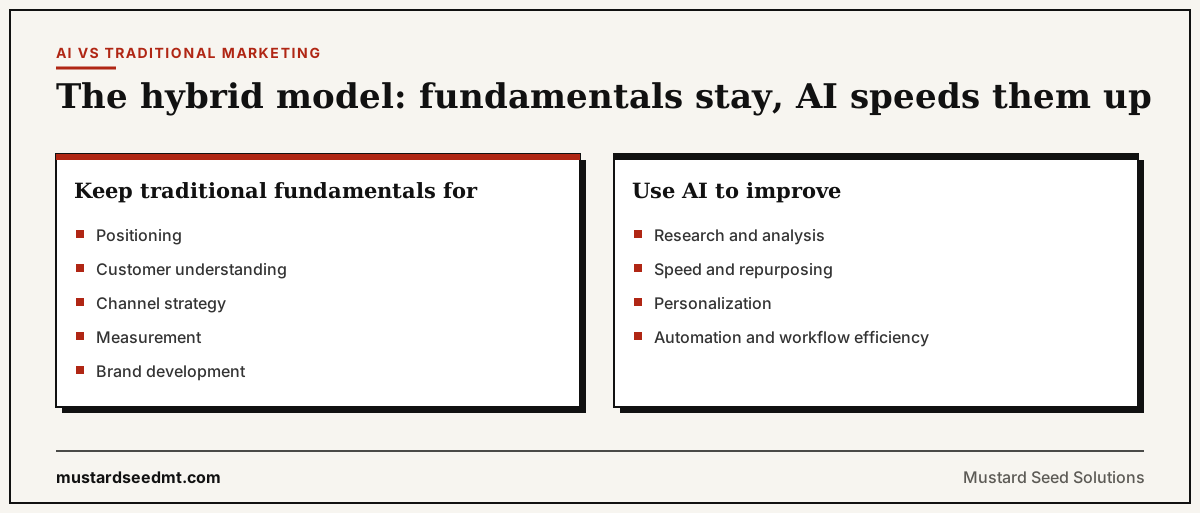
The practical answer is a hybrid model.
Use traditional marketing fundamentals for:
- 1Positioning
- 2Customer understanding
- 3Channel strategy
- 4Measurement
- 5Brand development
Use AI to improve:
- 1Research
- 2Speed
- 3Analysis
- 4Repurposing
- 5Personalization
- 6Automation
- 7Workflow efficiency
The goal is not to replace marketing with AI.
The goal is to build a better marketing system with AI inside it.
Final Thoughts
AI marketing and traditional digital marketing are not competing disciplines.
AI changes the operating model.
It allows marketers to perform more research, analysis, production, and optimization with fewer manual steps.
But the companies that benefit most will still need strong positioning, good customer insight, clear strategy, and experienced judgment.
Mustard Seed Solutions helps B2B technology companies combine strategic marketing leadership with AI enabled execution, search visibility, demand generation, and practical growth systems.