
Small marketing teams often face a difficult problem.
The company expects them to handle:
- 1Strategy
- 2Content
- 3SEO
- 4Social media
- 5Campaigns
- 6CRM
- 7Reporting
- 8Sales enablement
- 9Events
- 10Market research
But the team may only have one or two people.
A fractional CMO can provide senior marketing leadership, and fractional CMO services are usually structured around exactly that: an agreed number of days per month spent on direction rather than production.
AI can increase the execution leverage available to that leadership.
Together, they can create a practical model for companies that need better marketing without immediately building a large department.
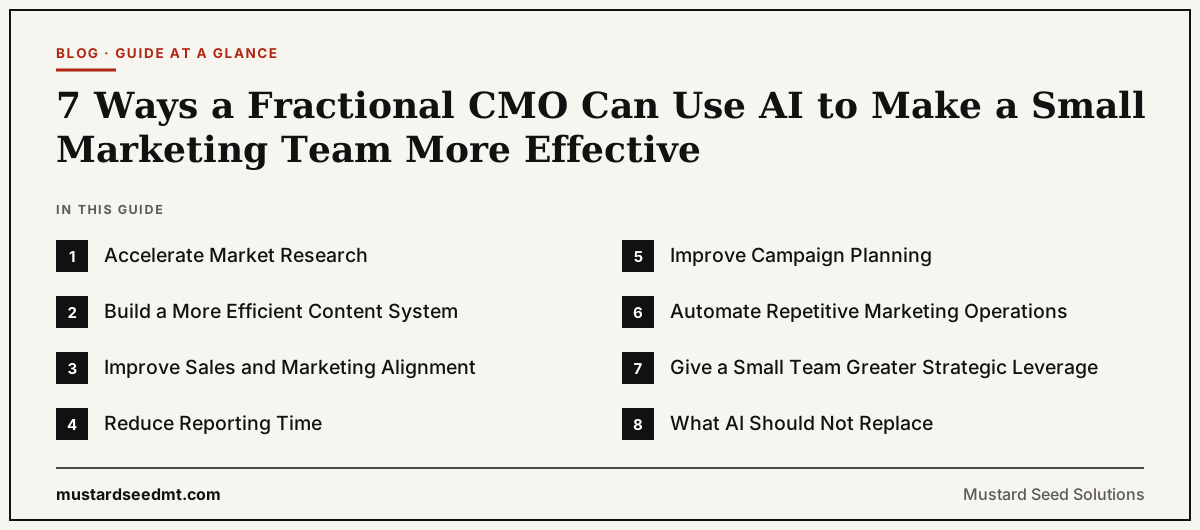
Here are seven ways a fractional CMO can use AI to make a small marketing team more effective.
1. Accelerate Market Research
A fractional CMO often begins by understanding:
- 1Customers
- 2Competitors
- 3Market trends
- 4Positioning
- 5Sales feedback
- 6Existing content
AI can help summarize and organize large amounts of information.
For example, it can support:
- 1Competitor comparisons
- 2Customer interview synthesis
- 3Sales note analysis
- 4Review analysis
- 5Market research summaries
This gives the fractional CMO more time to interpret the findings and make decisions.
2. Build a More Efficient Content System
Small marketing teams struggle to maintain content output.
A fractional CMO can create the strategy.
AI can help with production support.
A practical workflow may look like this:
Human
- 1Choose the topic
- 2Define the point of view
- 3Add customer insight
- 4Supply examples
- 5Approve the final version
AI
- 1Organize research
- 2Build outlines
- 3Create first drafts
- 4Repurpose content
- 5Suggest distribution formats
This can increase output without turning the content program into automated noise.
3. Improve Sales and Marketing Alignment
A fractional CMO needs close contact with sales.
AI can help analyze:
- 1Sales calls
- 2CRM notes
- 3Objections
- 4Lost deal reasons
- 5Competitor mentions
- 6Customer questions
This can reveal patterns that would otherwise remain scattered across the organization.
The CMO can then use the insight to improve:
- 1Messaging
- 2Content
- 3Lead qualification
- 4Campaigns
- 5Sales enablement
4. Reduce Reporting Time
Senior marketers should spend time interpreting performance, not manually building every report.
AI can help produce first draft analysis around:
- 1Lead volume
- 2Pipeline
- 3Website conversion
- 4Campaign performance
- 5Channel performance
- 6Content engagement
The fractional CMO can then focus on the decisions behind the numbers.
For example:
- 1Which campaign should receive more budget?
- 2Which channel should be reduced?
- 3Why is conversion falling?
- 4Which segment is producing better opportunities?
5. Improve Campaign Planning
AI can help generate more campaign options quickly.
A fractional CMO can use it to explore:
- 1Campaign themes
- 2Message variations
- 3Audience segments
- 4Landing page ideas
- 5Content combinations
- 6Calls to action
The CMO then applies judgment.
The value is not letting AI choose the campaign.
The value is giving an experienced marketer more options to evaluate.
6. Automate Repetitive Marketing Operations
Small teams lose significant time to administrative work.
AI can help reduce effort around:
- 1Meeting summaries
- 2CRM notes
- 3Brief creation
- 4Content tagging
- 5Reporting commentary
- 6Research summaries
- 7Internal updates
A fractional CMO can identify which workflows should be automated and which should remain manual.
This is important because poor automation can create more complexity instead of less.
7. Give a Small Team Greater Strategic Leverage
The biggest benefit is the combination.
A small marketing team may not need ten full time employees if it has:
- 1Senior fractional leadership
- 2One or two capable internal marketers
- 3Specialist external partners
- 4AI enabled workflows
For example:
Who owns what in the lean marketing team model
| Role | What they own or support |
|---|---|
| Fractional CMO | Owns strategy, positioning, priorities, budget, and sales alignment |
| Internal Marketer | Owns daily coordination and company knowledge |
| Specialists | Support SEO, GEO, design, paid media, PR, and video |
| AI | Supports research, analysis, drafting, repurposing, and administration |
This creates a flexible marketing operating system.
What AI Should Not Replace
A fractional CMO should keep humans responsible for:
- 1Positioning
- 2Customer interviews
- 3Strategic priorities
- 4Brand decisions
- 5Executive communication
- 6Final quality control
- 7High stakes customer messaging
AI should increase leverage.
It should not remove accountability.
Why This Model Fits B2B Technology Companies
B2B technology marketing often requires many specialist skills, but demand for each skill may not justify a full time role.
A company may need:
- 1GEO expertise this month
- 2Paid media support during a launch
- 3Market entry research next quarter
- 4Video support around an event
- 5Content every week
A flexible team can adjust to those needs.
The fractional CMO makes sure the moving parts remain connected.
Final Thoughts
AI makes small marketing teams more capable.
Fractional leadership makes them more focused.
The combination can allow a growing company to operate with a leaner structure while still accessing senior strategy and specialist expertise.
The objective is not maximum automation.
The objective is a marketing system where people spend more time on high value decisions and less time on repetitive work.
Mustard Seed Solutions helps B2B technology companies combine fractional marketing leadership, AI enabled workflows, specialist execution, GEO, SEO, demand generation, and international market entry into one practical growth system.