
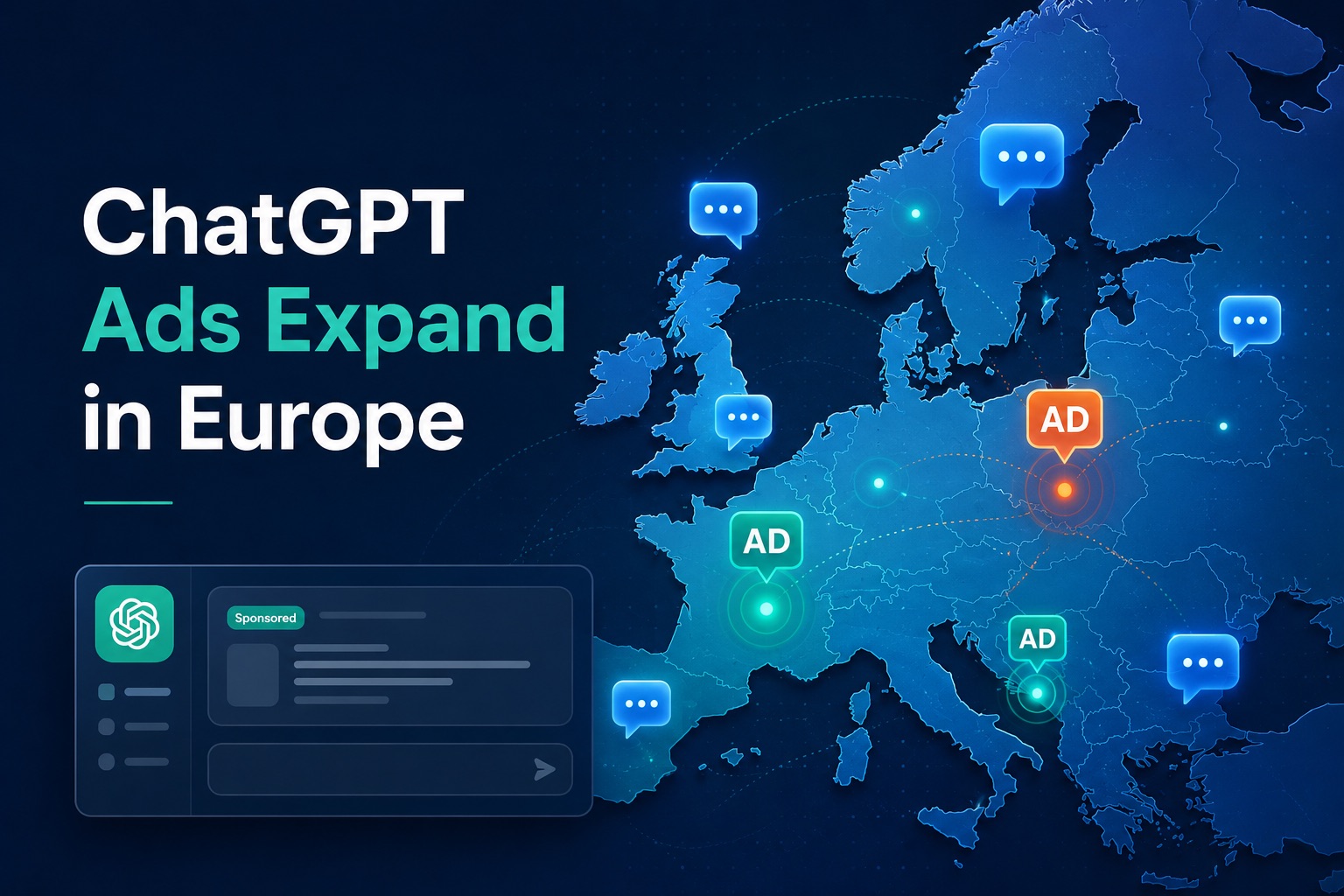
OpenAI announced on August 18, 2026 that ChatGPT Ads will expand to 31 European markets the following week. The rollout gives marketers a new paid channel inside a conversational environment where users may already be comparing options, researching purchases, and narrowing decisions.
According to OpenAI’s August 18 announcement, ads will initially be available through its Ads Solutions team, agency partners, and technology partners, with self service access expected later in the summer. Ads will appear only for Free and Go users, while Plus, Pro, and Enterprise remain ad free.
What changes when ChatGPT Ads enters Europe?
The biggest change is access to a new type of commercial context. Search ads usually respond to a short query, while a ChatGPT conversation can contain the user's goal, constraints, preferences, budget, and follow up questions.
That does not automatically make the channel better than search or social advertising. It does mean marketers should evaluate ChatGPT Ads as a distinct environment with its own intent signals, creative expectations, measurement limits, and brand safety considerations.
Why does conversational intent matter for advertisers?
A user asking for help choosing accounting software may reveal far more context than someone typing "best accounting software" into a search box. That can make the surrounding commercial moment more specific, but it also raises the bar for relevance.
Marketers should avoid treating ChatGPT Ads as another place to reuse generic display creative. The stronger opportunity is to align the ad with the decision the user is already trying to make, then give them a clear next step.
For teams already working on AI visibility, paid placement adds another layer to the same customer journey. A brand may appear organically in an AI answer, appear in an ad near that answer, appear in both, or appear in neither.
What should marketers test first?
Early campaigns should be designed to learn how conversational advertising behaves before large budgets move into the channel.
- Compare high intent categories with broader discovery topics
- Test landing pages that answer the same decision questions users ask in ChatGPT
- Track qualified actions, not only clicks
- Compare performance with search and paid social using consistent commercial goals
- Review where ads appear and whether the surrounding context suits the brand
OpenAI says its ad platform now supports conversion optimization, geo targeting, custom audiences, the OpenAI Pixel, a Conversions API, and third party measurement integrations. Those features make structured testing more practical, but marketers should still establish their own baseline before deciding the channel is incremental.
Where does ChatGPT Ads fit beside search and social?
ChatGPT Ads should be treated as an additional demand capture and discovery channel, not a replacement for established media. Google can still be strongest when buyers express explicit search intent, while LinkedIn, Meta, and other platforms may remain better for audience based reach or repeated exposure.
The useful planning question is where ChatGPT adds something different. A broader marketing strategy can compare the channel against the rest of the mix instead of evaluating it in isolation.
For B2B companies, the most interesting use cases may be software evaluation, vendor research, business problem diagnosis, and category education. Those are moments where a conversational assistant can influence the shortlist before a buyer ever reaches a conventional search results page.
What should marketers measure before scaling?
Clicks alone will not be enough. Marketers should track qualified visits, conversions, lead quality, branded demand, and whether ChatGPT sourced visitors behave differently from visitors acquired elsewhere. Teams can use the broader learning center to connect those signals with search, content, and demand generation.
The test should also ask whether the paid campaign changes incremental outcomes. If the same buyers would have reached the brand through existing search, organic, or referral channels, a low cost click can still be commercially weak.
The practical goal is to learn where ChatGPT Ads creates additional demand or captures demand more efficiently, then scale only the segments that show evidence of value.