
When one client makes up a large share of your revenue, you haven't landed stability — you've handed your business's survival to someone else's decisions. Real accounts of solopreneurs losing a client worth 30-40% of revenue show the same thing: the collapse looks sudden, but the exposure was there for months before it detonated.
One agency owner described a client that made up roughly 40% of annual revenue, worth around $50,000 a year — a relationship that felt stable right up until it wasn't. The client's CTO had quietly posted about a technical issue on Reddit, a competitor spotted it within hours and slid into their DMs with a fix, and by the time the owner heard about it secondhand in a meeting, the client had already begun migrating away. The issue itself, he admitted, was one his team could have fixed in fifteen minutes. It was a problem they'd solved for other clients dozens of times before.
That detail is the real lesson: the client didn't leave because of one bad week. They left because a small, fixable annoyance was allowed to sit unaddressed inside a relationship the owner assumed was too solid to need active maintenance. Concentration doesn't just create financial risk — it creates a false sense of security that stops you from doing the boring maintenance that keeps a big account. It's one specific risk inside the broader discipline of cash flow management for a one-person business.
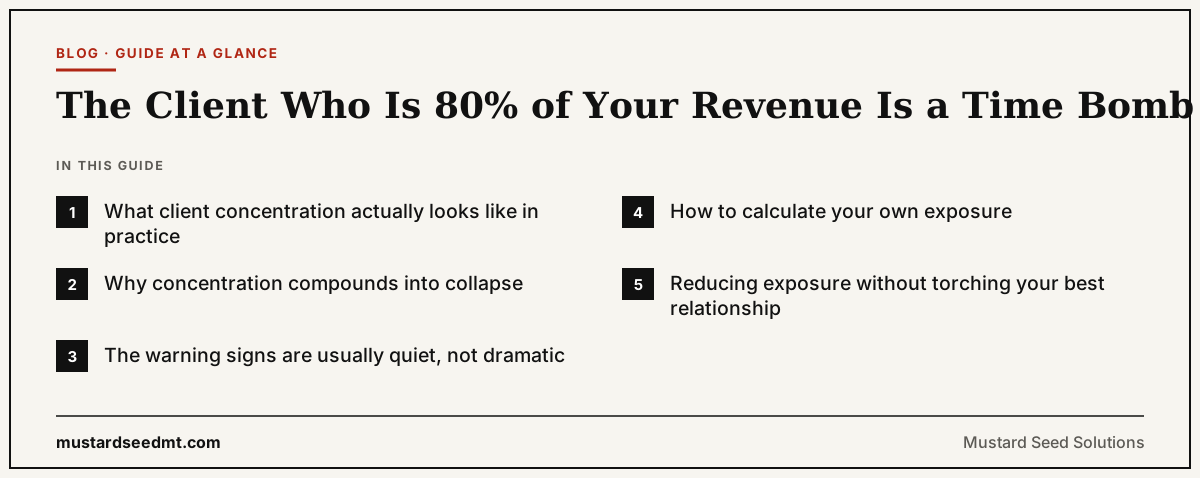
What client concentration actually looks like in practice
It rarely looks like a red flag while it's happening. It looks like success — a client that keeps growing its spend with you, delivers referrals, and feels like the account you built your business around. One commenter, reacting to the $50,000-client story, put the risk plainly: if a single client is 40% of your revenue, you're on thin ice regardless of how the relationship feels, because you likely don't have the staff or slack to absorb the loss.
A second account described a design studio owner who picked up a new client over the summer who quickly became "a pretty big part" of revenue. When the owner was hit with a sudden illness and had to scale back for two to three weeks, the client didn't complain or renegotiate — he simply stopped replying. Weeks later, the owner found him on a business subreddit asking for advice on DIY branding work he'd done himself, in a completely different direction than what he'd originally briefed. The client hadn't been dissatisfied enough to say so directly. He'd just quietly moved on the moment the relationship became inconvenient.
Why concentration compounds into collapse
The most severe version of this pattern shows up in an account from a founder who ran a small software and staffing agency that had grown to 25 employees. The business lost one of its biggest contracts when the client decided to bring the work in-house. He tried to recover by chasing a large staffing deal with another client, spent thousands sourcing candidates, and still landed no hires. Then the building housing his other major client burned down, and that client stopped paying immediately. Within months, the company that had felt stable a year earlier had no employees left and no way to cover costs. Each event was survivable on its own. Stacked on top of a business with too few revenue sources, they weren't.
That's the mechanism worth internalizing: concentration risk rarely detonates from one clean cause. It compounds — a lost account removes your cushion, so the next disruption (a slow month, a health issue, a client's own budget cut) hits a business with no reserves left to absorb it.
People responding to that founder's account largely agreed the deeper failure was structural rather than a string of bad luck: a business that size shouldn't have had its fate tied so tightly to two or three relationships in the first place. Several pointed out that diversification isn't a nice-to-have for when things are going well — it's the thing that determines whether a normal run of bad luck (a client's building burning down is not a failure of your business) turns into a survivable bad quarter or an existential one.
The warning signs are usually quiet, not dramatic
In both client-loss stories above, nothing that happened right before the exit looked like a crisis. A CTO asked a low-key public question about a technical hiccup. A client went quiet for a couple of weeks during a rough patch. Neither owner treated it as urgent, because on paper the relationship still looked healthy — invoices were current, the last conversation had been friendly, nothing had been formally raised as a complaint. That's precisely why concentration is dangerous: it removes your margin for missing a quiet signal, because there's no second big client to fall back on if you read the moment wrong.
The agency owner who lost the $50,000 client said he now checks Reddit, industry forums, and review sites daily for any mention of his company — probably overcorrecting, in his own words, but he framed it as the direct cost of having let one relationship carry too much weight for too long without that kind of active listening built in from the start.
How to calculate your own exposure
Before reacting to any single relationship, it helps to see the number in plain terms: what share of your last 90 days of revenue came from your single largest client, and how many weeks could you operate if that revenue stopped tomorrow. Our client concentration calculator does this math for you — enter your client revenue breakdown and it shows your concentration percentage alongside how much runway a sudden loss would leave you.
The number itself isn't the point. What matters is whether it changes how you behave: do you follow up proactively on small issues before they become a reason to leave, and are you actively bringing in the next account before you need it, or only after the big one is already gone.
Reducing exposure without torching your best relationship
None of the accounts above suggest firing a good client to "diversify." The realistic fix is additive, not subtractive: keep serving the big account well — including proactively checking forums, review sites, and support channels for issues a large client might mention to a peer before mentioning it to you — while deliberately capping how much new work you accept from any one source as a share of total revenue. Bring in one or two smaller accounts in parallel, even at a lower margin, so the percentage from your largest client falls because the denominator grew, not because the relationship did.
It's also worth noticing what these accounts don't recommend: none of the founders who described losing a large client suggested avoiding big accounts altogether. A large, well-served client can be the fastest way to grow revenue as a solopreneur. The distinction is between welcoming a big client and structuring your entire business around needing that one relationship to survive — the first is smart growth, the second is a bet you didn't realize you were making.
Client concentration isn't a mistake you make once. It's a number that quietly drifts upward while everything looks fine, until the day it doesn't. For the fuller picture of where risk shows up across a one-person business, see The 50 Biggest Solopreneur Challenges.